

By Junaid Qaiser
Recent interactions between Pakistani and American officials suggest that relations between Islamabad and Washington are entering a more constructive phase. While security cooperation remains important, the conversation is increasingly expanding to include diplomacy, trade, investment, and agricultural development. This broader engagement reflects a growing recognition that long-term partnerships are built not only on shared security concerns but also on economic opportunity and mutual growth.
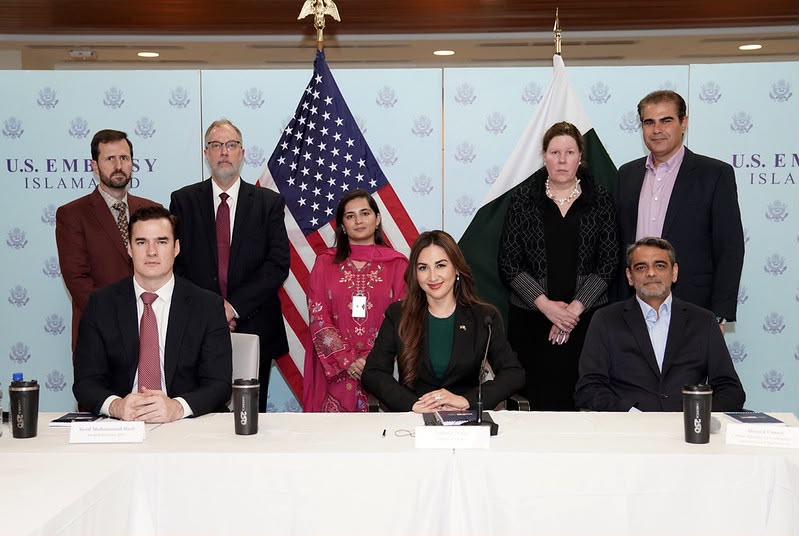
The recent meeting between Federal Minister for Law, Justice and Human Rights Senator Azam Nazeer Tarar and US Chargé d’Affaires Natalie A. Baker highlighted this evolving dynamic. During the discussions, Baker appreciated Pakistan’s positive role during the Gulf conflict and acknowledged the country’s efforts to encourage regional peace and stability. She also recognised the leadership of PM Shehbaz Sharif and Field Marshal Syed Asim Munir in supporting diplomatic initiatives aimed at reducing tensions during a challenging period for the region.
Pakistan has consistently argued that diplomacy remains the most effective path toward resolving conflicts. During periods of heightened tension in the Gulf, Islamabad called for restraint and engagement rather than confrontation. While Pakistan is not a major power in the traditional sense, its ability to maintain relationships across different regions and political blocs gives it a unique diplomatic advantage. The appreciation expressed by a senior American diplomat reflects an acknowledgment of this reality.
For decades, counterterrorism and regional conflicts largely defined bilateral engagement. Those areas remain important, but recent developments suggest that both countries are increasingly interested in building a more comprehensive partnership.
This was evident in Baker’s participation in a webinar focused on agricultural technology and economic cooperation. Addressing American businesses, Pakistani officials, and representatives of the agriculture sector, she highlighted the opportunities that exist for collaboration in one of Pakistan’s most important industries.
Agriculture remains the backbone of Pakistan’s economy. It contributes significantly to national output, supports millions of jobs, and plays a critical role in food security. Yet the sector continues to face serious challenges, including water shortages, low productivity in certain areas, outdated farming methods, and the growing effects of climate change.
Modernisation is no longer a choice; it is a necessity.
This is where cooperation with the United States can prove valuable. American agricultural technology is among the most advanced in the world, offering solutions in precision farming, efficient irrigation systems, digital farm management, biotechnology, seed development, and post-harvest storage. These innovations have the potential to help Pakistani farmers produce more while using fewer resources.
Importantly, this cooperation should not be viewed simply as a commercial transaction. The real value lies in knowledge transfer, training, and long-term partnerships. When technology is accompanied by local capacity-building, it creates sustainable improvements that benefit entire communities rather than individual projects.
The economic potential is considerable. American officials noted that US agricultural and related exports to Pakistan exceeded $1.5 billion in 2025. At the same time, Pakistan has expressed interest in attracting greater American investment in areas such as food processing, farm mechanisation, biotechnology, and cold-chain logistics. These sectors not only support agricultural growth but also create employment opportunities and contribute to broader economic development.
The planned US Department of Commerce Certified Agricultural Technologies Trade Mission to Pakistan later this year is another encouraging sign. The visit is expected to connect American businesses with Pakistani stakeholders and explore new opportunities for investment and collaboration. Such initiatives demonstrate that economic engagement is becoming an increasingly important pillar of the bilateral relationship.
What makes this shift particularly noteworthy is that it complements rather than replaces existing cooperation in other areas. Security collaboration, counterterrorism efforts, and diplomatic engagement continue to play a central role in US-Pakistan relations. However, the addition of stronger economic and technological partnerships creates a more balanced foundation for long-term cooperation.
For Pakistan, access to modern technologies and foreign investment can support economic growth and improve competitiveness. For the United States, deeper engagement with Pakistan offers opportunities in a large and strategically important market while contributing to regional stability. Both countries stand to benefit from a relationship that is driven by practical outcomes and shared interests.
The recent diplomatic exchanges and growing focus on agriculture and economic development suggest that both Islamabad and Washington understand this reality. Rather than concentrating solely on past grievances, they appear increasingly focused on future opportunities.
As global challenges become more interconnected, countries will need partnerships that combine diplomacy, economic cooperation, technological innovation, and regional engagement. The emerging direction of US-Pakistan relations reflects this changing landscape.
If current momentum continues, cooperation between the two countries may increasingly be measured not only by security achievements but also by the farms modernised, businesses created, investments attracted, and livelihoods improved. That would represent a meaningful step forward for both nations and a promising foundation for the future.
