
Ameer Muavia
PESHAWAR: Officers participating in the 47th Mid-Career Management Course (MCMC) visited the Command and Control Centre of the Khyber Pakhtunkhwa Safe Cities Project in Peshawar, where they were briefed on modern technology-based policing, crime prevention, traffic management, rapid police response and other aspects of smart policing.
Director Khyber Pakhtunkhwa Safe Cities Project DIG Ejaz Ahmad welcomed the visiting delegation and gave a detailed briefing on the project’s various departments, operational procedures, modern technologies and their effective use in policing.
Deputy Director Safe Cities Project Naveed Gul, Assistant Director Nauman Rafi, DSP City Operations Wajid Shah, DSP City Patrolling Usman Khan and other Assistant Directors of the Safe Cities Project were also present.
During the visit, the officers toured different sections of the Command and Control Centre and observed the practical working of the modern monitoring system. They were briefed on surveillance cameras, sensors, alert generation systems, drones, anti-drone systems, UAVs, panic buttons, facial recognition, Automatic Number Plate Recognition (ANPR), thermal cameras, e-challan, body-worn cameras, vehicle camera solutions, responder tablets and integration with other institutions.
The visiting officers were informed that Safe City cameras can help identify suspicious persons, stolen or suspicious vehicles and monitor their movements, enabling timely alerts to be sent to the relevant police units. In the event of an accident, suspicious activity, or the identification of a wanted person or vehicle, an immediate alert is generated at the Command and Control Centre, following which the concerned police units are mobilized for prompt action.
The delegation was also briefed on the Panic Button System, through which citizens, particularly women and children, can contact the Command and Control Centre during emergencies. Officials explained that the system is an important component of the modern public safety mechanism, particularly for securing public places, women’s markets and women’s educational institutions.
Speaking about the establishment of the Khyber Pakhtunkhwa Police UAV Division and the anti-drone system, DIG Ejaz Ahmad said that the KP Police had established a UAV Division of its kind for the first time in Pakistan, enhancing the force’s operational capabilities through modern technology and improving aerial surveillance. He also briefed the delegation on anti-drone guns, drone operators’ training and capacity-building measures.
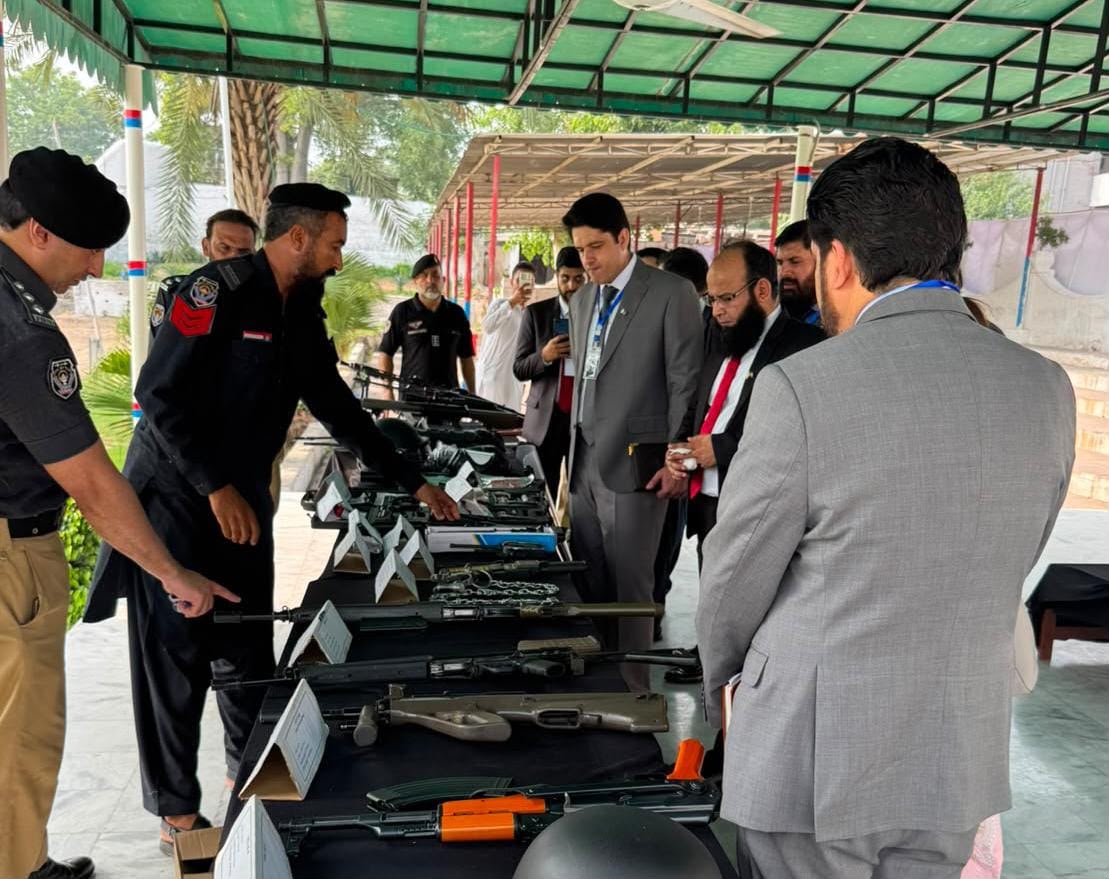
The visiting officers also inspected city patrolling vehicles and body-worn cameras and were briefed on the practical use of modern communication, surveillance and monitoring equipment installed in the vehicles. They were informed that body-worn cameras help record field activities of police personnel, improve transparency and strengthen monitoring, while city patrolling vehicles are equipped with modern surveillance and communication systems and are monitored through the Safe City Command and Control Centre.
The delegation was further briefed about the integration of cameras installed at government and private key buildings, sensitive locations, important installations and BRT stations with the central Safe City system to facilitate joint monitoring and enhance security. The officers were also shown live feeds from cameras installed in other districts.
The delegation was also briefed on the use of Safe City cameras for detecting and recording traffic violations and improving the legal enforcement process through modern technology. Officials said that since the establishment of the project, Safe City cameras had detected 12.7 million traffic violations. The delegation was informed that the e-Challan system is also expected to be launched soon, under which violations detected through the Safe City AI system will result in challans being sent to the registered residential addresses of the vehicle owners/drivers.
The visiting officers appreciated the Safe City Project as an important initiative for understanding technology-driven policing, crime prevention, rapid protection of citizens, traffic management, intelligence-based response and coordinated operations among different institutions.
Earlier, the visiting officers paid their respects at the Martyrs’ Memorial and paid tribute to police martyrs. Shields were also exchanged between Safe Cities Project Director DIG Ejaz Ahmad and members of the visiting delegation.
