

By:Junaid Qaiser
Pakistan and African nations sent a powerful message from Islamabad last week: the future of their relationship lies not merely in diplomacy, but in trade, investment, entrepreneurship and people-to-people connectivity. At the inaugural ceremony of the Pakistan-Africa Economic Council (PAEC), policymakers, diplomats and business leaders reaffirmed their commitment to increasing bilateral trade to $15 billion by 2030, diversifying economic relations and bringing the private sectors of both regions closer together. The gathering was attended by ambassadors, high commissioners and consuls general from Rwanda, Mauritius, Morocco, Zimbabwe, Sudan, Kenya and Ethiopia, alongside leading representatives of Pakistan’s business community and government institutions.
The significance of the event reflected a growing recognition that Pakistan and Africa possess enormous untapped economic potential and that stronger institutional linkages are needed to convert opportunity into measurable results. Through long-term planning, enhanced investment cooperation and deeper commercial engagement, both sides expressed their determination to elevate economic relations to a new level.
Federal Minister for Defence Production Muhammad Raza Hayat Hiraj described the establishment of PAEC as a milestone in the economic history of Pakistan and African countries. Pointing to Africa’s population of nearly 1.5 billion people, he emphasized the vast opportunities available to Pakistani businesses and highlighted the crucial role of the private sector in driving future growth. Khyber Pakhtunkhwa Governor Faisal Karim Kundi echoed these sentiments, noting that a rising Africa and an emerging Pakistan offer tremendous opportunities for mutual prosperity. He praised the initiative and expressed confidence that, under the leadership of Ambassador (Retd.) Hamid Asgher Khan, the council would become an effective platform for strengthening economic and trade relations.
The driving force behind the initiative, Ambassador Hamid Asgher Khan, used the occasion to articulate a compelling vision for the future. Having served for seven years in Africa during his diplomatic career, he described the continent as a “slumbering giant” that is awakening and preparing to play an increasingly influential role in the global economy. He argued that existing trade levels between Pakistan and African countries remain far below their true potential and stressed the need to achieve the ambitious $15 billion trade target over the coming years.
Khan’s observations deserve serious attention. Few Pakistani diplomats possess his depth of experience in African affairs, and his decision to devote his post-retirement years to strengthening Pakistan-Africa relations reflects both conviction and foresight. His message was straightforward: the opportunities exist, but they require institutions capable of connecting businesses, investors and entrepreneurs across continents. PAEC, in his view, is designed to serve precisely that purpose.
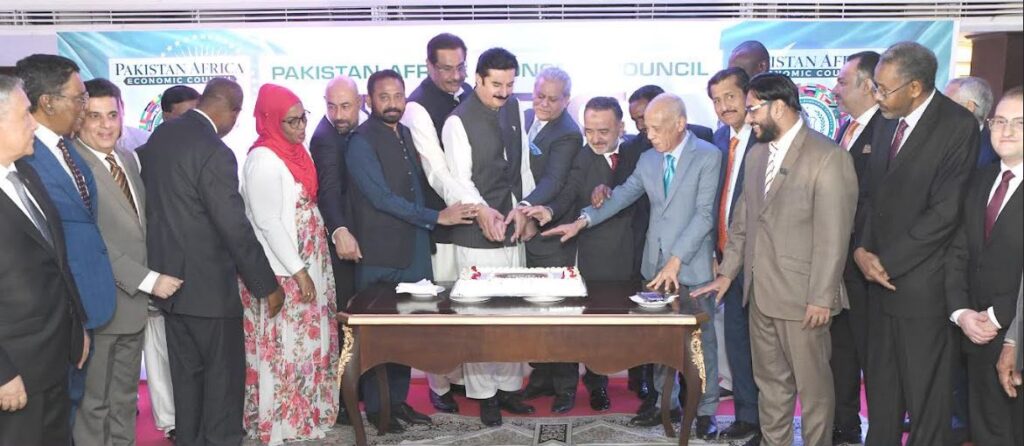
The broad participation at the conclave reinforced this vision. Federation of Pakistan Chambers of Commerce and Industry (FPCCI) President Atif Ikram Sheikh pledged the support of Pakistan’s largest business body and described Africa as a strategic priority for Pakistan’s economic future. Islamabad Chamber of Commerce and Industry President Sardar Tahir Mehmood called for a shift from traditional diplomatic engagement toward a comprehensive economic partnership based on trade, investment, technology transfer, joint ventures and job creation. Rawalpindi Chamber of Commerce and Industry President Usman Shoukat also hailed the council as a landmark development in Pakistan-Africa relations. The event further received recognition from Ambassador Atadjan Movlam of Turkmenistan, Dean of the Diplomatic Corps in Islamabad, who praised the initiative’s potential to strengthen economic cooperation.
Particularly noteworthy was the emphasis placed on practical sectors where collaboration can produce immediate results. Speakers identified agriculture, textiles, pharmaceuticals, information technology, mining, food processing, education, healthcare and infrastructure as areas where Pakistani expertise aligns naturally with African demand. Ambassador Hamid Asgher Khan highlighted information technology, healthcare, pharmaceuticals and education as sectors capable of rapidly expanding economic engagement, noting that Pakistan’s IT exports alone possess the potential for significant growth through stronger connectivity with African markets.
For many years, Africa has remained one of the most underappreciated dimensions of Pakistan’s economic diplomacy. Yet the continent is home to nearly 1.6 billion people, some of the world’s fastest-growing economies and an increasingly influential consumer market. As global economic power gradually shifts toward emerging regions, countries that establish strong partnerships today will be better positioned to benefit tomorrow.
PAEC therefore arrives at a critical moment. Its value lies not simply in promoting trade figures but in creating a permanent institutional bridge between Pakistan and Africa. Such a bridge can facilitate business partnerships, support entrepreneurs, encourage investment missions, promote educational exchanges and build the long-term trust required for sustainable economic cooperation.
The challenge ahead is substantial. Raising bilateral trade from approximately $4 billion to $15 billion will require policy consistency, improved connectivity, stronger financial mechanisms and sustained engagement from both governments and the private sector. Yet the enthusiasm displayed at the inaugural ceremony suggests that the necessary foundations are beginning to take shape.
Pakistan’s future economic success will depend, in part, on its ability to diversify its partnerships and explore new markets. Africa offers precisely that opportunity. Through the Pakistan-Africa Economic Council, Pakistan has taken an important step toward building a relationship based on shared prosperity, mutual respect and long-term cooperation.
If the vision articulated in Islamabad is translated into action, PAEC may well become what its founders intend it to be: a genuine bridge between Pakistan and Africa, connecting two regions whose economic futures are increasingly intertwined.
