
By: Sabahat Sarwar
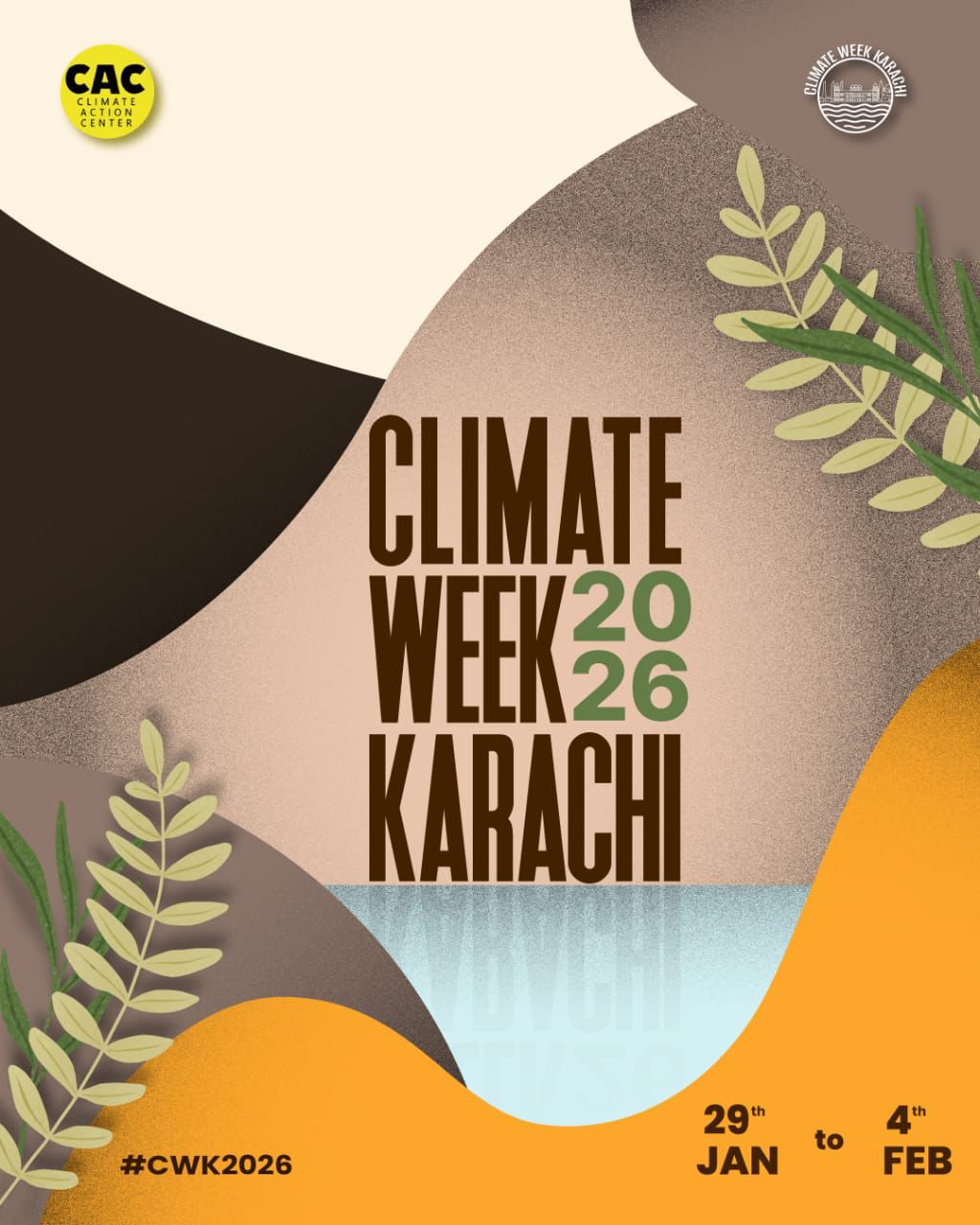
KARACHI: Climate Week Karachi (CWK) 2026 marks a historic milestone as Pakistan’s first-ever citywide climate week, organised by the Climate Action Center Karachi (CAC). Scheduled from 29 January to 4 February 2026, CWK unfolds as a citywide climate movement activating Karachi’s cultural, academic, civic, and public spaces.
Held under the theme “Tides of Tomorrow: City, Memory, Future,” Climate Week Karachi places the River Indus at the centre of urgent conversations on climate change, urban survival, energy transition, and climate justice. Stretching from the northern glaciers to the fragile delta at the Arabian Sea, the Indus is not only Pakistan’s primary river system but a living archive of history, labour, culture, and ecological memory.
Situated at the river’s deltaic edge, Karachi bears the cumulative impacts of upstream extraction, sea-level rise, salinity intrusion, and ecological degradation. CWK reframes the Indus as a living entity and shared inheritance, directly linked to the city’s water shortages, coastal erosion, heat stress, energy insecurity, and public health challenges.
Throughout the week, artists, climate activists, riverine and coastal communities, scientists, historians, policymakers, civil society organisations, students, and government institutions will collaborate to reimagine Karachi’s climate future through the story of the Indus, bridging scientific knowledge with cultural practice and lived experience.
A key focus of Climate Week Karachi 2026 is the city’s energy future. Continued dependence on fossil fuels has degraded air, water, and land while deepening social and economic inequalities. CWK highlights energy justice and the urgent transition toward clean, green, and renewable energy systems.
Solarisation is presented as a viable pathway, offering affordable, decentralised, and locally produced electricity. Alongside this, electric mobility, including e-bikes, electric rickshaws, and electric vehicles, is promoted as a practical solution to reduce emissions, improve air quality, and reshape urban transport.
Climate Week Karachi underscores that the energy transition is not merely technological, but social and cultural, closely connected to labour, public health, and climate justice. By linking renewable energy to the River Indus, the coastline, and Karachi’s layered histories, CWK raises a critical question:
What kind of energy will illuminate our future — and at whose cost?
Through exhibitions, dialogues, screenings, workshops, performances, and policy conversations, Climate Week Karachi 2026 positions Karachi as a space of imagination, resistance, and collective action, mobilising citizens toward climate-resilient and just urban futures.
The Climate Action Center (CAC) Karachi is a hub for climate awareness, advocacy, and action, promoting green practices and addressing environmental challenges such as air pollution and renewable energy transition. It works with grassroots organisations, researchers, and experts to foster community engagement and support climate-focused policy reform.
