
TP REPORT
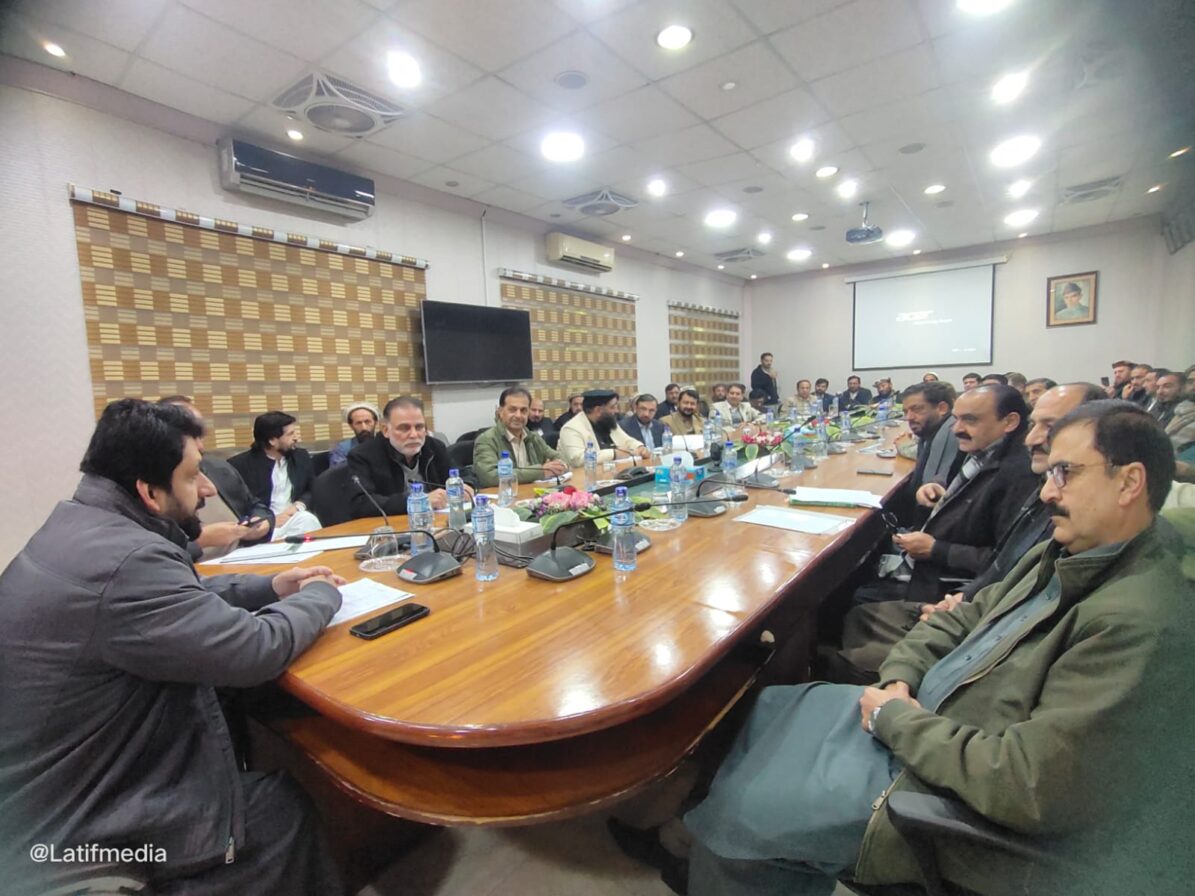
PESHAWAR: A high-level Open Kachahri (public consultative forum) on forest governance and sustainable forest management was held under the chairmanship of Mr. Junaid Khan, Secretary Climate Change, Forestry, Environment & Wildlife Department, Khyber Pakhtunkhwa. The forum aimed to strengthen direct engagement between the government and forest owners, ensure prompt resolution of issues, and promote mutual trust and cooperation.
The meeting was attended by Additional Secretary Ahmad Kamal, Chief Conservator Forest Region-I Mr. Ahmad Jalil, Region-II Mr. Shoukat Fayaz, Region-III Mr. Asghar Khan, concerned Conservators of Forests, along with representatives of forest owners from Malakand and Hazara Divisions. Member Provincial Assembly Mr. Zubair Khan (Alai Battagram) and prominent social figure Mr. Sher Zameen from Arandu, Chitral also participated and highlighted grassroots-level challenges.
During the Open Kachahri, forest owners expressed concerns regarding the expiry and near-completion of Working Plans and Monitoring, Marking, Woodlots, as well as administrative bottlenecks. Addressing the participants, Secretary Junaid Khan assured that the government remains firmly committed to rule of law, transparency and swift decision-making. He emphasized that monitoring is a tool for accountability, course correction and system improvement, not for creating unnecessary legal complications.
The Secretary states that the ban on scientific forest harvesting imposed in 1992 had caused serious setbacks to forest management and financial stability in the province. However, he rejected the perception of unilateral decision-making by the Forest Department, stating that local communities are engaged at every stage — from plantation and deployment of forest guards (Neghabans), to meeting domestic needs and carrying out commercial harvesting under approved Working Plans. He stressed that sustainable development is impossible without community participation.
Clarifying the temporary suspension imposed on June 24, 2024, he said it was not the result of any conspiracy but was introduced for corrective monitoring following complaints of irregularities. The suspension was lifted on November 12, 2024, after necessary rectifications, and harvesting and transportation activities were restored in accordance with prescribed rules. He underlined that Scientific Forest Management (SFM) is indispensable for long-term forest conservation and ecological balance, and is firmly grounded in Section 35 of the Forest Ordinance, 2002. He further informed that a detailed briefing will soon be presented to Chief Minister Khyber Pakhtunkhwa, Muhammad Sohail Afridi, to seek policy-level guidance.
The forum was informed that in Northern Forest Region-II, out of 24 Working Plans, 13 are approved and operational, 9 are under the approval process, and 2 are under preparation. Since 2015, a total of 11.722 million cubic feet of timber has been marked. Delays in certain compartments were attributed to court cases and local disputes.
Secretary Junaid Khan directed that expired Working Plans must be reviewed and revised on a priority basis, and adequate funds be provided to the Forestry Planning & Monitoring Circle for this purpose. He also announced the formation of a special committee under the leadership of the Additional Secretary to facilitate extensions of Working Plans nearing completion or expiry, ensuring timely relief and confidence-building among forest owners.
Regarding the transportation of dry standing and wind-fallen trees, it was stated that the process is being carried out under approved Working Plans. A special mechanism has already been devised for Guzara Forests, while the case of Kohistan forests has been forwarded to the Provincial Cabinet for approval.
Speaking at the forum, Mr. Sher Zameen from Arandu Gol, Chitral, highlighted that valuable trees have been decaying in forests for the past two decades, while local communities continue to protect them day and night from natural calamities and cross-border smuggling. He demanded urgent intervention. Responding to this concern, the Secretary stated that the Arandu Gol case has already been taken up with the provincial government and will soon be placed before the Provincial Cabinet for deliberation and approval.
The Secretary emphasized the pivotal role of the Forestry Planning & Monitoring Circle, describing it as the backbone of forest planning and oversight. He stated that the department is working to further strengthen this wing through enhanced human resources and financial support. To resolve discrepancies in forest records and maps, a comprehensive PC-I has been prepared under the Forest Development Fund, while the digitization and geo-referencing project has already been approved, paving the way for modern, transparent and technology-driven forest governance.
He reiterated that under Sections 36 and 44 of the Forest Ordinance, 2002, change in land use within forest areas is strictly prohibited. However, for the sustainable management of Non-Timber Forest Products (NTFPs), local communities are being actively engaged in collaboration with the Forest Department and Joint Forest Management Committees (JFMCs). He further disclosed that Eco-Tourism Rules and Standard Operating Procedures (SOPs) for mining activities are under formulation to promote local economic opportunities while safeguarding environmental integrity.
Highlighting the role of the Forest Development Corporation (FDC), the Secretary stated that the institution had historically played a vital role in scientific harvesting and revenue generation. Although prolonged policy restrictions created operational challenges, a third-party institutional and performance review was conducted in September 2023 through an international consultant on the directives of the Chief Minister Khyber Pakhtunkhwa. The report will be presented to the relevant forums and will incorporate feedback from forest communities.
Concluding the Open Kachahri, Secretary Junaid Khan reaffirmed that monitoring remains the cornerstone of transparency, accountability and good governance, and that corrective measures have already been implemented to strengthen the system.
