
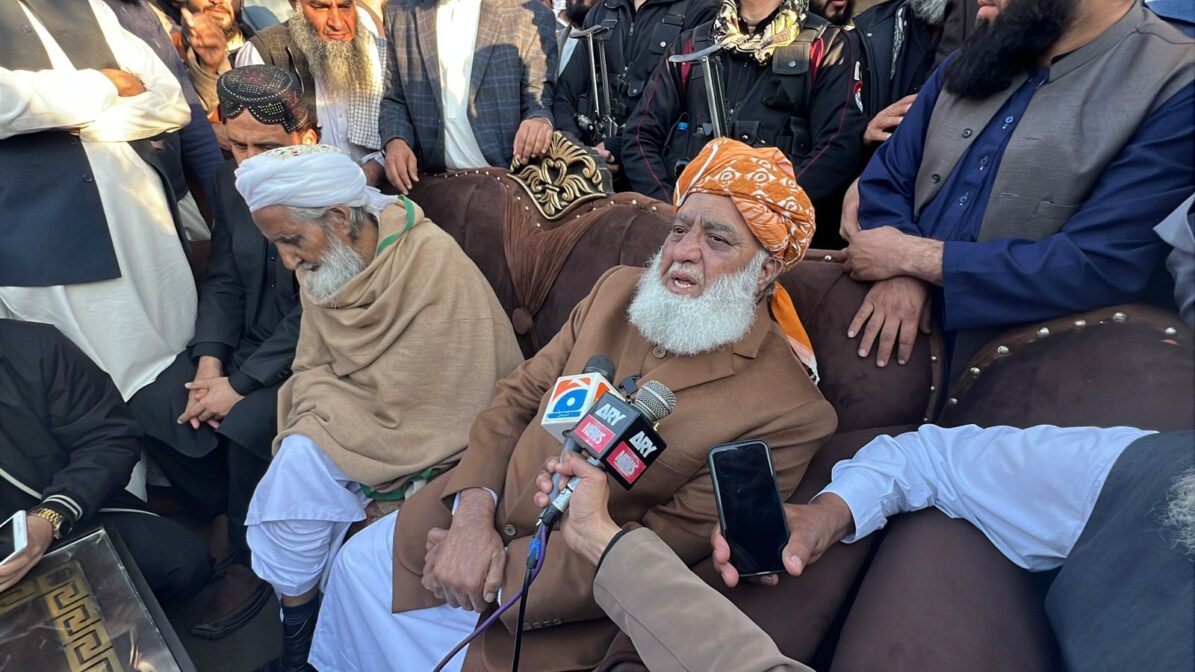
CHARSADDA: Jamiat Ulema-e-Islam (F) chief Maulana Fazlur Rehman, while addressing the media in Charsadda, expressed serious concerns over the country’s political, economic, and security situation. He called for activating the Parliamentary Security Committee to ensure that national-level policymaking is conducted through consultation with all relevant institutions and stakeholders.
He emphasized that decisions should not be made behind closed doors but rather through open debate and consultation within the parliamentary forum. According to him, without genuine democracy and a strong parliament, neither law and order nor economic stability can be ensured. Maulana Fazlur Rehman alleged that the current government came into power through rigging, which, he claimed, has eroded public trust in parliament.
Speaking about the situation in Khyber Pakhtunkhwa, he said the provincial government is not fully empowered and that major decisions are being made by the establishment and the federal government. He stated that unless policymaking institutions develop clear and effective policies, governments will continue to fail.
He further claimed that international financial institutions have held the country’s economy hostage, limiting Pakistan’s ability to make independent economic decisions. He demanded that provinces must be given their constitutional right over their resources and that a fair distribution of resources be ensured. He remarked that peace prevails where resources are available, while unrest surrounds deprived regions.
Referring to the Tirah region in Khyber district, he said that residents were forcibly displaced but no effective measures have been taken for their proper resettlement. He stressed the need for a comprehensive plan to ensure the dignified return and rehabilitation of affected communities.
Discussing regional developments, Maulana Fazlur Rehman expressed concern that if tensions escalate in Iran and Afghanistan, conflict could spread further across the region. He urged Pakistan to make independent decisions based on its national interests rather than external pressure.
He stated that there appears to be no clear and coherent national policy at present and alleged that decisions are being made by a few individuals, which he described as contrary to democratic principles. He maintained that fair elections and a genuine democratic process are essential for national unity and stability.
Maulana Fazlur Rehman concluded by saying that his party would support correct decisions taken in the national interest but would strongly oppose flawed policies. He stressed that serious national dialogue, parliamentary supremacy, and consensus are urgently needed to steer the country out of its current crises.
