

By Junaid Qaiser
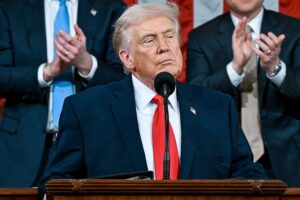
During his first State of the Union address of his second term, President Donald Trump spoke to Congress about a wide array of issues, both domestic and international. However, one topic really stood out for its clarity and urgency: Iran. In that moment, Trump articulated what has become a key element of his foreign policy towards the Islamic Republic—favoring diplomacy when possible, but resorting to overwhelming force if needed, all while firmly opposing Iran’s pursuit of nuclear weapons.
The tone of the address was distinctly firm. Trump labeled the Iranian leadership as a long-standing source of instability in the Middle East, accusing them of supporting violence through regional proxies. He presented the issue not merely as a regional conflict but as a direct threat to international security. His statements reflected a worldview that has guided his approach to Iran since his first presidency: pressure must precede negotiation, and credibility is built on a willingness to act.
At the core of his argument was last year’s U.S. military operation, dubbed Operation Midnight Hammer. This mission specifically targeted Iran’s key nuclear sites, including the underground facility at the Fordow Fuel Enrichment Plant, the enrichment setup at the Natanz Nuclear Facility, and the nuclear technology center in Isfahan. Trump framed these strikes as a bold move that thwarted Iran’s nuclear ambitions and underscored Washington’s enduring commitment to curbing nuclear proliferation in the region.
However, the president’s speech wasn’t just about military might. One of the most crucial points he made was the focus on diplomacy. Trump made it clear that talks with Iran are in progress and that he prefers to tackle the crisis through conversation. Still, he coupled that message with a firm warning: any deal must include a clear and binding promise from Iran that it will never seek nuclear weapons.
That demand lies at the center of the current diplomatic effort. Talks between the United States and Iran are scheduled to continue in Geneva, where negotiators hope to narrow the gap between Washington’s insistence on strict limits and Tehran’s demand for recognition of its right to peaceful nuclear technology. Iranian Foreign Minister Abbas Araghchi has described the negotiations as a historic opportunity and suggested that a deal may be within reach if diplomacy is given priority.
For Tehran, the central issue is sovereignty. Iranian officials maintain that their nuclear program is intended solely for civilian purposes and argue that international agreements should acknowledge their right to enrich uranium for peaceful use. At the same time, some signals from Iranian negotiators suggest a willingness to compromise, including proposals to reduce highly enriched uranium stockpiles or send part of them abroad.
The gap between the two sides, however, remains substantial. Washington views domestic enrichment as a potential pathway to nuclear weapons, while Iran sees abandoning enrichment entirely as an unacceptable surrender of its technological and political independence. Bridging that divide will require creative diplomacy and a level of trust that has been scarce for decades.
Hovering over the negotiations is a powerful reminder of the stakes involved. The United States has strengthened its military posture in the Middle East, a move widely interpreted as a signal that diplomacy must produce results. Iran, for its part, has warned that any further attack would trigger retaliation against American interests in the region. This uneasy balance of pressure and negotiation underscores the high-risk nature of the moment.
Trump’s State of the Union address therefore served not only as a review of past actions but also as a declaration of future intent. His message was straightforward: America prefers peace, but it will not compromise on the fundamental issue of nuclear weapons. The doctrine he outlined combines negotiation with deterrence, reflecting a belief that diplomacy is most effective when backed by credible strength.
Whether this strategy will lead to a lasting agreement is still up in the air. What’s evident, though, is that the next few weeks could be pivotal for U.S.–Iran relations. If the talks go well, they might pave the way for easing tensions in a region that has been marked by conflict for so long. But if they don’t, the fallout could reach far beyond the negotiating table.
In that light, Trump’s speech was more than just a policy announcement—it was a moment that highlighted the challenges ahead. His approach to Iran is now facing its crucial test, and how it plays out will not only influence the future of Washington and Tehran’s relationship but also the overall stability of the Middle East.
