
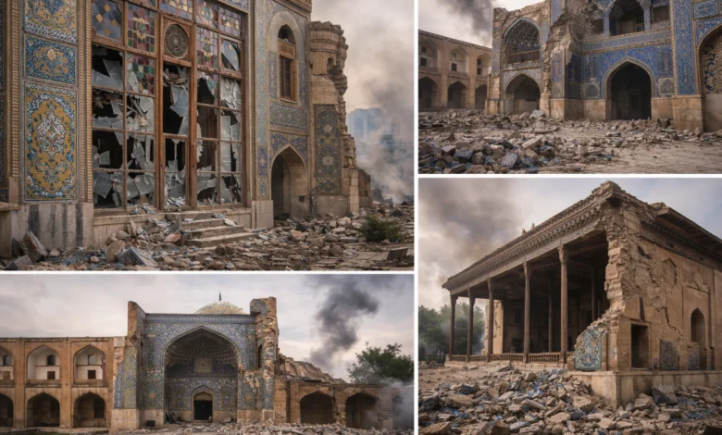
The United States and the Zionist regime of Israel, under what are described as unfounded pretexts, carried out a harsh and unjust attack against Iran, inflicting significant human and material losses on the country and its people. The scope of these damages has not been limited merely to civilian casualties and the destruction of urban infrastructure; it has also extended to some of Iran’s most significant historical spaces.
Cultural heritage is not merely a collection of ancient buildings.
These monuments represent the material layers of a nation’s collective memory. They are signs of historical pathways, cultural exchanges, and shared experiences that have developed over centuries. When such sites are damaged, what disappears is not only stone and brick; a part of a society’s historical narrative about itself is also lost.
Over the past decades, the global community has repeatedly faced similar experiences. The destruction of the temples of Palmyra, the demolition of the Buddhas of Bamiyan, and the extensive damage to the historic fabric of Mosul demonstrated how vulnerable cultural heritage can be during times of war. Each of these events was later recognized not only as a national loss but also as a tragedy for the shared heritage of humanity.
For this reason, over the past several decades a range of international rules and conventions have been developed to protect cultural heritage during armed conflicts. The 1954 Hague Convention for the Protection of Cultural Property in the Event of Armed Conflict, the 1972 UNESCO World Heritage Convention, and United Nations Security Council Resolution 2347 all emphasize a common principle: cultural heritage, regardless of geographical borders, constitutes part of the shared heritage of humanity, and its protection is a global responsibility.
According to these frameworks, states and parties engaged in military conflicts are obliged to prevent damage to cultural sites and monuments, and when harm occurs, they must facilitate investigation and protection measures. Experiences in recent years also show that the international community has not remained indifferent to such cases. In 2016, the International Criminal Court prosecuted the intentional destruction of cultural heritage in Timbuktu, Mali, as a war crime for the first time. This landmark case demonstrated that damage to cultural heritage can carry serious legal consequences at the international level.
Within this context, reports about damage to historical sites in Iran are not merely a local or national matter. Such incidents naturally attract the attention of the international community and specialized institutions concerned with cultural heritage. Organizations such as UNESCO, ICOMOS, and other related bodies have played an important role in documenting and protecting historical monuments in conflict zones in recent years.
What is most important today is recognizing that cultural heritage becomes extremely vulnerable during wartime. Historical structures were never designed to withstand explosions or the pressures generated by military conflicts.
cannot stop deadly missiles and declarations remain merely words, the world can no longer remain silent in the face of such events.
Wars sooner or later come to an end. Cities are rebuilt and infrastructures are reconstructed. However, when historical heritage is destroyed, restoring it is rarely possible. For this reason, protecting history during wartime is not a marginal issue but an inseparable part of the global responsibility toward human culture and civilization. The death of more than a hundred Iranian schoolgirls is tragic enough; we cannot stand by indifferently while thousands of years of civilization collapse into the ashes of war.
BY: Writer Dr. Mehdi Taheri currently working as a Cultural Attaché in the Embassy of the Islamic Republic of Iran in Islamabad
