
Kousar Khan
In April 2026, the world watched as tensions between the United States and Iran spiraled towards an open confrontation. The Strait of Hormuz, ‘artery of global energy’, stood at the center of the crisis. Markets trembled, prices soared, the world entered into a dangerous phase of lockdown and yet diplomacy seemed to stall under the weight of mistrust.
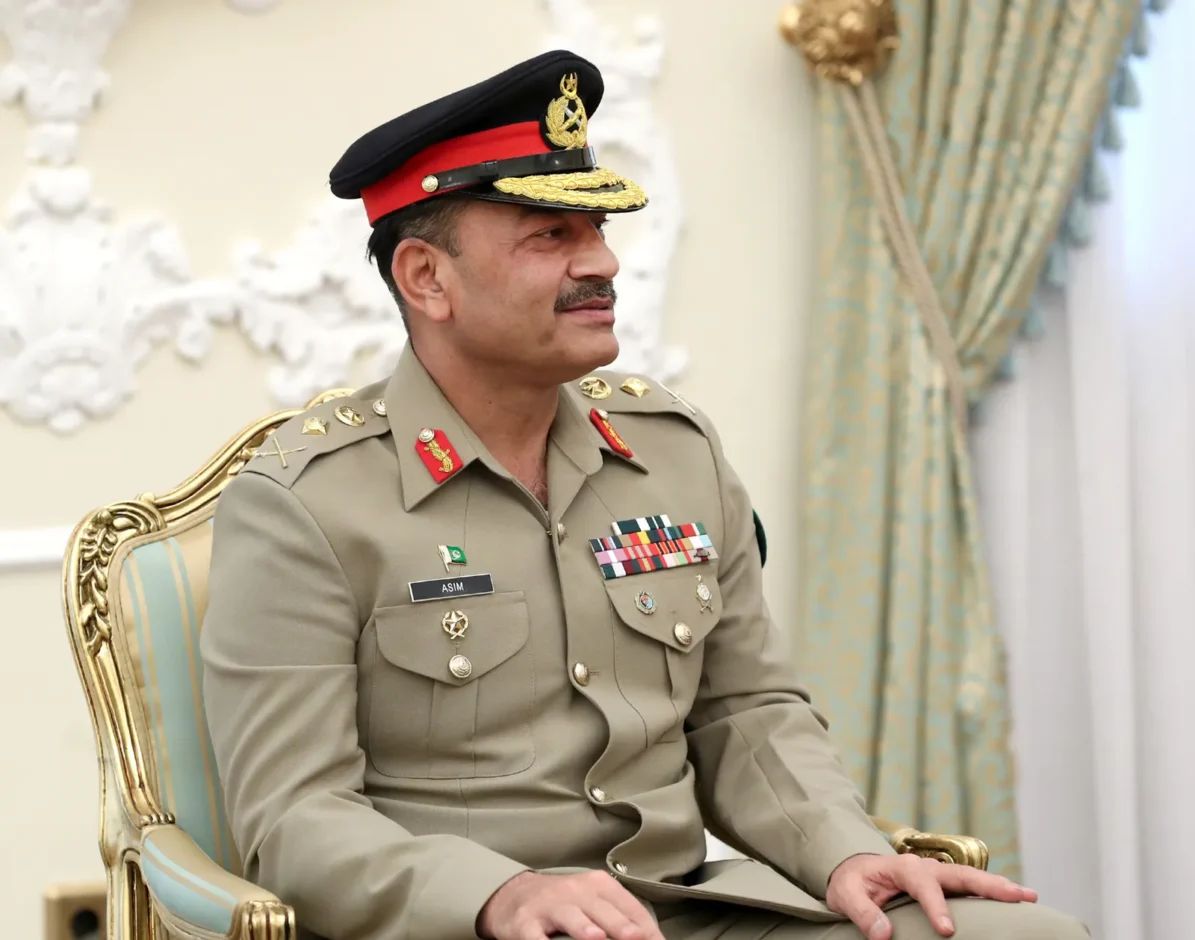
As tensions edged dangerously close to open conflict, the world expected the usual actors to hold the mediation files. Instead, something far less predictable happened: Pakistan emerged as the global peacemaker. And at the heart of that shift stood a person most reliable by both sides, Syed Asim Munir, Field Marshal (FM), the Chief of Defence Forces (CDF), and Chief of Army Staff (COAS) of Pakistan.
What makes this moment terrific is not just that Pakistan facilitated the near impossible dialogue. It is that, in a crisis where decades long mistrust defined every action, every tweet, and every press conference, both sides were willing to listen, through one man. That kind of access is rarely granted in international politics, that too by rivals, openly threatening each other, sending ripples through the global energy market.
This was never just another round of talks—it was engagement between unequal but powerful actors, a global superpower and a decisive regional heavyweight. The United States, with its unmatched global reach, and Iran, with its deep strategic influence across the Middle East, rarely rely on intermediaries they do not fully trust. To stand between them is not routine diplomacy—it is a position earned through credibility. And that is precisely the space Pakistan occupied, with its CDF and COAS, Field Marshal Syed Asim Munir, not merely facilitating conversation but shaping its direction
When delegations from Iran, led by Abbas Araghchi and Mohammad Bagher Ghalibaf, and the United States, represented by Vice President JD Vance along with Steve Witkoff and Jared Kushner, arrived in Islamabad (April 11-13), the world closely watched every step, every gesture as these were not symbolic meetings but adversaries sitting across the table in a city that, until recently, was claimed to be diplomatically inefficient. The formal host was Prime Minister Shehbaz Sharif, but the continuity of the process and its very survival depended on the quiet, persistent engagement of the CDF and COAS.
International observers noticed. The Guardian described Pakistan as an “unlikely diplomatic broker,” while seasoned diplomat Maleeha Lodhi went further, stating bluntly that without Field Marshal Syed Asim Munir, the process “would not work.”, this loudly acknowledging of agency.
Even more telling was the response from Washington. Donald Trump is not known for calibrated praise, yet his words carried unusual clarity. Calling Pakistan’s leadership “two fantastic people,” and referring to the CDF and COAS as doing a “great job,” he signaled something deeper than appreciation, reliance. Him describing FM Syed Asim Munir as his “favorite field marshal” may sound informal, even personal, but they reflect a reality: at a moment when the world couldn’t bear any more confrontation between Iran and the US, he was the trustworthy individual by the hegemon itself.
That same bridge extended to Tehran. The subsequent visit by Syed Asim Munir to Iran (April 15-17) was not a routine engagement but a visit conducted at a time when even a pause in mutual communication could have triggered escalation. Iranian officials, including Abbas Araghchi, received Field Marshal Syed Asim Munir as a credible messenger with open arms, receiving him directly. He was perceived as someone capable of carrying proposals without distortion.
It is in this space, between adversaries, between escalation and restraint, that the idea of a “global peacemaker” begins to take shape. Not as a slogan, but as a title. According to Fox News, Syed Asim Munir had already been operating as a quiet backchannel between Washington and Tehran for months, indicating and acknowledging his long term peacemaking vision. Al Jazeera and other outlets echoed similar assessments, pointing to his role in sustaining communication when formal diplomacy struggled to keep pace with events.
Even the multilateral system, often cautious in its language, acknowledged the effort. UN Secretary General, António Guterres, emphasized the importance of Pakistan’s mediation as a peacemaker and the need for dialogue to continue. In diplomatic terms, that is as close as it gets to an endorsement.
But perhaps the most telling dimension of this evolving narrative lies not in the praise itself, but in who finds it uncomfortable and unsettling.
For India, Pakistan’s emergence as a global peacemaker presents a strategic dilemma. For decades, New Delhi has sought to frame Pakistan primarily through a security lens; unstable, reactive, and defined by conflict. That narrative becomes harder to sustain when the same Pakistan is facilitating dialogue between a global superpower and a regional heavyweight, and doing so with a level of credibility acknowledged across capitals.
This is where the discomfort surfaces. Figures like Shashi Tharoor, known for their articulate critiques of Pakistan, have found themselves in a nuanced position’ unable to dismiss outright the scale of Islamabad’s diplomatic engagement. Even limited acknowledgment of Pakistan’s role, however carefully worded, signals a shift in perception that cannot easily be reversed.
Because perception, once altered, formulates beliefs and reshapes reality.
A Pakistan that can convene adversaries, sustain dialogue, and influence outcomes is not easily boxed into old narratives. It complicates strategic messaging. It challenges long-held assumptions. And it introduces a new variable into regional equations: credibility.
For India, this is not just about optics. It is about influence. If Pakistan is seen as a stabilizing force in global crises, its voice carries further. Its engagements deepen. Its partnerships expand. And in a region where influence is often contested as fiercely as territory, that matters.
None of this erases the underlying rivalries or disputes. But it does change the context in which they are viewed.
For Pakistan, the implications are equally significant. The ability to act as a mediator between the United States and Iran is not a one-off achievement—it is a signal of capacity. It suggests that Pakistan, under the leadership of its CDF and COAS, can operate beyond its immediate geography, shaping conversations that have positive global consequences.
There is also a quieter, more practical dimension to this role. A prolonged conflict in the Gulf would have sent shockwaves through global energy markets, driving prices upward and placing additional strain on already fragile economies. For countries like Pakistan, the economic fallout could have been severe. By helping to prevent escalation, Islamabad was not only contributing to global stability, it was safeguarding all the vulnerable economies.
This duality – serving both national interest and international stability – is what gives the current moment its depth.
And it is here that the figure of Field Marshal Syed Asim Munir, as CDF and COAS, comes into sharper focus. His leadership reflects a synthesis of deterrence and diplomacy: the capacity to respond firmly when required, and the judgment to prioritize dialogue when possible. It is a balance that is difficult to achieve, and even harder to sustain.
In the end, the story of April 2026 is not just about a crisis averted. It is about a shift in how power is exercised and perceived. It is about a country stepping into a role that few expected it to play, and a leader who, at a critical moment, chose to engage rather than escalate.
For some, this shift is welcome. For others, it is unsettling.
But for the rest of the world, watching from the edge of a crisis that did not spiral out of control, it is a reminder that sometimes, the most consequential victories are the ones that never make it to the battlefield.
Field Marshal Asim Munir’s role in the April 2026 crisis reflects a shift in how influence is exercised. Not through confrontation, but through connection. Not through dominance, but through direction.
In a moment when the world edged toward conflict, he helped redirect it toward dialogue.
And in doing so, he did more than mediate a crisis, he redefined Pakistan’s place within it
