

By Muhammad Anwar
The global economy often finds its heartbeat in the most unlikely of places, specifically narrow stretches of water that the world takes for granted until the flow stops. Among these, the Strait of Hormuz stands as the most critical chokepoint on the planet. This hook-shaped waterway connects the oil-rich Persian Gulf to the open waters of the Arabian Sea. While geography defines it as a mere ninety-six-mile passage, its strategic weight is measured in millions of barrels of energy and the fundamental food security of entire nations. Historically, this waterway has been a site of intense rivalry between global powers for centuries. In the modern era, it has become a high-stakes trigger. It is no longer just a trade route; it is a global life-support system that, if cut, could paralyze industry and send shockwaves through every household from London to Tokyo.
The “Quiet Era” and the Surge of 2026
For decades, the Strait operated in a state of tense stability. During this quiet era, its importance was often overlooked by the public. Before the 2026 escalations between the United States and Iran, the passage was mostly discussed in academic circles or during brief moments of regional friction. The world had become somewhat desensitized to the threats of closure, if only because Iran’s own economy relied on these waters; a total blockade was a distant impossibility. However, as the world moved toward Liquefied Natural Gas (LNG) to replace older fuels, our dependence on this single gate grew significantly. With nearly 21 million barrels of oil and twenty percent of the world’s LNG passing through these narrow lanes daily, the quiet era has officially ended. We now live in an age where this chokepoint is the world’s most sensitive economic nerve.
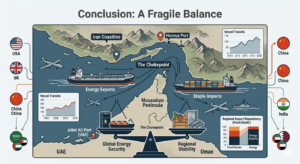
The Asian Giants: Feeding the Hunger of China and India
The primary users of this route are no longer just Western powers, but rather the rising economies of Asia. These nations consume approximately 80% of the oil flowing through the Strait, which means their industrial growth is physically tied to the stability of these waters.
- China: As the world’s largest crude importer, China receives nearly 20% of its oil through Hormuz. While China has built massive storage tanks to hold over a billion barrels for emergencies, it remains the top single destination for tankers leaving the Gulf.
- India: India is arguably even more vulnerable. About 64% of its cooking gas and 50% of its natural gas arrive via this chokepoint. For an average Indian family, a problem in the Strait does not just mean more expensive petrol; it means a direct shortage of the fuel needed to cook daily meals.
- Japan and South Korea: These nations are at the highest risk in terms of their total energy mix. Japan gets a staggering 87% of its fossil fuels from this route, and South Korea is close behind at 81%. For these countries, the Strait is the oxygen that keeps their factories and cities running.
The Western Perspective: Europe, the UK, and the USA
The Western world views the Strait through a lens of price stability and energy security. Even if they do not buy all their oil from the Gulf, a disruption there changes prices in every corner of the globe.
- European Union: After moving away from Russian gas in 2022, Europe became heavily reliant on Qatari LNG. Since these ships must pass through Hormuz, Europe inadvertently traded one geopolitical risk for another. When the Strait is threatened, electricity bills in Berlin and Paris spike instantly.
- United Kingdom: The UK receives a smaller share of its physical gas from the Gulf, but because global markets are interconnected, British citizens still pay what is known as the “Hormuz Premium.” When global supply drops, prices in London rise regardless of where the gas actually comes from.
- The United States: The US is now a major oil producer itself, but it still requires specific types of oil from the Gulf for its refineries. More importantly, the US military acts as the primary guarantor of the Strait, ensuring that trade stays open to prevent a global economic collapse that would destroy American investments and trade networks.
The Inbound Lifeline: How the Gulf Survives
While the world focuses on the oil running out, we must also remember what goes in. The Gulf nations, including Qatar, the UAE, and Kuwait, are desert countries that import nearly 90% of their food. For them, the Strait is a literal lifeline for daily existence.
- Food Security: Brazil and Argentina provide essential poultry and sugar; India and Pakistan provide rice and fresh vegetables; Australia provides wheat and livestock.
- Building the Future: Saudi Arabia’s massive Vision 2030 projects require steel, machinery, and electrical equipment from China, Germany, and India. Without the Strait, the modernization of the Middle East would simply come to a halt.
The Legal Question: Can Iran Lawfully Control the Strait?
One of the most debated topics in international circles is whether Iran has the legal right to control or close the Strait. This is a complex academic point that often leads to heavy criticism and diplomatic friction. To understand this, we must look at the United Nations Convention on the Law of the Sea (UNCLOS).
Under international law, the Strait of Hormuz is considered an “international strait.” This means that even though the shipping lanes fall within the territorial waters of Iran and Oman, ships from all nations have the right of transit passage. This right is non-suspendable, meaning that, legally, no country can block it in peacetime.
However, Iran has not ratified the 1982 UNCLOS treaty. Instead, Iran argues that it is only bound only by the 1958 convention, which grants a more limited right called “innocent passage.” Under innocent passage, a coastal state can temporarily suspend traffic if it believes its national security is at risk. This legal disagreement is the root of the conflict. While the world sees a blockade as an illegal act of war, Iran often frames its actions as a legal exercise of its sovereignty. Any forceful closure by Iran is viewed by the international community as a violation of the global freedom of navigation, leading to the intense military presence we see today.
Pakistan and the Gwadar Safety Valve
In this high-risk landscape, Pakistan’s geography offers a unique and powerful solution. The Gwadar Port, located on the Arabian Sea, sits comfortably outside the narrow mouth of the Strait. This gives it a massive strategic advantage for the entire region.
- The CPEC Advantage: Through the China-Pakistan Economic Corridor (CPEC), Gwadar can act as a vital Plan B. Oil can be offloaded in Gwadar and transported overland to China, bypassing the volatile Strait of Hormuz and the long journey through the Strait of Malacca.
- A Regional Pressure Valve: For the Gulf nations, Gwadar offers a way to move goods and energy even if the Strait is blocked. It provides the safety valve the world desperately needs to prevent a total economic shutdown.
The Search for Alternatives: Pipelines and Their Limits
Nations have tried to build emergency exits using pipelines, but the numbers show they are not a complete solution. Saudi Arabia has a pipeline to the Red Sea, and the UAE has one to Fujairah. Together, however, they can carry only about 7 million barrels a day, which is less than half of what usually passes through the Strait. Currently, there is no physical or logistical way to fully replace the Strait of Hormuz.
The Thin Line Between Prosperity and Paralysis
The Strait of Hormuz is a paradox of our modern age, a tiny stretch of water that holds the power to make or break the world’s greatest economies. It is where geography, international law, and human survival meet. Whether it is the heat in a London home, the rice in a Kuwaiti kitchen, or the steel for a new city in Saudi Arabia, the pulse of our daily lives depends on the ships that navigate this narrow passage. As long as we remain anchored to global trade, the stability of these few miles of water will remain the difference between global progress and total paralysis.
Muhammad Anwar is a development professional and CEO of Freedom Gate Prosperity with over three decades of experience in governance and civic engagement. He is a regular writer on public policy and social issues, and a social entrepreneur committed to peace, democratic values, and sustainable development in Pakistan.
