

Like many residents of Islamabad, I have watched the Marka-e-Haq Monument gradually take shape over the past several months. Every week, the structure appears taller and more impressive, drawing the attention of thousands of commuters passing through the area. As the monument nears completion, it has prompted a question that extends far beyond this single project: why do nations invest so heavily in memorials, and are these investments truly worthwhile?
The debate is neither new nor unique to Pakistan. Throughout history, civilizations have built monuments to honour great leaders, commemorate historic events and preserve collective memory. Ancient Egypt built the pyramids. France proudly maintains the Arc de Triomphe. The United States constructed the Lincoln Memorial and, more recently, the National September 11 Memorial. Germany transformed some of the darkest chapters of its history into museums and memorials that educate millions of visitors every year. These sites have become much more than architectural landmarks. They are places where history is preserved, lessons are learned, and national identity is strengthened.
South Asia has followed the same tradition.
India’s Statue of Unity, dedicated to Sardar Vallabhbhai Patel, was inaugurated in 2018 at a reported cost of around USD 430 million. Supporters viewed it as a symbol of national unity and a catalyst for tourism, while critics argued that the same resources could have been invested in schools, hospitals or rural development. India also established the National War Memorial in New Delhi, creating a modern space to honour members of its armed forces.
Bangladesh has preserved the memory of its Liberation War through the National Martyrs’ Memorial and the Liberation War Museum. Nepal rebuilt the historic Dharahara Tower after the devastating 2015 earthquake, presenting it as a symbol of resilience and national recovery. Sri Lanka continues to maintain memorials connected with the end of its civil war, although many remain politically sensitive. Across South Asia, governments have accepted that preserving national memory is important, but each project has also generated debate about priorities and public spending.
Pakistan’s own story can be read through its memorials.
The journey begins with Mazar-e-Quaid in Karachi, completed in 1971 as the final resting place of Quaid-e-Azam Muhammad Ali Jinnah. It remains the country’s most respected national monument and welcomes thousands of visitors every year. Minar-e-Pakistan was completed in 1968 in Lahore on the very site where the Lahore Resolution was adopted in 1940. It stands as a lasting reminder of the political vision that eventually led to the creation of Pakistan.
In Islamabad, the Pakistan Monument has become the country’s most recognizable modern memorial. Its distinctive petal-shaped design represents the unity of Pakistan’s provinces and territories, while the adjoining museum allows visitors to explore the country’s constitutional, political, and cultural evolution. It demonstrates that a memorial can also serve as an educational institution rather than simply a place for ceremonial events.
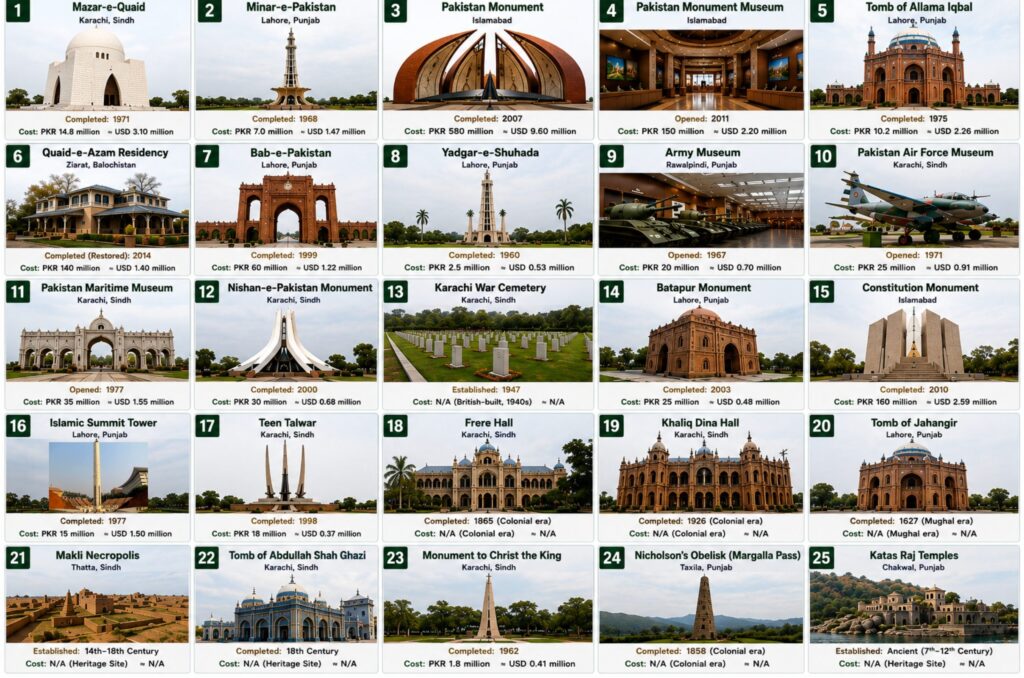
Lahore preserves several other milestones of Pakistan’s national journey. The Tomb of Allama Muhammad Iqbal honours the philosopher whose ideas inspired the Pakistan Movement. Bab-e-Pakistan commemorates the migration of millions of people during Partition, while Yadgar-e-Shuhada pays tribute to the sacrifices of Pakistan’s armed forces. The Batapur Monument remembers one of the important battles fought during the 1965 war.
Less familiar to many Pakistanis, but equally significant, is the Islamic Summit Minar in Lahore. Constructed between 1975 and 1977 following the historic Second Islamic Summit Conference of 1974, it commemorates one of Pakistan’s greatest diplomatic achievements. Designed by renowned Turkish architect Vedat Dalokay, who also designed Faisal Mosque, the monument symbolizes Pakistan’s leadership role in bringing the Muslim world together during a critical period in international politics.
Pakistan’s heritage extends well beyond these well-known landmarks. The Pakistan Air Force Museum, Pakistan Maritime Museum and Army Museum preserve the history of the country’s defence institutions. The Constitution Monument reflects Pakistan’s constitutional journey, while Frere Hall, Khaliq Dina Hall, Teen Talwar, Karachi War Cemetery, Makli Necropolis, Katas Raj Temples, Nicholson’s Obelisk, the Shrine of Abdullah Shah Ghazi and the magnificent Tomb of Emperor Jahangir collectively represent centuries of political, cultural and religious history. Together, these twenty-five memorials and historical monuments tell the story of Pakistan from ancient civilizations and the Mughal era to independence, diplomacy, nation building and constitutional development.
Soon, another chapter will be added through the Marka-e-Haq Monument in Islamabad. Built to commemorate Operation Bunyan-un-Marsoos, it is intended to honour the courage and sacrifices of Pakistan’s armed forces while providing another public space for remembrance. Whether it ultimately becomes a vibrant national institution or simply another impressive structure will depend on how it is managed after construction is completed.
This naturally brings us to the question that often accompanies such projects.
Can a developing country justify spending billions of rupees on memorials?
The answer lies somewhere between emotion and economics.
A nation without memory gradually loses its identity. Memorials preserve history, strengthen patriotism and allow younger generations to understand the events that shaped their country. They can also support tourism, create employment and encourage research when combined with museums, archives, libraries and educational programmes. Many countries have successfully transformed memorials into centres of learning that continue to benefit society long after construction has ended.
At the same time, governments cannot ignore the principle of opportunity cost. Every public investment reflects a choice. Pakistan continues to face serious challenges in education, healthcare, access to clean drinking water, climate resilience, employment, and urban infrastructure. Citizens therefore have every right to ask whether every new monument provides sufficient public value to justify its cost.
There is another dimension that deserves greater attention. Modern memorials should not only preserve history but also protect the future. Large construction projects consume enormous quantities of cement and steel, increasing carbon emissions and placing additional pressure on natural resources. Future memorials should therefore incorporate green architecture, renewable energy, rainwater harvesting, native landscaping and environmentally sustainable maintenance. A monument dedicated to future generations should itself reflect responsibility towards the environment they will inherit.
Perhaps the debate itself needs to change. Instead of asking whether Pakistan should build memorials or invest in development, we should ask whether every memorial can also become an instrument of development. A national monument that includes a museum, digital archive, research center, public library, educational programs and green public spaces becomes much more than a symbol. It becomes a living institution that preserves history, supports tourism, creates employment and strengthens civic education.
The true value of a memorial is therefore not measured by its height, its marble or its construction cost. It is measured by the knowledge it preserves, the values it inspires and the contribution it makes to future generations. If Pakistan succeeds in building memorials that educate as well as commemorate, then these monuments will become investments in national character rather than simply additions to the country’s skyline.
About the Author:
Muhammad Anwar is the Chief Executive Officer of Freedom Gate Prosperity (FGP). He is a public policy analyst and development practitioner who writes regularly on governance, democratic values, economic reforms, education, climate resilience, and social development.
