
Shahid Qurashi
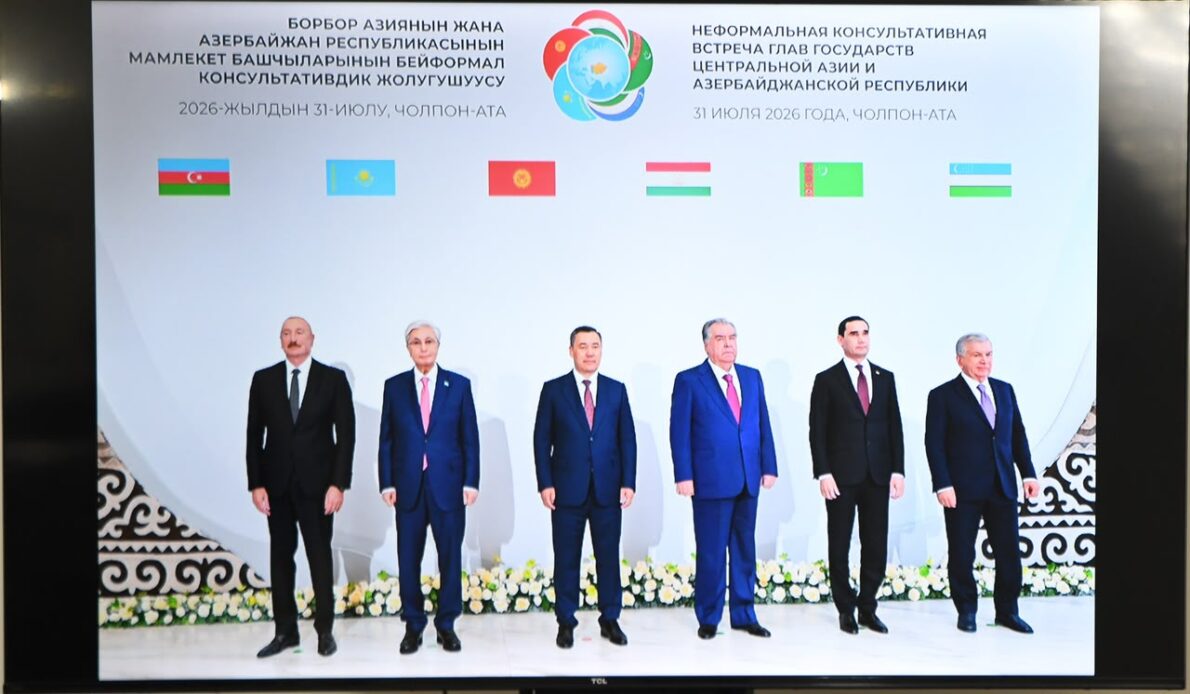
The Kyrgyz Republic has highlighted the key outcomes of the informal Consultative Meeting of the Heads of State of Central Asia and the Republic of Azerbaijan, held on July 31 in Cholpon-Ata on the shores of Issyk-Kul Lake.
Hosted by Kyrgyz President Sadyr Japarov, the summit marked a significant development in regional cooperation as Azerbaijan joined the Central Asian consultative format as a full participant. The leaders also signed the Cholpon-Ata Declaration, reaffirming their commitment to regional peace, connectivity, economic cooperation and stability.
The meeting came amid improving relations among Central Asian states, including the resolution of long-standing border issues between Kyrgyzstan, Uzbekistan and Tajikistan. The regional bloc, comprising around 85 million people and a combined gross regional product exceeding $600 billion, is increasingly emerging as an important bridge between Europe and Asia.
President Japarov thanked regional countries, including Pakistan, for supporting Kyrgyzstan’s successful election to the UN Security Council as a non-permanent member for 2027-2028.
Kyrgyzstan said its priorities at the UN Security Council would include strengthening international trust, peacebuilding, disarmament and non-proliferation, support for developing and landlocked countries, conflict mediation, protection of women and children, food and energy security, and stability and regional integration of Afghanistan.
Transport and energy connectivity were also central to the discussions. The China-Kyrgyzstan-Uzbekistan railway and the Kambarata-1 Hydropower Project were highlighted as major regional initiatives.
The Kambarata-1 project is expected to have a generation capacity of 1,860 MW and produce around 5.6 billion kWh annually. Kyrgyzstan holds a 34 percent stake, while Kazakhstan and Uzbekistan each hold 33 percent.
Work on the 532-kilometre China-Kyrgyzstan-Uzbekistan railway is also progressing, with more than 17 percent of construction reportedly completed. The project is expected to strengthen trade connectivity between China, Central Asia and Europe.
The summit also discussed tourism cooperation, including a proposal for a unified tourist visa for visitors to Central Asian countries.
Parallel to the summit, Uzbek President Shavkat Mirziyoyev and Azerbaijani President Ilham Aliyev paid state visits to Kyrgyzstan. Kyrgyzstan and Uzbekistan signed a Treaty on Allied Relations, while Kyrgyzstan and Azerbaijan also elevated bilateral relations through an alliance treaty.
During Azerbaijan’s state visit, 11 joint documents were signed, while Uzbekistan and Kyrgyzstan signed 12 joint documents. The two countries also exchanged their highest state honors.
Regional leaders additionally participated in the inauguration of the Baku Resort & Spa Hotel on the shores of Issyk-Kul and attended the opening of an international-class golf resort.
The Issyk-Kul region also hosted the UIM F1H2O World Championship on August 1-2, attracting leading powerboat racers and the presidents of Kyrgyzstan, Kazakhstan, Uzbekistan and Tajikistan.
The Kyrgyz side described the Cholpon-Ata meeting as a historic turning point that could strengthen the region’s strategic role by linking Central Asia with the Caspian Sea, the Middle Corridor and wider Eurasian connectivity networks.
Pakistan, due to its strategic location at the crossroads of South Asia, Central Asia and the Middle East, was identified as a country that could benefit significantly from expanding trans-Caspian connectivity, trade and investment.
