
By Ramzan Mughal
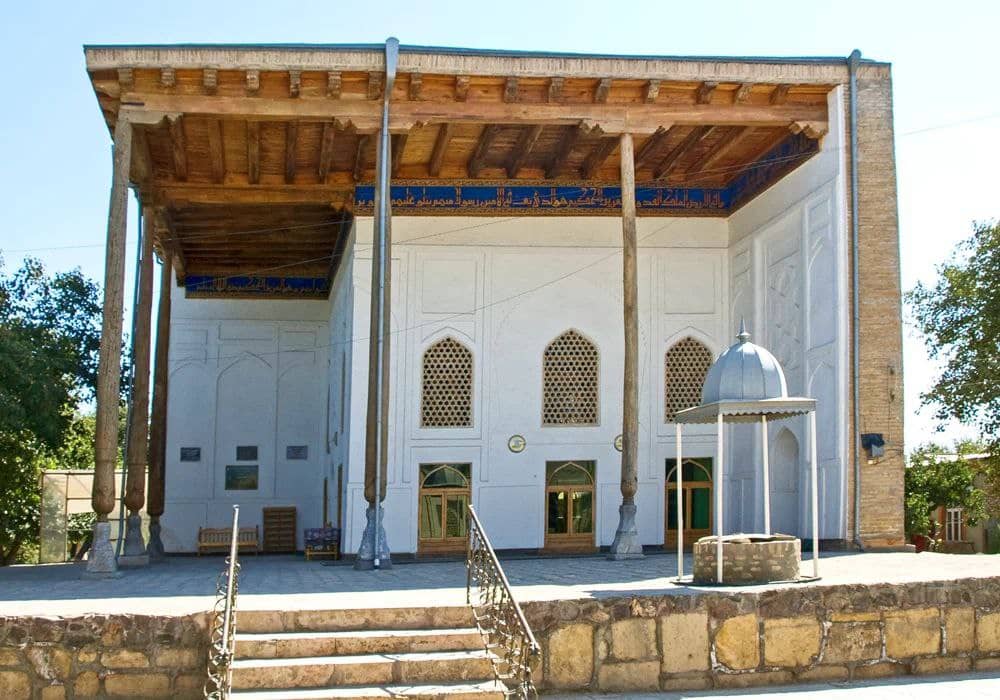
Among the sacred sites of Bukhara that have been preserved through the centuries, the Baland Mosque, built in the 16th century, holds a special place. It is a rare example of Shaybanid-era architecture and, for more than five centuries, has served as the spiritual and communal center of its neighborhood.
The mosque was named “Baland,” meaning “elevated,” because it was constructed high upon massive stone foundations. It is said that the original platform rose more than two meters, higher than the height of a person. The building is square in shape, made of baked brick, and remarkably contains no interior columns. For this reason, it is popularly known as Masjidi Bistun — “the pillarless mosque.”
According to historical sources, the sand used in the mosque’s construction was brought from the sacred land surrounding the Kaaba. There are also traditions suggesting that its dimensions were designed in proportion to the Kaaba itself. Because of these beliefs, some people hold the devotional view that praying in this mosque carries the spiritual merit of a “pilgrimage on foot.”
Though modest in size, the mosque is extraordinarily rich in decoration and meaning. Its interior is adorned from floor to ceiling with intricate ornamental patterns. The ceiling, crafted from blue willow wood and embellished with muqarnas, is secured by 74 chains. The upper sections of the walls bear verses from Surah Al-Fath, written in both thuluth and Kufic scripts. Ten epigraphic panels displaying hadiths are placed along the interior walls. The use of gold leaf around the mihrab has led to the mosque being respectfully referred to as “Tillaqori” — “adorned with gold.”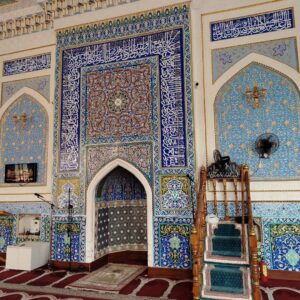
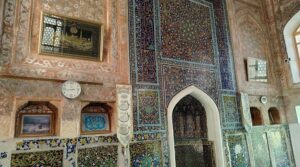
The decorative program prominently features the kundal technique, with embossed patterns covering the walls entirely. Hexagonal ceramic tiles and the harmonious blend of blue and green tones give the interior a distinctive radiance. Sunlight entering through eight clerestory windows reflects off the majolica tiles, creating a captivating play of light within the sacred space.
On the northeastern side stands an eight-meter-high iwan supported by five walnut-wood columns. These five columns are interpreted as symbolizing the Five Pillars of Islam. A historic well in the courtyard has also been preserved as part of the monument’s heritage.
During the Soviet period, the mosque was used as a warehouse and later as a music club. However, since 1989 it has resumed its function as a place of worship. In 1998 it was granted the status of a congregational mosque, and during the years of independence it was restored, reclaiming its historical appearance. Today, the mosque can accommodate approximately 90 worshippers inside and nearly 300 including the iwan and courtyard.
The Baland Mosque is not only an architectural monument but also one of the landmarks that shape the spiritual identity of Bukhara. Every brick, every ornament, and even the sand said to have been brought from sacred soil stands as a symbol of the people’s faith and reverence.
