
Ethiopia’s National Dialogue: A Milestone on The Path to National Consensus and Lasting Peace
Four years in the making, Ethiopia’s National Dialogue moved from grassroots consultation to a five-week national conference that closed on 22 August 2026 — the country’s most far-reaching attempt yet to let its citizens define their shared future.
Why Ethiopia Turned to Dialogue
Ethiopia launched its National Dialogue to solve the long-standing structural challenges and political divisions. The process was designed to move the country away from zero-sum politics and toward a culture of peaceful engagement and consensus-building. It set out to heal disagreements over historical narratives, the constitution, and the federal system, while fostering a durable and citizen-led social contract.
Ultimately, the dialogue has been regarded as a critical pathway to sustainable peace: a means of building a shared national identity and a stable governance framework capable of preventing future cycles of instability.
Recognizing the urgency of these challenges, and the need for an institutional mechanism to carry them forward, Ethiopia established the Ethiopian National Dialogue Commission (ENDC) on 29 December 2021 under Proclamation No. 1265/2021, as an independent public body. The Commission was mandated to foster national consensus, sustainable peace, and reconciliation through an inclusive and participatory process. In doing so, the ENDC gave Ethiopia a historic opportunity to move beyond decades of political confrontation and mistrust and toward consultation and broad-based national consensus. At its core, the National Dialogue exists to give Ethiopians an independent platform on which to discuss matters of national importance and search for common ground.
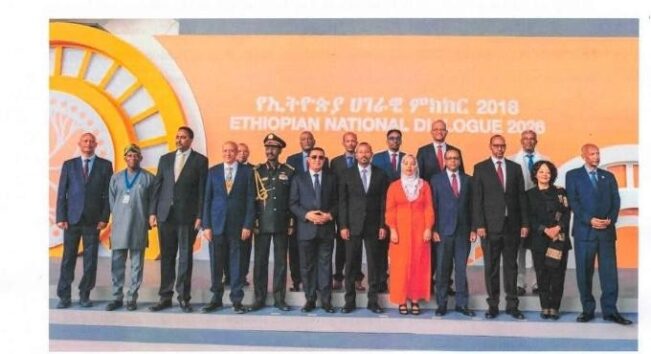
Launching Ceremony of the Ethiopian National Dialogue
A Home-Grown Approach Rooted in Indigenous Knowledge
National dialogues are nationally owned political processes, undertaken when existing institutions alone cannot resolve a country’s divisions. Ethiopia’s traditional institutions have played a vital role in fostering the National Dialogue and taking ownership of the reconciliation process. The Dialogue’s focus has been to establish a process owned by every segment of society, rooted in Ethiopia’s own institutions and built on grassroots contribution rather than imposition.
Incorporating home-grown knowledge and culture into the National Dialogue has been central to making it both impactful and inclusive. The Commission has worked to weave indigenous knowledge, culture, and inclusive-dialogue frameworks into every stage of the process.
Built From the Ground Up: An Inclusive Process
Ethiopia is home to people of diverse cultural, religious, and ethnic backgrounds. Adapting the concept of a national dialogue to Ethiopia has therefore required contributions from across society—religious, political, and cultural groups alike—and has demanded time, professionalism, research, and knowledge to avoid imposing frameworks that do not fit the Ethiopian context.
Durable peace requires more than dialogue. It requires institutions capable of carrying its outcomes forward.
Within this context, the Dialogue’s methodological choice was to build its agenda from the ground up, through a broad, bottom-up approach intended to reflect contemporary realities of Ethiopia as well as its historical, political, and governance-related questions. That approach unfolded across three broad stages, moving from the grassroots to the national level:
| 1. Local & Woreda Consultations | 2. Regional & Diaspora Consultations | 3. Federal Agenda and Main Conference |
| Grassroots input gathered directly from farmers, elders, women, youth, and community groups across the country. | Synthesis of regional priorities alongside input from Ethiopians abroad, in Africa, the Middle East, Asia, Europe, and North America. | National-level consensus-building around eight core pillars, culminating in the plenary conference and its final recommendations. |
This layered model was designed to ensure that the questions ultimately placed before delegates originated with citizens themselves, rather than being prescribed by political elites. Ethiopians abroad were folded into this same design rather than treated as an afterthought, with pre-dialogue consultations held in the United States, Canada, the United Kingdom, Sweden, the United Arab Emirates, and other countries with large diaspora communities.
Years of grassroots groundwork culminated in the National Dialogue Conference, which formally opened in Addis Ababa on 15 July 2026, bringing together 4,000 delegates drawn from regional states, political parties, civil society organizations, religious institutions, professional associations, traditional leadership structures, youth and women’s groups, and the Ethiopian diaspora to address political and historical divisions and to chart a path toward lasting peace.
To manage deliberation at this scale, delegates were organized into eight thematic assemblies of 500 people each, one for every agenda pillar, which were in turn divided into smaller discussion circles to allow for genuine debate before views were consolidated back up through intermediate groups and returned to the full assemblies for final deliberation.
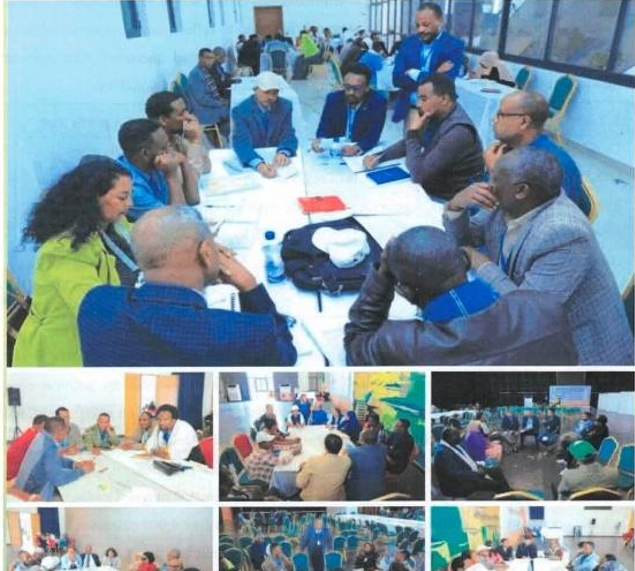
Participant Consultation
From Consultation to Consensus: A Process Concluded
After five weeks of deliberation, the National Dialogue Conference concluded in Addis Ababa on 22 August 2026, bringing to a close a four-year process that moved from grassroots consultation to a nationally negotiated set of recommendations. Eight thematic agenda pillars were validated earlier through extensive workshops with academia, civil society, religious leaders, elders, and community representatives.
Those pillars covered nation-building and identity, the structure and form of government, including the federal system and power-sharing arrangements; the status and administration of the federal cities of Addis Ababa and Dire Dawa; religious affairs and interfaith harmony; institution-building, rule of law, and human rights, including transitional justice and other socio-economic issues.
Alongside the conference, the government’s parallel calls for political parties and armed groups to pursue their objectives through negotiation rather than conflict have already yielded results, with several groups responding by entering peaceful negotiations. At the closing ceremony, former Nigerian President Olusegun Obasanjo congratulated the government of Ethiopia and its people for advancing dialogue, mutual understanding, and national consensus.
Government Commitment to Seeing the Process Through
Throughout the process, the Government of Ethiopia has demonstrated its commitment to the National Dialogue at every stage: establishing the Commission by law, supporting grassroots agenda collection, providing continuous budget and logistical support, and publicly pledging to review and implement the recommendations that emerge without interference.
The government regards the National Dialogue as an essential, high-priority mechanism for forging long-term peace and national consensus. Presiding over the conference’s opening in July, Prime Minister Dr. Abiy Ahmed called Ethiopians to replace political confrontation with dialogue and compromise, and also expressed the government’s commitment to translate the recommendations into the country’s legislative and policy agenda.
European Union and International Partners: Backing Ethiopia’s Democratic Journey
While the National Dialogue has been emphatic in presenting itself as a nationally owned initiative, it has also drawn substantial diplomatic backing from the international community. This backing forms part of a broader European engagement with Ethiopia’s democratic development. The European Union has long supported Ethiopia’s democratic development, including its work on good governance and institutional capacity-building, and has followed the National Dialogue closely as a complement to that electoral progress.
On 15 July 2026, the day the conference opened, EU High Representative for Foreign Affairs and Security Policy and Vice-President (HR/VP) Mrs. Kaja Kallas travelled to Addis Ababa, where she held talks with Prime Minister Dr. Abiy Ahmed and Foreign Affairs Minister Dr. Gedion Timothewos, and visited the conference in person. She described what she saw as a grassroots approach in which teachers from villages and people from different walks of life come together to discuss peace, reconciliation, and lasting security. “I think this approach is really a good approach, and I hope that it comes to concrete results,” Kallas said, adding that she hoped the Dialogue would translate into tangible outcomes capable of strengthening peace, reconciliation, and national unity in Ethiopia. She also underscored Ethiopia’s strategic importance to peace and stability in the Horn of Africa, pointing to the country’s large population and geopolitical weight as reasons it remains a key regional actor.
Development partners, including the European Union, together with several member states and Norway, showed their support. More broadly, the conference attracted representatives of foreign governments and international organizations who voiced political support for Ethiopia’s own effort to resolve its differences through dialogue.
.
