
By Junaid Qaiser
Prime Minister Shehbaz Sharif’s visit to Vienna has accomplished more than just commemorating 70 years of diplomatic relations between Pakistan and Austria — it has set the stage for a partnership that could reach new heights beyond what has been achieved to date.
During his meeting with Austrian Federal Chancellor Christian Stocker at the historic Hofburg Palace, Sharif made it clear that there’s a desire to move from friendly diplomacy to a more structured economic collaboration. They covered a wide range of topics, including trade, investment, renewable energy, tourism, IT, healthcare, education, and skilled mobility — sectors where both nations have a lot to offer.
For Pakistan, the timing couldn’t be more crucial. As the nation strives to solidify its economic recovery and rebuild investor trust, collaborating with technologically advanced European partners is not just a nice-to-have — it’s a must. Austria’s strengths in engineering, hydropower, environmental tech, and advanced manufacturing fit perfectly with Pakistan’s development goals, especially in the areas of renewable energy transition and modernizing industry.
The discussions in Vienna went beyond just government meetings. The joint CEOs’ forum, led by both leaders, brought together business communities from each side for direct dialogue. From textiles and surgical instruments to energy efficiency and agro-industries, the focus was on transforming political goodwill into tangible business results. The agreements being discussed are expected to be wrapped up soon, showcasing a shared dedication to moving past mere symbolism. Equally important was the open conversation about migration.
Pakistan made it clear that it stands against illegal immigration and is actively working to break down human smuggling networks. However, the more strategic offer lies in structured labor mobility. With nearly 60 percent of its 240 million population under 30, Pakistan views its youth as an asset rather than a burden. The proposal to supply internationally certified skilled workers to Austria and other European partners marks a practical shift — replacing irregular migration with organized, mutually beneficial workforce partnerships.
This approach speaks to European labour market realities while safeguarding Pakistan’s international image. It reflects a maturing policy framework where economic opportunity and legal compliance go hand in hand.
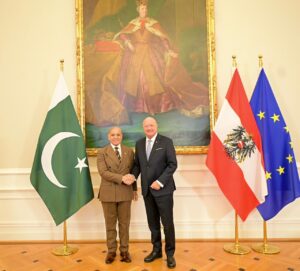
Sharif also used the Vienna platform to invite Austrian companies to participate in Pakistan’s upcoming EU–Pakistan Business Forum in Islamabad. The message was clear: Pakistan is open for investment, particularly in sectors such as mining, minerals, renewable energy and value-added agriculture. Austria’s technological sophistication can complement Pakistan’s resource base and demographic advantage.
Beyond economics, the visit reaffirmed shared support for multilateralism and the central role of the United Nations in addressing global challenges — from climate action to sustainable development and peacebuilding. In a world increasingly defined by fragmentation and unilateral impulses, such alignment carries diplomatic weight.
Ceremonial elements — the guard of honour, the playing of national anthems, the signing of the guest book — underscored the warmth of the relationship. However, the real significance lies in the commitment to follow-up mechanisms, expanded government-to-government and business-to-business engagement, and the understanding that 70 years of diplomatic history must now translate into tangible economic gains.
This was the first time in more than three decades that a Pakistani prime minister visited Austria, and it has rekindled an essential European connection just as economic optimism is growing in Islamabad. Vienna has infused fresh energy into the partnership, with both sides demonstrating a clear political will to turn dialogue into sustainable cooperation.
With a structured follow-up, increased business engagement, and a rising interest in trade, energy, and skilled mobility, the relationship between Pakistan and Austria is on the brink of a new chapter. The momentum generated in Vienna lays the groundwork for a stronger, more dynamic partnership focused on shared opportunities and long-term mutual benefits.
