
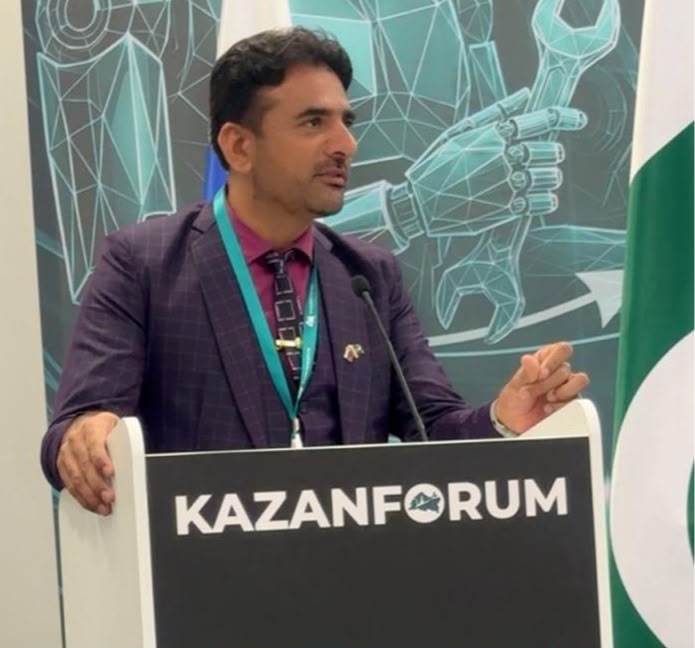
By Dr. Faisal Javaid
The proposed Pakistan-Russia freight train is more than a railway project. It is a test of whether Pakistan can convert its geography into strategic and economic advantage as Eurasian trade is reshaped by geopolitical uncertainty.
Russia is looking south. Pakistan should be ready.
On August 11, Russia’s Ministry of Transport confirmed that Russian and Pakistani railway administrations had established the framework for a test cargo shipment through the International North-South Transport Corridor (INSTC). The two sides are working on the route, cargo types, tariffs and delivery times, with the test date to be coordinated with Pakistan and transit countries. Russian Ambassador Albert P. Khorev has similarly stated that freight services connecting Moscow with Karachi and Faisalabad in both directions are being prepared, with Belarusian participation also under consideration. These statements concern the same evolving freight initiative and indicate that it has entered a more practical phase.
The process began earlier. Pakistan and Russia signed a Memorandum of Understanding on railway cooperation at the St Petersburg International Economic Forum in June 2024. On September 18, 2024, Pakistan joined the proposed Belarus-Russia-Kazakhstan-Uzbekistan-Afghanistan-Pakistan-Indian Ocean multimodal transport corridor, giving the bilateral initiative a wider regional dimension.
The project subsequently encountered geopolitical realities. The first trial was scheduled for March 15, 2025, and later pushed towards April. A second launch was planned for June 22, with Pakistan Railways preparing the first 16-wagon freight train. That attempt was postponed after the Iran-Israel conflict disrupted the regional transit environment and the Iran-Pakistan border crossing.
These delays exposed a fundamental weakness of international corridors: a route crossing several countries remains vulnerable to political and security developments anywhere along its path. That is why the forthcoming test matters. The question is no longer whether Islamabad and Moscow support the project, but whether it can work commercially.
The test should measure transit time, freight costs, customs procedures, border delays, insurance requirements and the availability of two-way cargo. A successful pilot should become the basis for a regular freight service rather than another cycle of announcements and postponements.
The strategic significance, however, extends beyond bilateral trade.
Russia’s interest in southern connectivity is growing as established routes face greater geopolitical uncertainty. The Black Sea has become more exposed to the consequences of the Russia-Ukraine war, while instability surrounding Iran has highlighted the vulnerability of the Strait of Hormuz. Russian Deputy Prime Minister Marat Khusnullin has argued that railway access to the Indian Ocean should be explored because of risks associated with the Bosphorus and Strait of Hormuz.
For Pakistan, this creates an important opening. Karachi, Port Qasim and Gwadar provide access to the Arabian Sea and Indian Ocean, potentially connecting Eurasian land routes with markets beyond.
Pakistan should not present itself as a risk-free alternative. Its stronger proposition is route diversification. In an uncertain geopolitical environment, having multiple routes is itself a strategic asset.
Iran remains important because it provides the most immediate connection between Pakistan and the INSTC. Islamabad should therefore continue improving the Taftan-Zahedan section and ML-3. But the experience of 2025 demonstrates why Pakistan should not depend on a single transit route.
China offers another possibility. Pakistan should examine how Russian and Central Asian cargo could connect through Chinese infrastructure and reach Pakistani ports. The Quadrilateral Traffic in Transit Agreement (QTTA), involving Pakistan, China, Kazakhstan and Kyrgyzstan, also deserves greater attention as a framework for expanding Central Asian access to Pakistan.
Afghanistan is potentially important, but it must be approached realistically. There is currently no operational railway connecting Central Asia through Afghanistan to Pakistan. The Trans-Afghan railway therefore remains a future project. Its construction could transform regional connectivity, but Pakistan’s security concerns regarding Tehrik-i-Taliban Pakistan (TTP) and cross-border militancy remain a major obstacle.
Russia can contribute through the Moscow Format on Afghanistan. Pakistan should encourage Moscow to give greater attention to the security conditions necessary for regional connectivity and to preventing Afghan territory from being used for militant activity against neighbouring states. Connectivity and security cannot be treated as separate issues.
Pakistan should therefore adopt a multi-corridor strategy: the INSTC through Iran as the immediate option; China-based connectivity as an alternative; QTTA-related routes for deeper Central Asian integration; and the Trans-Afghan railway as a longer-term possibility.
The objective should not be to choose one corridor over another. It should be to ensure that Pakistan has more than one route to Eurasia and that Eurasia has more than one route to Pakistan.
For years, regional connectivity has been discussed through MoUs, ministerial meetings, feasibility studies and corridor maps. These are necessary, but they do not create functioning trade routes. The next phase must be measured differently: how many trains run, how much cargo they carry, how competitive freight rates are, how quickly borders can be crossed and whether private companies find the routes commercially sustainable.
Pakistan’s ports must also be integrated into this strategy. Karachi, Port Qasim and Gwadar should be treated as components of a broader Eurasian logistics network connecting Russia and landlocked Central Asian economies with the Indian Ocean.
The Russia-Pakistan freight train may initially carry limited cargo, but its strategic significance could be much greater. It can become the starting point for a wider network linking Russia and Central Asia with Pakistan through several routes.
Pakistan has long been described as being at the crossroads of regions. The challenge now is to turn that geography into functioning connectivity.
The first train will test the route. The real challenge is whether Pakistan can build the infrastructure, commercial systems and regional partnerships that allow the next hundred trains to follow.
Dr. Faisal Javaid is affiliated with the Federal Urdu University of Arts, Science & Technology (FUUAST), Islamabad
Email: faisaljavaid2008@gmail.com
