
PROVINCE REPORT
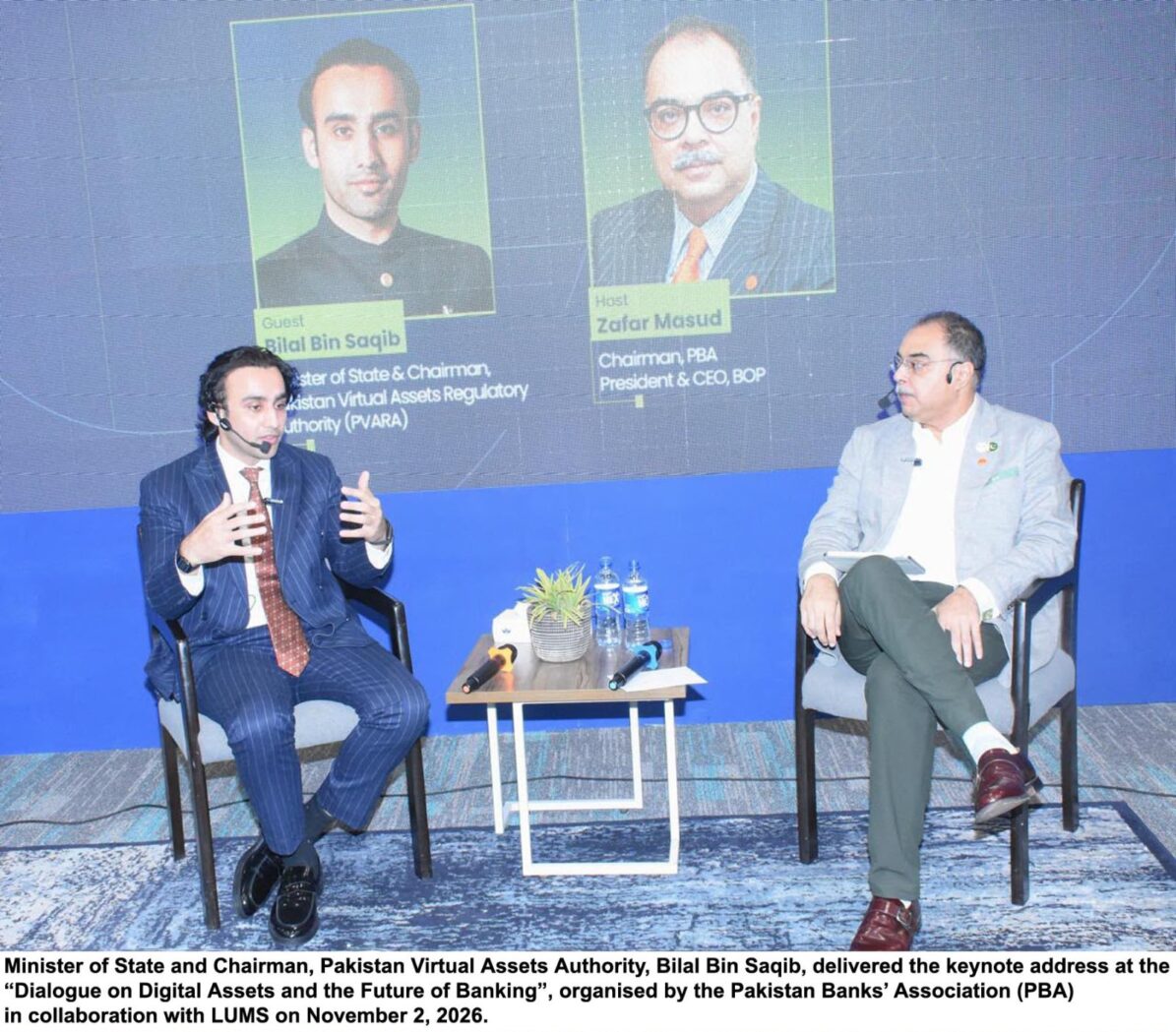
LAHORE: Minister of State and Pakistan Virtual Assets Regulatory Authority (PVARA) Chairman Bilal Bin Saqib has said that Pakistan must embrace financial innovation and emerging technologies to become a global player in the evolving financial landscape, stressing that the country cannot afford to remain a mere consumer of technologies while international financial rules are being rewritten.
He was speaking during a discussion with Pakistan Banks Association (PBA) Chairman Zafar Masud at a dialogue on “Digital Assets and the Future of Banking” held at the Lahore University of Management Sciences (LUMS) on Monday.
Bilal Bin Saqib said Bitcoin had served as the gateway to the wider digital assets ecosystem, adding that the level of adoption demonstrated the world-class talent of Pakistanis and their ability to adapt to the future of finance. However, he said the potential of blockchain technology extended far beyond Bitcoin and cryptocurrency trading, encompassing changes in the movement and storage of value, tokenisation, access to investment opportunities and programmable money. He said these developments could significantly benefit Pakistan by promoting financial inclusion, providing investment opportunities to a wider population and transforming the country’s financial infrastructure.
Referring to the changing global financial landscape, he said major international financial institutions, including JPMorgan, HSBC, Citibank and BNY, had started adopting blockchain-based technologies to develop better financial products and explore new business opportunities. He stressed that Pakistan should become a co-author of the emerging global financial rules instead of remaining a consumer of technologies developed elsewhere. He said Pakistan had previously remained outside the discussions when international correspondent banking and card payment systems were established, adding that the country continued to bear the cost of that exclusion.
“The question is whether we want to rent our future or own our future,” he remarked. He said Pakistan needed to work closely with banks and the State Bank of Pakistan (SBP) to establish an enabling regulatory environment that encouraged innovation without compromising financial stability. He warned that the cost of inaction could be far greater than the risks associated with taking timely and responsible action. He said remittances were a lifeline for Pakistan, but much of the international money transfer infrastructure still relied on systems established decades ago. He observed that even a two to three per cent reduction in transaction costs on Pakistan’s approximately $41 billion in remittances could channel an additional billion dollars into the grassroots economy. He said PVARA was already working with the State Bank on a joint working group to examine the potential of emerging technologies in improving payment efficiency and reducing remittance costs. A pilot project focusing on the Gulf remittance corridor was also being considered.
He further stressed the need for banks to collaborate on shared financial infrastructure, including custody services, know-your-customer (KYC) systems and cybersecurity, while competing to provide better customer services and more affordable products. He said regulators should coordinate their efforts to provide clarity and confidence to financial institutions, enabling banks to focus their resources on innovation and product development. He said PVARA was working with the State Bank and the Securities and Exchange Commission of Pakistan (SECP) to create an enabling environment for financial innovation.
Bilal Bin Saqib also called for greater engagement with Pakistan’s overseas professionals working in the financial technology sector, saying they could bring valuable institutional experience and expertise to the country. He expressed confidence that Pakistan’s banking sector and financial institutions could play a significant role in transforming the country into a regional hub for financial innovation. On cybersecurity, he cautioned that emerging technologies and digital financial systems required robust security arrangements, adding that cyberattacks should not be viewed as a failure of technology but as a reminder of weaknesses in security protocols. Referring to major international cyber incidents, he said financial institutions must strengthen their cybersecurity frameworks and prepare for increasingly sophisticated, state-sponsored threats. He stressed that Pakistan’s banks and regulators needed to work together to ensure that the country’s digital financial infrastructure remained secure, resilient and capable of supporting future innovation. Bilal Bin Saqib also responded to the questions of the participants of the dialogue.
LUMS Vice Chancellor Dr Ali Cheema, SBP Deputy Governor Saleem Ullah and others were also present.
