Islamabad(staff reporter)
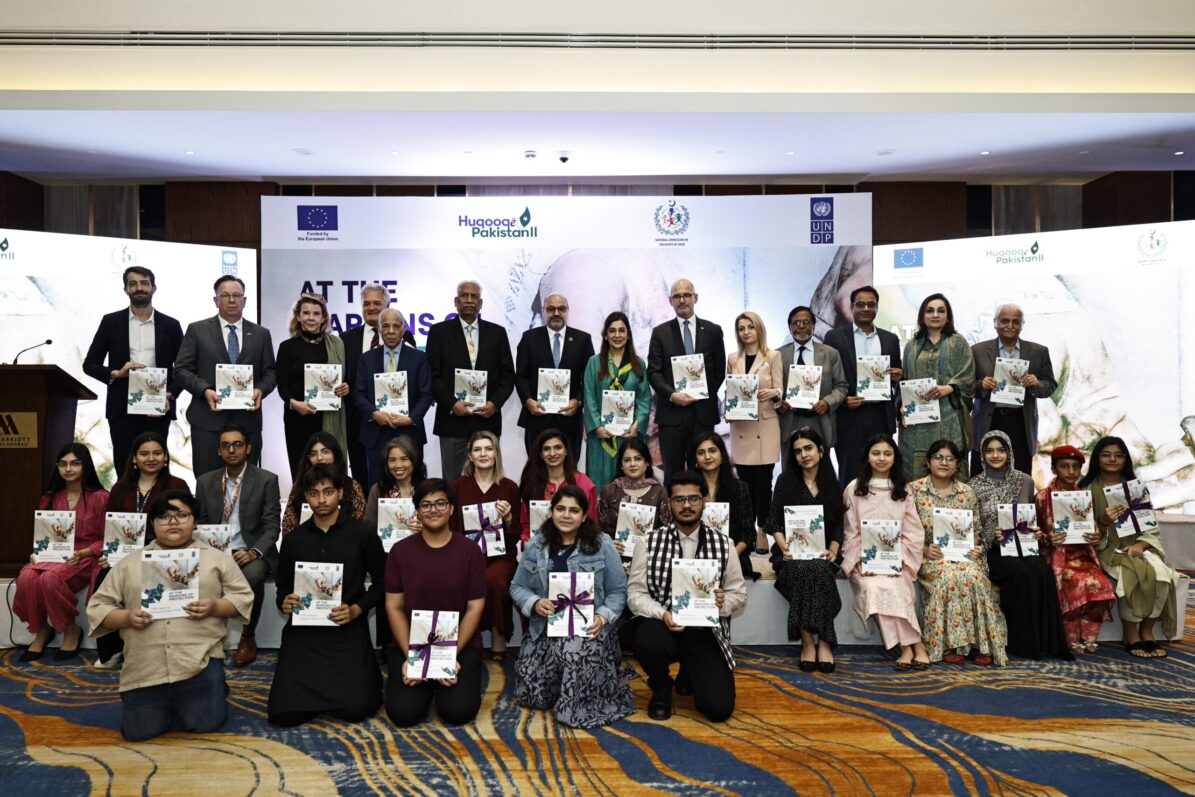
The European Union (EU), through the Huqooq-e-Pakistan II project, in collaboration with the National Commission on the Rights of Child (NCRC) and the United Nations Development Programme (UNDP), has launched a comprehensive report titled “At the Margins of Protection: Child Labour in Pakistan’s Private Sector.” The report provides evidence-based insights and policy recommendations to better understand and address child labour across private sector value chains in Pakistan.
The report highlights that approximately one in every ten children in Pakistan is engaged in child labour, often under hazardous, exploitative, and hidden conditions beyond formal oversight. It identifies structural drivers such as poverty, limited access to education, and weak enforcement mechanisms as key factors contributing to the persistence of child labour, particularly in informal sectors and supply chain-linked environments.
The launch event brought together senior government officials, child and human rights experts, private sector representatives, civil society organizations, development partners, and UN agencies to discuss the report’s findings and policy implications.
Philipp Oliver Gross, Deputy Head of Mission of the European Union to Pakistan, commended the efforts of NCRC in monitoring child labour. He stated that the report represents a “key stepping stone” in advancing efforts to address child labour, which affects an estimated 8.6 million children in Pakistan. He further emphasized that ending child labour remains a strong commitment of the Government of Pakistan and is central to its international obligations, including the GSP+ status.
Based on extensive nationwide consultations, key informant interviews, and a review of legal and institutional frameworks, the report identifies critical challenges including disjointed data systems, limited labour inspection coverage, and gaps in coordination between federal and provincial stakeholders. It underscores the need for integrated policy responses linking social protection, education retention, and livelihood support.
Dr. Samuel Rizk, UNDP Resident Representative, highlighted the need for institutional reform and stronger protection mechanisms. He noted that child labour remains widespread, particularly in informal sectors and lower tiers of supply chains, often remaining hidden from view. He reaffirmed UNDP’s commitment to supporting Pakistan in strengthening its institutions, data systems, and policies to safeguard children’s rights.
The report calls for a shift from fragmented interventions to a coordinated, systems-based approach. Key recommendations include harmonization of legal standards across provinces, strengthening labour inspection systems, improving data integration, and enhancing private sector accountability. These align with the National Action Plan on Business and Human Rights (NAP-BHR), which identifies child labour as a priority area.
Ayesha Raza Farooq, Chairperson NCRC, reaffirmed the Commission’s commitment to eliminating child labour, describing the report as “not an endpoint but a roadmap for action.” She emphasized that NCRC will continue working with government institutions, development partners, and the private sector to translate these recommendations into concrete actions that protect children and strengthen accountability mechanisms across Pakistan.
The launch marks an important milestone under the Huqooq-e-Pakistan II project, reinforcing collective efforts to address child labour through evidence-based policymaking, institutional strengthening, and multi-stakeholder collaboration.