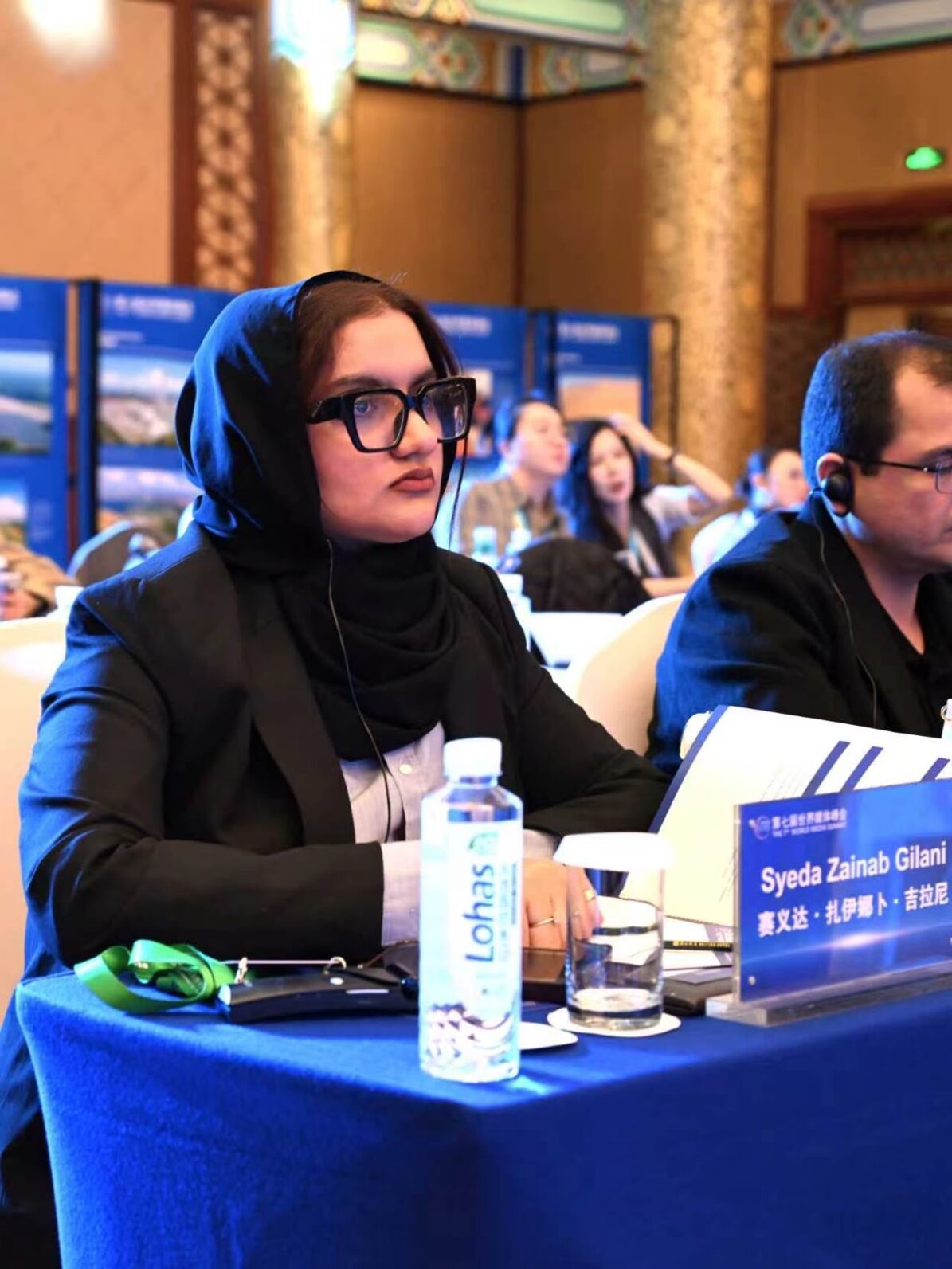
By Syeda Zainab Gilani
Attending the 7th World Media Summit in Beijing was an extraordinary experience for me as an emerging journalist from Pakistan. Being part of an international gathering that brought together leading journalists, editors and media professionals from across the world was both an honour and a valuable learning opportunity. It gave me the chance to listen to diverse perspectives, engage with people working at the forefront of global journalism and gain a deeper understanding of the challenges and opportunities shaping the future of the profession.
Held from November 5 to 9, 2026, under the theme “Media in the Intelligent Age: From Consensus to Action,” the summit brought together nearly 500 representatives from nearly 330 media organisations and institutions across 112 countries and regions. Discussions focused on artificial intelligence, media innovation, international cooperation and the responsibility of journalism in an increasingly complex information environment.
Participating in the sessions and meeting delegates from different countries reinforced one central thought: journalism is entering a period of profound transformation. AI is changing how information is gathered, processed, verified and delivered. But the more important question is whether the media industry can embrace this technology without compromising accuracy, independence and public trust.
Throughout the summit, artificial intelligence emerged as one of the most important subjects of discussion. Media professionals examined its growing role in news production, from research and translation to editing, fact-checking and multimedia content.
AFP Chairman and CEO Fabrice Fries offered a clear perspective on this transformation. Describing AI as an efficient resource, he said: “It’s a tool, a very efficient tool, but it’s not a substitute.” Reuters President Paul Bascobert made a similarly important observation, describing AI as a resource that increases speed, efficiency and scale. His statement, “We automate tasks. We do not automate judgment,” captured one of the summit’s most significant messages.
These remarks highlight an important distinction. AI can process large volumes of information, assist research and reduce repetitive newsroom tasks. It can give journalists more time to investigate, analyse and report. However, technology cannot replace the professional judgment required to understand a story, assess its importance and decide whether information is reliable enough to publish. The idea of augmented journalism offers a useful way forward: technology should support journalists, allowing them to focus on the human aspects of reporting, including meeting sources, understanding events and explaining complex developments with context and depth.
One of the most important issues raised during the summit was the growing challenge of misinformation and the role of AI in fact-checking. Artificial intelligence has made it easier to create convincing images, videos and audio recordings that may not represent reality. Deepfakes and manipulated content can circulate rapidly, sometimes reaching large audiences before journalists have an opportunity to establish the facts.
AFP Chairman Fabrice Fries told the high-level dialogue that addressed this challenge directly when discussing the use of AI to identify suspected deepfakes. He explained that software can assist in the fact-checking process, but the final decision must remain human. As he stated, “In the end, it’s the journalist that decides, that verifies, and that publishes.” and this is an important reminder for the profession. A verification tool may detect signs of manipulation or help trace the origin of a claim, but journalists must still examine the evidence, establish context and consult reliable sources before publishing.
For Pakistan, this challenge is particularly relevant as misinformation can spread rapidly through social media and messaging platforms, especially during politically sensitive developments, public emergencies and major national events. A manipulated video or unverified claim can create confusion long before a correction reaches the same audience. AI could help Pakistani newsrooms examine suspicious material, analyse documents, translate information and identify claims requiring further investigation. However, an AI-generated answer is not automatically a verified fact. Journalists must continue asking where information originated, whether the source is credible and whether a claim can be independently confirmed.
Reuters President Bascobert also stressed that journalism’s core task remains getting the facts, checking them and reporting them. In an age of rapidly multiplying information, this responsibility is more important than ever. The summit also encouraged reflection on how countries with different levels of technological development can benefit from AI. For Pakistan, adopting new technology is important, but ensuring that it responds to local newsroom needs is equally essential.
AI must also reflect the languages and realities of the communities it serves. For Pakistan, this means giving greater attention to Urdu and regional languages such as Pashto, Sindhi, Balochi, Punjabi and Saraiki. Technology must understand local contexts, not just translate words.
Kyodo News President Toshimitsu Sawai emphasised the importance of human accountability, stating: “Humans bear final decision-making authority and responsibility for content.” Meanwhile, UN Office at Geneva Director-General Tatiana Valovaya highlighted risks including misinformation, privacy violations, algorithmic bias and unequal access to AI. These concerns are particularly important for smaller newsrooms that may lack the resources and expertise to adopt new technologies.
For Pakistan, this means investing not only in new tools but also in journalist training, local-language technology and responsible newsroom policies. Developing countries must also have a voice in shaping media technology, rather than simply adopting systems developed elsewhere. The summit took an important step in this direction through the adoption of the Beijing Consensus and the launch of the Global Media Initiative for the Joint Development of AI Application Standards, promoting cooperation on responsible AI use, information authenticity, data security and professional ethics.
The World Media Summit reinforced my belief that the future of journalism should not be viewed as a competition between human beings and machines. AI offers enormous possibilities, but its value ultimately depends on how responsibly it is used. For Pakistani journalists, the way forward is to approach AI with openness and professional curiosity while understanding its limitations. We must learn to use new tools and encourage innovation without compromising the standards that distinguish journalism from the uncontrolled circulation of information.
The most important lesson from Beijing is that technological progress must strengthen journalism rather than weaken its foundations. In the intelligent age, success will be measured not by how quickly a newsroom produces content, but by how accurately and responsibly it informs the public. AI may transform journalism’s tools, but the obligation to establish the truth remains human. That responsibility must never be automated.