

By Junaid Qaiser
Japan has always been admired for its incredible journey from the ashes of war to becoming one of the globe’s most advanced economies and a leader in technology. Today, that same spirit of resilience seems to be at the heart of Sanae Takaichi’s leadership, as she steps in as Japan’s first female prime minister. She’s put forth an ambitious plan to boost the country’s economic strength, enhance its security, and elevate its role on the world stage. Her message to parliament was straightforward: Japan needs to regain its confidence, invest in its future, and ensure it plays a vital role in an increasingly unpredictable world.
Addressing the House of Representatives, Takaichi made it clear that her administration will focus on investment as a key element of national strength. For years, Japan’s economic policies have been held back by cautious fiscal management and a lack of long-term investment in emerging sectors. Takaichi is signaling a shift from that mindset, arguing that being overly frugal has often robbed the country of chances to invest in growth and innovation. Her plan to introduce multi-year budgets aimed at crisis management and the development of cutting-edge technology shows her commitment to breaking this cycle and reviving economic vitality.
Takaichi has framed her leadership around a broader concept of national resilience. In her policy address, she pledged to reinforce Japan’s diplomatic, defense, economic, technological and intelligence capabilities while also investing in human resources. The emphasis on coordinated national strength reflects the reality of today’s geopolitical landscape, where economic power, technological innovation and security preparedness increasingly overlap.
Part of this agenda involves reforms intended to make Japan more attractive for investment. Takaichi has expressed support for relaxing certain labour regulations and creating a clearer, more predictable fiscal framework for businesses and local governments. By focusing on long-term funding commitments rather than frequent supplementary budgets, her administration aims to provide greater stability and confidence for investors. The government also plans to unveil a public-private investment roadmap designed to channel resources into strategic sectors such as artificial intelligence, advanced manufacturing and crisis-response systems.
Security issues are a major focus in Takaichi’s strategy. She has described the regional security situation as the most complicated Japan has faced since World War II. A key part of her vision focuses on Japan’s defense policy. She has shown a willingness to rethink certain aspects of Japan’s pacifist constitution—crafted after World War II—which limits the capabilities of the Self-Defence Forces. While these changes are politically sensitive, they are becoming a hot topic in Japan as the strategic landscape in Asia changes. For Takaichi, enhancing national defense doesn’t mean abandoning pacifism; it’s about making sure Japan can maintain its independence and stability.
Takaichi’s perspective is heavily influenced by the legacy of the late Shinzo Abe, under whom she held various cabinet roles. Much like Abe, she supports a proactive foreign policy and believes Japan should play a bigger part in regional security. Her initiative to broaden the “Free and Open Indo-Pacific” framework—first introduced by Abe—seeks to enhance collaboration with partners across Asia, Europe, and beyond. In practical terms, this translates to strengthening relationships with regional democracies, while also fostering close ties with the Association of Southeast Asian Nations. Nevertheless, the foundation of Japan’s foreign policy continues to be its alliance with the United States. Takaichi has made it clear that managing this relationship will be a key focus of her diplomatic approach, especially as global power dynamics evolve.
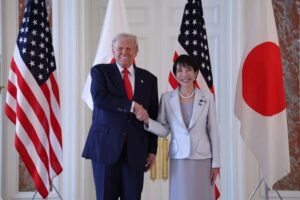
Her relationship with Donald Trump has already emerged as a significant factor shaping the direction of Japan–U.S. ties. During her election campaign, Trump publicly praised Takaichi and later described her as a “highly respected and very popular” leader, offering a rare endorsement for a foreign candidate. Looking ahead, Takaichi is expected to visit the White House in March 2026 to further strengthen cooperation on economic security and strategic issues.
Some observers are already calling Takaichi one of the most influential women in global politics. She has even drawn comparisons to Margaret Thatcher, presenting herself as a decisive leader focused on economic reform. She steps into her role with a strong parliamentary backing and high public expectations. This political capital gives her a unique chance to push for structural reforms that past administrations have struggled to implement. However, it also means she carries a heavy responsibility to deliver real results, especially when it comes to boosting economic growth and managing complex regional issues.
For those watching from a distance, Japan’s evolution under Takaichi presents a fascinating case study in national renewal. It shows how strategic investments, a drive for technological advancement, and a clear policy vision can shape a nation’s future, even when times are tough. Japan’s journey serves as a reminder that true national strength doesn’t come from just one policy; it’s built on a long-term commitment to innovation, stability, and responsible leadership.
As Takaichi declared before parliament, the goal is to keep “turning on switches for growth.” Whether this ambitious agenda will succeed remains to be seen in the coming years, but one thing is clear: Japan is stepping into a new era of confidence and ambition. If her plans take hold, the phrase “Make Japan Strong Again” may come to symbolize a broader revival of the nation’s economic vitality and global influence.
