
Our Correspondent
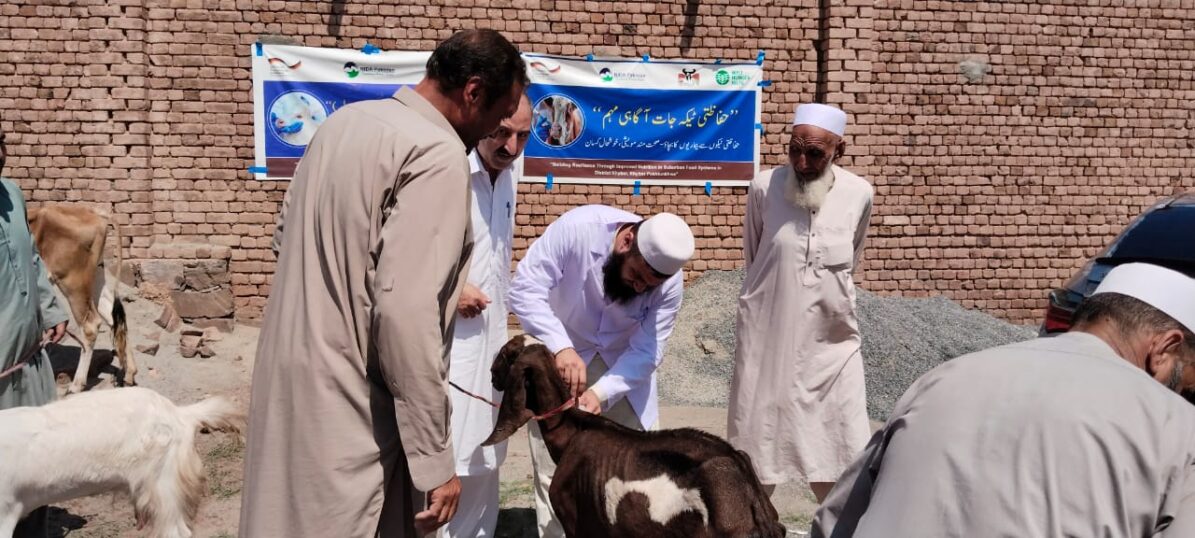
PESHAWAR: A ground breaking livestock development initiative has brought new hope to smallholder farmers in Bara, District Khyber, where NIDA Pakistan, with financial support from Welthungerhilfe (WHH) and technical collaboration from the Livestock and Dairy Development Department, has successfully completed a series of vaccination and artificial insemination (AI) awareness campaigns aimed at improving livestock health, productivity, and household livelihoods.
Implemented under the project “Building Resilience Through Improved Nutrition in Sub Urban Food Systems in KP (PAK-1136),” the campaign introduced modern livestock management practices to rural communities while strengthening farmers’ access to government veterinary services. The initiative focused on preventing livestock diseases, promoting artificial insemination, and encouraging farmers to adopt improved animal husbandry practices for long-term food security and economic resilience.
A total of 10 awareness campaigns were organized across ten villages in Bara, attracting 243 livestock farmers, including smallholder livestock keepers who depend heavily on goats, cattle, sheep, and buffaloes for their income and nutrition.
One of the campaign’s most significant achievements was the successful vaccination of 1,597 animals against Foot and Mouth Disease (FMD)—including 494 cattle, 966 goats, and 137 sheep—far exceeding the project’s initial target of approximately 1,200 animals.
Veterinary teams from the Livestock and Dairy Development Department also provided on-site animal health consultations, pregnancy diagnosis, treatment for sick animals, and practical demonstrations on disease prevention and livestock management. More importantly, the campaign introduced goat artificial insemination (AI) for the first time in Bara, marking a milestone in the district’s livestock sector.
Using semen from improved Pakistani goat breeds such as Beetal and Makhi Cheeni, veterinary experts demonstrated how artificial insemination can improve meat and milk production while overcoming one of the most common challenges faced by rural farmers—the shortage of quality breeding bucks.
To reinforce learning, 1,000 information, education and communication (IEC) brochures were jointly developed by NIDA Pakistan and the Livestock and Dairy Development Department and distributed among participants. Community Livestock Extension Workers (CLEWs) delivered awareness sessions in the local language, ensuring that farmers clearly understood vaccination schedules, disease prevention measures, and the benefits of improved breeding technologies.
“The introduction of goat artificial insemination is more than a technical innovation—it is a practical solution that enables farmers to improve livestock productivity, strengthen household incomes, and build resilience against future challenges,” a project representative from NIDA Pakistan said.
The campaign also strengthened partnerships between rural communities and government livestock services. According to project officials, the Livestock and Dairy Development Department has committed to continuing vaccination and artificial insemination services in response to farmers’ needs, ensuring sustainability long after the project’s completion.
Among the many beneficiaries is Lehaz, a 58-year-old smallholder farmer and night watchman from Speen Qabar-A, whose experience highlights the transformative impact of the initiative.
For months, Lehaz struggled to find a suitable breeding buck for his female goat. Repeated attempts failed, and he feared losing an entire breeding season. During one of the awareness campaigns, veterinary experts vaccinated his goat and performed artificial insemination using improved breed semen.
The results exceeded his expectations.
Several months later, the goat successfully gave birth to healthy twin kids—one male and one female.
“I searched many times for a male buck but could not find one,” Lehaz recalled. “Through this campaign, my goat received artificial insemination at the right time. Today it has given birth to healthy twins, and I am extremely happy. I will definitely use this service again.”
The success quickly attracted attention throughout the village, encouraging neighboring farmers to explore artificial insemination as an alternative to traditional breeding methods.
Another farmer, Ali Muhammad from Yousaf Talab, also benefited from the campaign after his goat successfully conceived through artificial insemination and later delivered twin kids. Although one kid unfortunately died a month after birth due to unknown causes, the remaining healthy offspring convinced him of the value of modern breeding technology.
“Many times we miss the breeding period because a quality male goat is unavailable,” Ali Muhammad said. “Now I have seen the results myself. I am willing to pay for artificial insemination in the future and will encourage other farmers to use it as well.”
Strengthening Rural Livelihoods
Project officials believe the initiative demonstrates how collaboration between development organizations and public institutions can deliver sustainable solutions for rural communities.
By combining disease prevention, improved breeding techniques, farmer awareness, and stronger institutional linkages, the campaign has laid the foundation for healthier livestock, increased meat and milk production, higher household incomes, and improved food security across the project area.
Community-Based Organizations (CBOs), Village Organizations (VOs), Community Livestock Extension Workers, and veterinary staff played a vital role in mobilizing farmers, organizing campaign activities, and ensuring that services reached remote communities.
The project has also created growing demand for vaccination and artificial insemination services, with many farmers expressing their willingness to continue using these services at their own expense.
As climate change, livestock diseases, and declining productivity continue to threaten rural livelihoods, initiatives like this demonstrate how targeted investments in livestock health and innovation can deliver lasting social and economic benefits.
By introducing modern breeding technology for the first time in Bara and protecting nearly 1,600 animals against Foot and Mouth Disease, NIDA Pakistan, Welthungerhilfe (WHH), and the Livestock and Dairy Development Department have not only improved livestock productivity but also strengthened farmers’ confidence in adopting modern agricultural practices.
The success of these campaigns offers a promising model for replication in other underserved areas of Khyber Pakhtunkhwa, where improved livestock management can contribute significantly to resilient livelihoods, better nutrition, and sustainable rural development.
