

By Junaid Qaiser
In moments of regional upheaval, ambiguity can be mistaken for strategy. But every so often, a state chooses clarity over calculated silence. That is what Pakistan has done. The recent messaging attributed to the Pakistan Armed Forces is not a balancing act dressed up as diplomacy—it is, instead, a deliberate articulation of where Pakistan stands and, just as importantly, where it will not stand.
For weeks, a familiar story has been making the rounds: that Pakistan is quietly trying to “balance” its relationships with both Iran and the Kingdom of Saudi Arabia (KSA). It’s a tempting narrative, one that fits neatly into the larger picture of geopolitical maneuvering and multi-alignment. But, as the official response indicates, this view is fundamentally off the mark. Pakistan isn’t adjusting its ties with Riyadh; it’s reinforcing them. The strategic partnership with Saudi Arabia isn’t just transactional or conditional——it is, by all indications, ironclad.
This clarity matters, particularly at a time when the region risks sliding into a wider and more dangerous confrontation. The conflict involving Iran, Israel, and the United States is already volatile. Expanding its theatre—especially by drawing Saudi Arabia into direct confrontation—would not merely escalate tensions; it would fundamentally alter the nature of the conflict. What is currently a complex geopolitical struggle could quickly devolve into something far more perilous: a fracture within the Muslim world itself.
Pakistan’s clear message, through Pakistan Armed Forces’ X account, is rooted in both strategic calculation and historical experience. The idea of dragging Saudi Arabia into this conflict is described, quite pointedly, as “self-defeating” and even “conspiracy-oriented.” That language reflects a deeper concern—that external actors, and perhaps even internal miscalculations, could transform a contained crisis into a broader sectarian or intra-Muslim confrontation. For Pakistan, that is a red line.
There is also a moral dimension to this stance, one that resonates deeply within Pakistani society. Saudi Arabia is not just another regional country; it holds a unique place in the hearts of millions of Pakistanis as the custodian of Islam’s two holiest sites. Any attempt to turn it into a battlefield is not merely a geopolitical misstep—it is an emotional and ideological rupture. This is why the question posed by Pakistani officials carries such weight: why force a war upon a country that has, despite sustained provocations, refrained from deploying its full military capabilities?
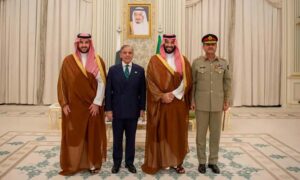
At the diplomatic level, Pakistan’s position has been reinforced through direct engagement. Prime Minister Shehbaz Sharif’s conversation with Crown Prince Mohammed bin Salman was not a routine exchange of pleasantries. It was a reaffirmation of solidarity at a time when words carry strategic consequences. By condemning attacks on Saudi Arabia and reiterating unequivocal support, Islamabad has signaled that its partnership with Riyadh is not open to reinterpretation.
Earlier, Pakistan’s Deputy Prime Minister and Foreign Minister, Ishaq Dar, confirmed that he personally informed Iranian leadership, specifically Foreign Minister Abbas Araghchi, that Pakistan has a binding strategic mutual defense agreement with Saudi Arabia
At the same time, Pakistan is attempting something more nuanced—though not ambiguous. It is positioning itself as a voice against intra-Muslim conflict. This is a difficult role, one that requires both credibility and restraint. Calling for unity while firmly backing one side against external aggression is a delicate balance, but it is not a contradiction. Pakistan’s message is that unity cannot be built on the back of coerced conflict or strategic overreach.
The broader regional response reinforces this concern. The collective condemnation by Gulf states and their allies underscores a growing consensus: that violations of sovereignty, whether direct or through proxies, cannot be normalized. The reference to international law and UN Security Council resolutions is not mere diplomatic language—it is an attempt to anchor the crisis within a framework that discourages further escalation.
However, beneath all of this lies a more pressing question: who benefits from turning this conflict into Muslim versus Muslim? It is a question Pakistan is asking openly, and it is one that deserves serious reflection across the region. History has shown that internal divisions have often proven more destructive than external threats. To repeat that pattern now, in an already fragile geopolitical environment, would be a grave mistake.
Pakistan’s stance comes down to a principle it has chosen to articulate plainly: stand by what is right and just. In a geopolitical environment often defined by careful ambiguity, that kind of clarity is rare. It may not resolve the crisis on its own, but it does set a marker—one that signals where Pakistan stands as the region navigates an increasingly uncertain path.
There is, in this position, both realism and restraint. Pakistan is not claiming to reshape the conflict, nor is it pretending to be a neutral bystander. Instead, it is asserting that some lines should not be crossed and some relationships are not up for reinterpretation.
