
By Junaid Qaiser
Foreign policy is shaped by timing, collaboration, and the gradual building of credibility. Pakistan’s recent diplomatic efforts — spanning from Vienna to London and reaching Washington — illustrate a nation that is purposefully broadening its international influence. This trajectory isn’t by chance; it’s driven by political intent and bolstered by institutional confidence.
Prime Minister Shehbaz Sharif’s visit to Austria marked the first visit by a Pakistani prime minister in over thirty years, coinciding with seventy years of diplomatic relations. In Vienna, discussions with Chancellor Christian Stocker were centered on economic collaboration — focusing on trade, investment, and sectoral partnerships — effectively linking foreign outreach with Pakistan’s domestic recovery objectives. Engagements with the International Atomic Energy Agency, the United Nations Office on Drugs and Crime, and the United Nations Industrial Development Organization highlighted Islamabad’s commitment to multilateral diplomacy, particularly in peaceful nuclear cooperation, counter-narcotics efforts, and sustainable industrial growth.
From Austria, London the diplomatic trajectory extended to Washington for President Donald Trump’s Board of Peace summit, where discussions on consolidating a Gaza ceasefire and mobilising reconstruction financing placed Pakistan within a critical global conversation. Participation in such a forum signals that Islamabad is increasingly regarded as a contributor to solutions rather than a peripheral observer.
At the heart of this expanding diplomatic arc is Field Marshal Asim Munir. He’s been at the forefront, tackling the challenges of economic crises in 2023 and making his mark at high-profile summits in 2026. His leadership has skillfully intertwined military strategy with a wider diplomatic approach. In a nation where the military’s influence is hard to overlook, Munir has focused that power on bolstering foreign policy goals instead of complicating them.
His outreach has been intentional. By re-engaging with the United States, strengthening defense and strategic partnerships with Gulf allies, and maintaining a strong presence at key global events, he has significantly raised Pakistan’s profile. Reports of discussions with senior American officials during the Munich Security Conference — including talks on developing stabilization strategies — highlight the level of trust that Pakistan’s military leadership has earned.
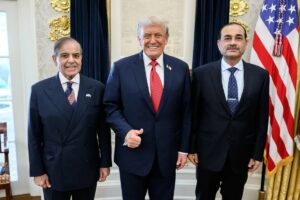
Looking beyond mere symbolism, the results have been quite real. Defence exports are on the rise, institutional credibility has been bolstered since the 2025 conflict, and strategic ties with Washington and key Middle Eastern capitals have grown stronger. In a world where global alliances are in flux and uncertainty reigns in geopolitics, Pakistan has stepped up, not just as a bystander but as a nation ready to influence discussions that impact regional stability.
CDF Munir’s engagements in Munich were very productive. By addressing broader geopolitical challenges, he projected Pakistan as a potential bridge between East and West — advocating connectivity, trade corridors and cooperative security frameworks. That approach reflects a transition in strategic thinking: moving from geostrategic dependency toward becoming a hub for commerce and stability across Asia.
The synergy between civilian leadership and military command has given Pakistan’s diplomacy a coherence that was often elusive in the past. Political leadership has defined priorities — economic revival, diversified partnerships and multilateral engagement — while military professionalism has reinforced credibility in security discussions. Together, they have broadened Pakistan’s diplomatic bandwidth.
Global stature isn’t something that’s just claimed or handed out easily. It develops when a nation shows it can be reliable, has a clear strategy, and can contribute positively. Pakistan’s growing diplomatic reach indicates a shift in its story — moving away from a narrative often marked by crises to one that’s increasingly focused on engagement and proactive initiatives.
In a time of shifting alliances and redefined partnerships, staying relevant is all about adaptability. With strong leadership and a thoughtful approach to international relations, Pakistan seems committed to making sure its voice is not just heard but also considered in the decisions that influence the region and beyond.
