

By Junaid Qaiser
In a region where tensions can escalate with alarming speed, the most responsible message a leader can deliver is often the simplest: war must remain the last resort. That was the central theme of President Asif Ali Zardari’s address to the joint sitting of parliament, a speech that sought to combine firmness with restraint at a moment when South Asia and the wider region are experiencing renewed uncertainty.
The president’s message to India was blunt but measured. Pakistan, he said, stands ready to defend itself but continues to prefer dialogue over confrontation. In urging New Delhi to move away from the logic of battlefield escalation and toward meaningful negotiations, he underscored a reality that both countries cannot ignore: the stakes of conflict between two nuclear-armed neighbours are simply too high.
At the same time, the address made clear that restraint should not be mistaken for weakness. Referring to recent tensions with India and cross-border threats emanating from Afghanistan, President Zardari argued that Pakistan had already demonstrated its capacity to respond decisively when its sovereignty was challenged. According to him, Pakistan’s armed forces acted with professionalism and discipline, turning aggression into what he described as a strategic and diplomatic success.
This dual message—peaceful intent backed by credible deterrence—has long shaped Pakistan’s security outlook. The operations described as Maarka-e-Haq and Ghazab Lil Haq were presented as examples of how the country responded after exhausting diplomatic avenues. For Islamabad, the point was not simply military victory but the reaffirmation of national unity. In moments of crisis, the president noted, the political leadership, armed forces, and public stood together with a shared sense of purpose.
The address also placed Pakistan’s security concerns within the wider instability unfolding across the region. The president condemned the conflict involving Iran and expressed support for the sovereignty and territorial integrity of the country, while also urging restraint after attacks that have shaken several Gulf states. For Pakistan, whose diplomatic and economic ties stretch across the Middle East, a widening regional war would bring serious consequences.
Another major theme of the speech was the unresolved dispute over Jammu and Kashmir. Pakistan has long maintained that lasting peace in South Asia will remain elusive until the aspirations of the Kashmiri people are addressed. The president reiterated Islamabad’s diplomatic and moral support for their cause, arguing that no genuine stability can emerge in the region while the conflict continues to fester.
Equally troubling, from Pakistan’s perspective, are India’s actions regarding the Indus Waters Treaty. The president warned that any attempt to manipulate river flows or suspend the agreement would amount to the weaponisation of water. For a country whose agriculture and food security depend heavily on these rivers, the issue carries enormous national importance. Islamabad, he made clear, would defend its water rights through legal and diplomatic channels.
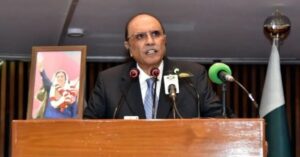
While much of the speech addressed security and foreign policy, President Zardari also turned to the domestic front, acknowledging that economic recovery must remain the government’s central priority. Pakistan may have stepped back from the brink of economic collapse, but for many citizens—particularly salaried workers, pensioners, and small traders—the hardship has been prolonged. The next phase of reform, he suggested, must focus on inclusive growth, job creation, and relief for those most affected by inflation and economic slowdown.
The president also emphasised the importance of strengthening the federation through the constitutional framework established by the Eighteenth Amendment of Pakistan. Provincial autonomy, he argued, has deepened participatory governance and ensured that federating units remain partners in national development rather than passive recipients of federal authority.
Taken together, the address reflected the complex environment Pakistan now faces. The country must navigate a fragile regional landscape marked by conflict, rivalry, and shifting alliances while simultaneously focusing on economic stability at home. In such circumstances, the balance between deterrence and diplomacy becomes critical.
President Zardari’s remarks ultimately conveyed a straightforward message. Pakistan seeks peace, but not at the expense of its sovereignty or security. War may remain a possibility in a volatile neighbourhood, yet it is neither a preferred option nor a strategic objective. By emphasising restraint while reaffirming national strength, Islamabad appears to be signalling that stability in South Asia will depend less on displays of power and more on the willingness of states to return to dialogue.
In a region accustomed to crises, that reminder may be more necessary than ever.
