
TAZEEN AKHTAR
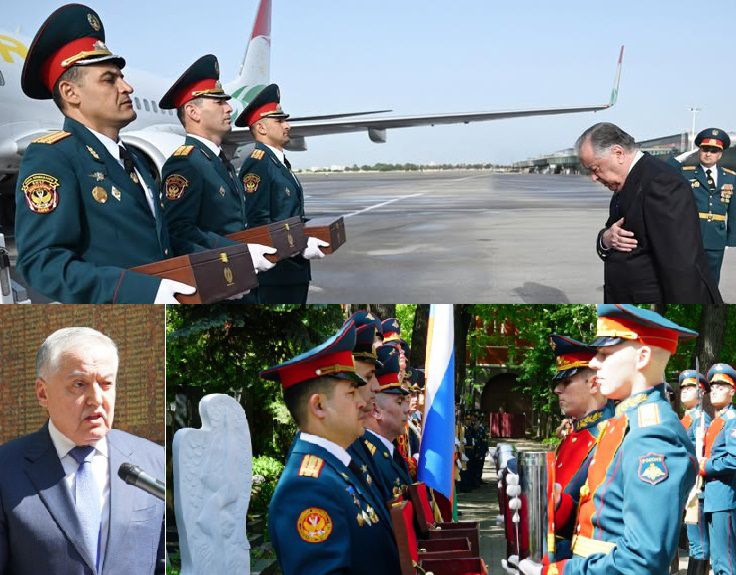
ISLAMABAD :Russia has handed over the soil from the burial site of Heroes of Tajikistan that was recieved by the leader of the nation , President Emomali Rahmon at Dushanbe airport. The heroes include Nusratullo Maksum, Shirinscho Shokhtemur, and Nisar Muhammad Yousafzai of Swabi KP Pakistan who played significant role in creation of the Republic of Tajikistan in USSR.
On 18 May 2026, a solemn ceremony took place at the Donskoye Cemetery in the city of Moscow for the acceptance of capsules with soil from the burial site of the heroes of Tajikistan Nusratullo Makhsum and Shirinsjo Shokhtemur, as well as the outstanding son of the Tajik people Nisar Muhammad Yousafzai.
The delegation of the Republic of Tajikistan was headed by the Minister of Foreign Affairs Sirojiddin Muhriddin.
This initiative, implemented at the direct instruction of the Leader of the Nation, President of the Republic of Tajikistan, esteemed Emomali Rahmon, is regarded as a significant event in the implementation of state policy for restoring historical justice and preserving national memory.
This step also symbolizes the spiritual reunification with the Motherland of historical figures who devoted their lives to serving the people.
Foreign Minister Sirojiddin Muhriddin, noted that Nusratullo Makhsum and Shirinsho Shohtemur, in the 1920s–1930s, demonstrating outstanding political will, defended the right of the Tajik people to self-determination and development.
Capsules with soil from the burial site of the heroes of Tajikistan were delivered to the city of Dushanbe on May 19, 2026, and became part of the national memorial complex, symbolizing the continuity of generations and the inseparable connection of the country’s historical past with its present and future.
Nisar Muhammad Yousafzai (1897 – 8 October 1937) was a Pakistani Afghan communist revolutionary, educationist, soldier and Soviet politician who played a significant role in the creation of Tajikistan.
A decorated soldier of the Third Anglo-Afghan War, Nisar would take part in a Soviet expedition in Gilan and later be one of the main proponents advocating for the creation of a Tajik Soviet Socialist Republic within the Soviet Union. He was Tajikistan’s first minister of education from 1926 until his murder in 1937. He was also the first ever Afghan communist.
Nisar Muhammad Yousafzai was born to a Esapzai Pashtun family in the village of Zaida, Swabi District of the North-West Frontier Province in 1897. He was the son of Awal Khan and his grandfather was Mohammad Ali.
In Tashkent, Nisar Muhammad became an active member of the Communist Party of the Soviet Union. He became an advocate for a separate Tajik state outside of the Turkestan SSR. He along with others, published newspapers and campaigned for Tajik autonomy.
In 1924, the Tajik Autonomous Soviet Socialist Republic was formed as part of the Uzbek Soviet Socialist Republic and would later become the Tajik Soviet Socialist Republic.
In 1926, Nisar Muhammad was appointed as the People’s Commissar of Education of Tajikistan. He also served as a Pashto language instructor at Moscow University, Nisar was fluent in multiple languages including his native Pashto, Persian, Russian, and Uzbek.
On 8 October 1937, Nisar Muhammad was arrested on false charges by the NKVD (People’s Commissionerate for Internal Affairs) during the Great Purge. During his interrogation, a guard struck him, triggering an altercation in which the interrogator sustained severe head injuries. The guards stormed the room and shot Nisar Muhammad.
