
TP Report
ISLAMABAD : Russian Ambassador to Pakistan, Albert P. Khorev, has said that Russian diplomacy is rooted in centuries of statecraft, dialogue, and strategic balance, and that these traditions continue to guide Russia’s contemporary foreign policy, including its steadily expanding relations with Pakistan.
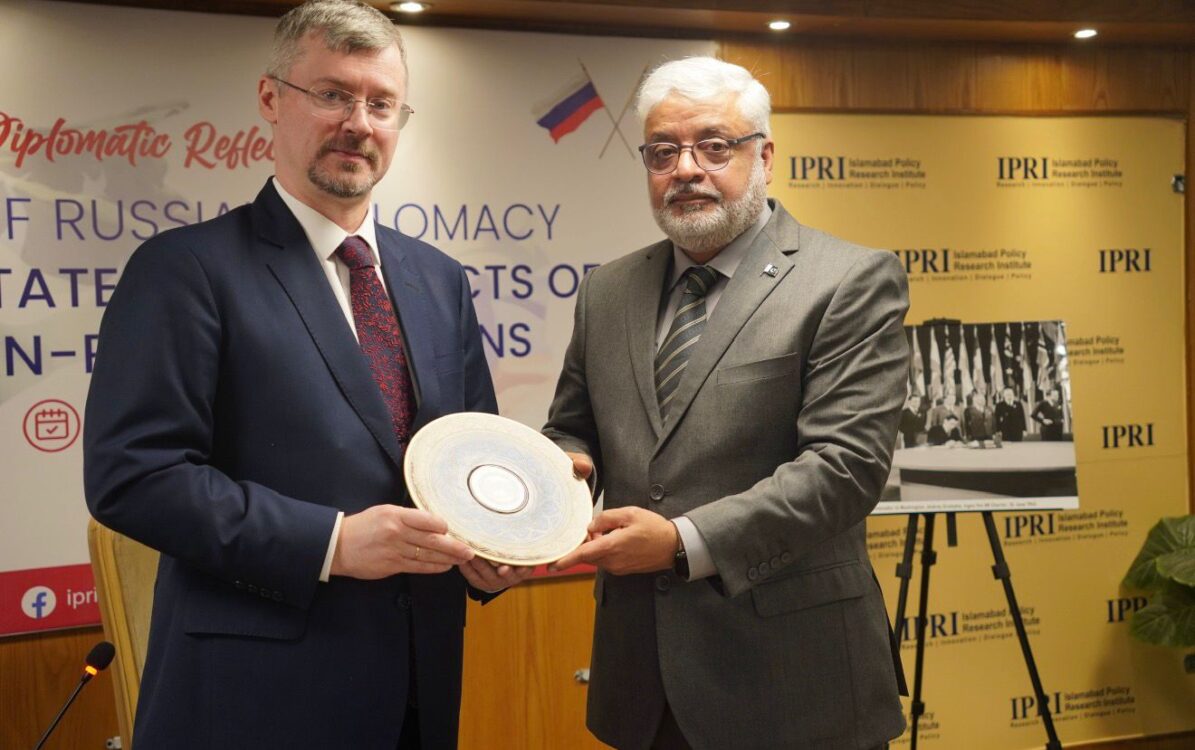
He was speaking at a seminar titled “Legacy of Russian Diplomacy: Current State and Prospects of Russia–Pakistan Relations” held at the Institute of Policy Research Institute (IPRI). The event was presided over by President IPRI Lt General (R) Majid Ehsan and attended by diplomats, scholars, policy experts, and students.
The Ambassador noted that the seminar was being held on the eve of Russia’s Diplomats’ Day, celebrated annually on February 10. He explained that the date commemorates the establishment of Russia’s Ambassadorial Service in 1549, the country’s first independent foreign affairs institution, while emphasizing that Russian diplomacy had evolved over several centuries even before its formal institutionalization.
Tracing the historical foundations of Russian diplomacy, Ambassador Khorev recalled that as early as the 9th century, Ancient Rus actively participated in European international relations. He highlighted the first known Russian embassy to Constantinople in 838 and the 860 Treaty of Peace and Love with the Byzantine Empire as milestones that marked Rus’s recognition as an independent state. By the 11th century, he said, a structured diplomatic hierarchy had emerged, supported by educated envoys and multilingual negotiators, including clergy following the adoption of Christianity.
Referring to the Mongol period, the Ambassador underscored the diplomatic wisdom of figures such as Alexander Nevsky, who adopted a policy of compromise to preserve statehood, protect the Orthodox Church, and safeguard education and literacy. He noted that this pragmatic diplomacy helped lay the foundations for Russia’s eventual reunification and resurgence.
Ambassador Khorev went on to highlight the institutional strengthening of Russian diplomacy during the 15th and 16th centuries, particularly the establishment of the Ambassadorial Service under Tsar Ivan IV. He paid tribute to Ivan Viskovaty, the first head of the service, whose diplomatic skill helped position Moscow as a significant international actor.
Reviewing the contributions of prominent Russian diplomats, the Ambassador referred to Vasily Golitsyn’s role in concluding landmark treaties with China and the Polish-Lithuanian Commonwealth, Andrei Osterman’s contribution to Russia’s rise as a Baltic power following the Treaty of Nystad, and Karl Nesselrode’s four-decade leadership during which Russia concluded major agreements with Persia, the Ottoman Empire, and European powers.
He also highlighted the strategic vision of Alexander Gorchakov, who steered Russian diplomacy during a period of international isolation in the 19th century, supported the independence of Balkan states, and restored Russia’s sovereign rights in the Black Sea. The Ambassador recalled Gorchakov’s famous maxim: “Russia is not angry. Russia is concentrating.”
Moving to the 20th century, Ambassador Khorev spoke about Georgy Chicherin’s role in establishing Soviet diplomacy amid international isolation, Vyacheslav Molotov’s leadership during the Second World War and the formation of the anti-Hitler coalition, and Andrei Gromyko’s pivotal contributions to arms control, crisis management, and the creation of the United Nations.
He noted with particular emphasis that diplomatic relations between Russia and Pakistan were established on May 1, 1948, following an agreement between Andrei Gromyko and Pakistan’s Foreign Minister Zafrullah Khan. He recalled the Soviet Union’s role in facilitating the 1965–66 Tashkent Declaration between Pakistan and India, describing it as a landmark achievement of Soviet diplomacy that helped avert further conflict in South Asia.
The Ambassador also referred to Yevgeny Primakov’s legacy in shaping a multi-vector Russian foreign policy based on national interests, highlighting his efforts to strengthen ties with CIS countries and his principled stand during the 1999 NATO bombing of Yugoslavia, symbolized by the historic “Primakov loop” over the Atlantic.
Outlining Russia’s current foreign policy priorities, Ambassador Khorev said Russia is committed to upholding the UN Charter, promoting a truly multipolar world order, combating neo-colonialism and neo-Nazism, preserving the historical truth of World War II, and opposing all forms of extremism and discrimination.
Turning to contemporary Russia–Pakistan relations, he said that despite challenges during the Cold War, bilateral ties had developed in key areas, particularly energy and industry. He recalled Soviet assistance in establishing Pakistan’s oil and gas sector, the Karachi Steel Mills, and major thermal power plants across the country.
He said that relations gained renewed momentum in the 2000s as Russia pursued deeper engagement with the Global South. Today, he added, political dialogue between Moscow and Islamabad is dynamic and constructive, supported by regular high-level contacts. He noted that leaders of the two countries met twice last year, while parliamentary exchanges and foreign minister-level engagements have further strengthened mutual understanding.
Ambassador Khorev said Russia and Pakistan closely coordinate at multilateral forums such as the United Nations and the Shanghai Cooperation Organisation, sharing common positions on global security, counterterrorism, fair trade, and respect for cultural and civilizational diversity.
He outlined promising avenues for economic cooperation, including plans to restore Karachi Steel Mills, develop transport links via the North–South International Transport Corridor, launch joint pharmaceutical production, expand hydropower projects, and explore oil and gas resources. He added that both sides are working on alternative payment mechanisms, including barter arrangements, to ensure uninterrupted trade amid sanctions.
Highlighting humanitarian and cultural cooperation, the Ambassador said Russia has significantly increased scholarships for Pakistani students, expanded Russian language programs, and strengthened people-to-people contacts through the Russian House in Karachi. He also mentioned recent cultural initiatives, including a concert by a Russian folk ensemble and the installation of a monument to Yuri Gagarin in Islamabad.
Concluding his address, Ambassador Khorev reaffirmed the Russian Embassy’s commitment to further deepening bilateral ties and engaging with Pakistan’s academic and policy communities. “We will continue working to realize the full potential of Russia–Pakistan relations,” he said, thanking the audience and inviting questions.
