
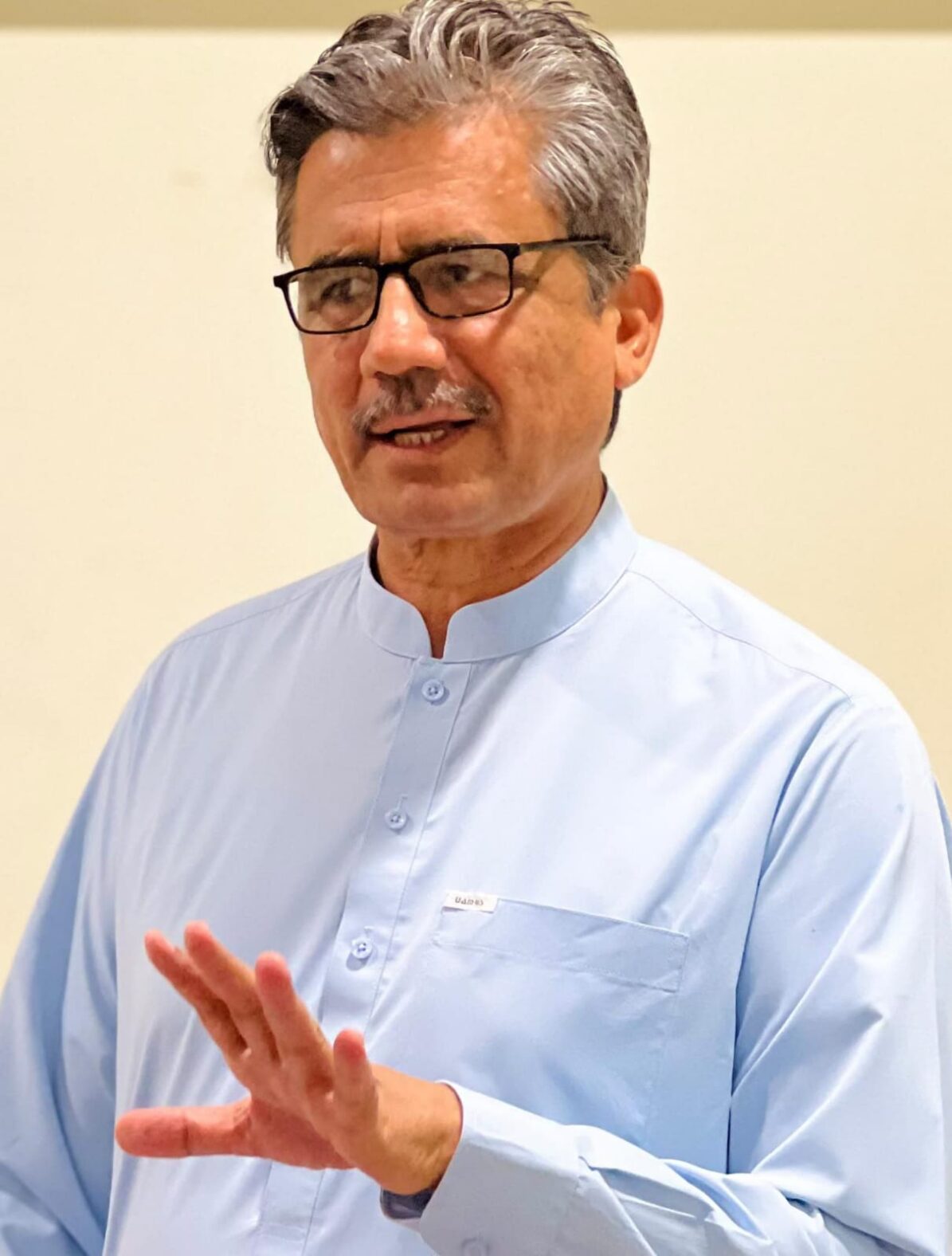
Dr. Itbar Khan
Teachers are the builders of nations. They consume themselves but illuminate the paths of others. They may not be kings, but they prepare the leaders of tomorrow. They may not sit on thrones, but they shape the minds of those who will one day make decisions for society and the nation. They may not possess great wealth, but they create a nation’s greatest wealth—its people. And when many other hopes appear to be fading, the hope of a nation continues to reside in its teachers.
To pay homage to teachers, each year World Teachers’ Day is celebrated on the 5th of October. This year the theme of the day is “Standing with teachers: 60 years of protecting the profession, advancing its status and shaping our futures.” The theme marks six decades since the adoption of the 1966 ILO/UNESCO recommendation concerning the Status of Teachers and draws attention to the need to protect, strengthen, and value the teaching profession.
The importance of teaching and knowledge has deep roots in Islamic thought. The first revealed verses of the Qur’an begin with the command: “Read in the name of your Lord who created.”
(Qur’an 96:1). “Are those who know equal to those who do not know?” (39:9), and it states that Allah raises in rank those who believe and those who have been given knowledge (58:11). These verses establish the profound dignity attached to reading, learning, knowledge, and teaching. The Prophet Muhammad (peace be upon him) also glorified the teaching profession, as He (PBUH) was sent to the world as a teacher. Teaching, therefore, is not merely a profession, but it is a responsibility connected with the development of human beings and the world.
Teachers are the hope of a nation when every hope fades away. History provides powerful examples of the role education plays in national recovery. One such example is Prussia following its defeat by Napoleon in 1806. The defeat produced a profound political and social crisis, and subsequent reforms included major efforts to strengthen education, administration, and human development. Similarly, Japan rose from ashes and became a powerful country through their intense focus on education. When Russia sent Sputnik 1, first artificial satellite, into space on October4, 1957, the USA does not focus on bridges and industry, but it brought radical changes in its education system. It is obvious that nation building requires more than physical institutions, it requires human capacity. And teachers are the souls who develop human souls. As Allama Muhammad Iqbal in a verse says that teachers are architects of human souls.
A nation may have roads, buildings, industries and institutions, but their quality ultimately depends upon the people who design, manage and sustain them. Behind every doctor, engineer, scientist, civil servant, entrepreneur and scholar stands a chain of teachers who contributed to that person’s development. Teacher, therefore, is not simply one employee within the education system. The teacher is part of the foundation upon which the wider society is built. Nelson Mandela famously expressed the transformative power of education when he said, “Education is the most powerful weapon which you can use to change the world.”
The role of teachers extends beyond the classroom. Teachers often become mentors, counsellors, guides, role models and sources of emotional and moral support. In many communities, particularly where educational and social resources are limited, teachers perform responsibilities that extend well beyond formal instruction. Parents entrust teachers with one of their most valuable possessions—their children. They expect schools to contribute not only to academic achievement but also to character, discipline, responsibility and social development. A teacher may spend only a few hours a day with a student, yet an encouraging word, a piece of advice or a simple expression of confidence can influence that student’s life for many years. This is one reason the contribution of teachers cannot be measured only by examination results. The real impact of a teacher may become visible decades later—in the character of a former student, in a professional contribution, in responsible citizenship or in the way that former student treats others.
If education possesses such transformative power, then those who make meaningful education possible deserve serious recognition and support. This brings us to a fundamental question: What is society doing for teachers?
We frequently ask teachers what they should do for students. We ask them to improve learning outcomes, use technology, adopt innovative teaching methods, assess students effectively, maintain discipline, provide counselling, participate in administrative activities and respond to changing educational demands. But we must also ask what teachers need to perform these responsibilities effectively. Teachers require professional development, appropriate resources, reasonable workloads, supportive leadership, professional autonomy, fair compensation and dignified working conditions. Without these conditions, calls for educational improvement can become unrealistic expectations placed upon individuals who are already under considerable pressure.
Teachers need a comfortable and conducive environment where they may focus on learning. These days the teacher sand principals are overburdened in the name of accountability. Accountability is necessary in every profession, including teaching. Quality assurance, evaluation and supervision have important roles in maintaining standards. However, supervision should serve the purpose of improving teaching and learning rather than creating unnecessary administrative burdens. In some educational settings, teachers face increasing demands for documentation, reporting, meetings, inspections and multiple forms of monitoring. These activities may have legitimate purposes, but when they become excessive, they can take time away from the core responsibilities of teaching, lesson preparation, assessment, research, mentoring and interaction with students. Therefore, those who are involved in the administration have the responsibility to avoid overburdening teachers with multiple duties. Let teachers focus on their well being and learning of students. Our educational leaders and policymakers to distinguish between supportive supervision and surveillance. Teachers need accountability, but they also need professional trust. They need evaluation, but they also need constructive feedback. They need standards, but they also need opportunities and resources to meet those standards. The purpose of supervision should ultimately be better teaching—not simply more paperwork.
A profession responsible for preparing future generations cannot remain attractive if its practitioners feel economically insecure and socially undervalued. Teacher salaries, workload and working conditions are internationally recognized as important factors influencing recruitment, retention and the sustainability of the profession. When highly qualified teachers struggle with inadequate compensation while carrying substantial academic and administrative responsibilities, the profession may become less attractive to talented young people.
If capable graduates increasingly avoid teaching as a career, educational institutions may find it more difficult to recruit and retain talented professionals. The resulting shortage affects the quality and continuity of education. Fair compensation is therefore not simply a matter of rewarding teachers. It is also an investment in the future supply and quality of the teaching profession.
Most of the time, teachers are increasingly treated as people who must simply implement instructions rather than as educated professionals whose expertise and judgment should contribute to educational decision-making. Reforms are introduced without consulting teachers. They are mostly implemented on the directions of people who have vested interests. They are least interested in the success, and more interested in the completion of their project. In Pakistan, educational reforms are NGO driven, where teachers are least bothered. The decision makers need to treat teachers as professionals. This would lead to the success of projects and educational advancement.
Teachers are also sometimes blamed for problems that originate far beyond the classroom—problems involving curriculum, resources, family circumstances, poverty, social inequality, technology misuse and broader institutional weaknesses. Teachers certainly have responsibilities, and professional accountability must remain important. But accountability should be balanced with recognition of the conditions in which teachers work. We cannot expect teachers to solve every social problem while providing them with insufficient time, resources and professional support. We cannot ask teachers to carry the future of society on their shoulders and then fail to support those shoulders.
Standing with teachers is not merely an act of appreciation or sympathy. It is an investment in society. Supporting teachers means supporting children. Supporting teachers means supporting families. Supporting teachers means strengthening education. And strengthening education means strengthening human development and responsible citizenship.
The teachers may be respected Beyond Teachers’ Day. Teachers’ Day should not be limited to ceremonies, speeches, flowers and social-media messages. Celebration is valuable, but genuine appreciation must be reflected in educational policy and institutional practice. If we truly value teachers, we should create conditions in which they can teach effectively. Society, policy makers, and administrators need to protect their professional dignity, reduce unnecessary administrative pressures, provide opportunities for continuous professional learning, listen to their experiences and voices in all decisions. They need a fair and dignified working environment. Moreover, educating children is a complex phenomenon, each one has to play his part in educating the nation. Teachers may not be blamed for every failed student. Everyone has equal share of responsibility. An African saying goes that it takes a whole village to raise a child.
The writer is an Associate Professor
at the Department of Education, University of Malakand
He can be reached at: itbarkhan@uom.edu.pk
