

By Junaid Qaiser
For centuries, great civilizations were connected by the Silk Road. Caravans carried silk, spices, precious metals, ideas, and cultures across vast distances, linking East and West through networks of trade and human interaction. Today, a new Silk Road is emerging across Asia. It is not built of stone roads, ports, or caravans. It is built of fiber-optic cables, data centers, artificial intelligence, digital payments, and interconnected technology platforms.
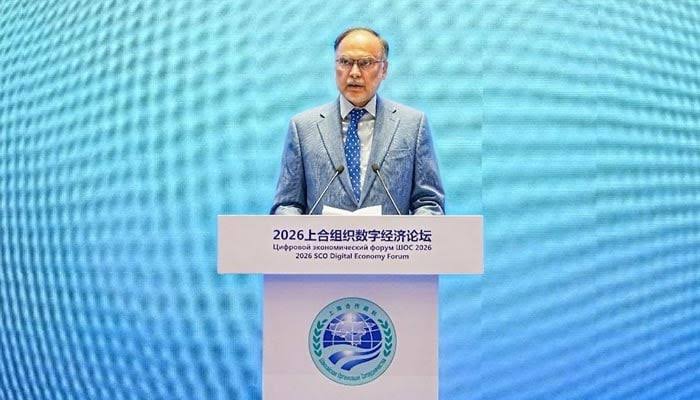
The countries that understand this transformation and invest accordingly will shape the economic future of the region. Those that fail to adapt risk being left behind in a world increasingly defined by digital competitiveness. It is against this backdrop that Federal Minister for Planning, Development and Special Initiatives Ahsan Iqbal’s address at the 2026 Shanghai Cooperation Organization (SCO) Digital Economy Forum in Urumqi deserves serious attention.
His remarks reflected a broader strategic vision for Pakistan’s place in an increasingly digital Asia. At a time when global trade patterns are changing, artificial intelligence is transforming industries, and economic influence is increasingly linked to technological capability, Pakistan is seeking to position itself as an active participant rather than a passive observer.
Ahsan Iqbal’s call for interconnected tech corridors among SCO member states is particularly significant. For decades, regional connectivity has been discussed primarily in terms of roads, railways, ports, and energy pipelines. These remain important, but the next phase of regional integration will be driven as much by digital infrastructure as by physical infrastructure.
In the twenty-first century, economic corridors must carry more than goods. They must facilitate the movement of data, knowledge, financial services, innovation, and digital commerce. Trusted digital networks can connect businesses across borders, enable seamless transactions, support research collaboration, and create opportunities for millions of young entrepreneurs. In many respects, the digital economy is becoming the new geography of power.
Pakistan appears increasingly aware of this reality. The country’s digital landscape has expanded dramatically over the past few years. More than 150 million users are now part of the digital ecosystem, while data consumption continues to rise at an impressive pace. The government’s ongoing broadband expansion programme, which aims to increase fiber-optic connections from three million to over five million and eventually provide high-speed broadband access to ten million households, reflects an understanding that connectivity is no longer a luxury. It is a prerequisite for economic growth.
Equally encouraging is the performance of Pakistan’s technology sector. With IT and ICT exports reaching a record $4.6 billion during the last fiscal year, the sector is demonstrating its capacity to generate foreign exchange, create employment opportunities, and enhance Pakistan’s international competitiveness. Yet the most important aspect of the government’s digital vision may be its recognition that outsourcing alone cannot define Pakistan’s technological future.
For too long, developing countries have been content to provide services while others create products, own platforms, and control intellectual property. Sustainable prosperity requires moving up the value chain. Ahsan Iqbal’s emphasis on developing proprietary technologies, digital platforms, and tech-driven manufacturing reflects a more ambitious and forward-looking strategy.
His proposal for an SCO Digital Governance and AI Capacity-Building Network is equally noteworthy. Across much of the developing world, the challenge is not merely access to technology but the ability to govern and utilize it effectively. Digital transformation requires capable institutions, trained professionals, modern regulatory frameworks, and a culture of innovation.
The five initiatives proposed by Pakistan—including a Digital Governance Academy, a Digital Public Infrastructure Exchange, a Digital Government and AI Fellowship programme, a Responsible AI and Data Governance Forum, and a Digital Inclusion and Innovation Facility—offer practical mechanisms for cooperation among SCO member states. More importantly, they move the conversation beyond rhetoric and toward measurable outcomes.
Another important aspect of Pakistan’s digital transformation is its focus on human capital. Technology by itself solves very little. The real driver of innovation is people. The government’s target of developing one million AI-skilled non-IT professionals by 2030, alongside the establishment of seven AI hubs under the National AI Advancement Initiative, reflects a recognition that the future economy will require digital skills across every sector.
Whether in agriculture, healthcare, education, manufacturing, logistics, or public administration, artificial intelligence will increasingly influence productivity and competitiveness. Countries that invest in human capabilities today will be better positioned to benefit from these technological shifts tomorrow.
Equally significant is the progress being made in narrowing the digital gender divide. Female mobile internet usage has increased substantially, while the overall digital gap between men and women has narrowed considerably. This is not simply a matter of social inclusion. It is an economic imperative. No nation can fully realize its potential while excluding a significant portion of its population from participation in the digital economy.
There is also a broader geopolitical dimension to Pakistan’s digital ambitions. Geography has always been one of Pakistan’s greatest assets. Located at the crossroads of South Asia, Central Asia, China, and the Middle East, Pakistan has long aspired to become a hub of regional connectivity. Traditionally, this aspiration has been associated with trade routes and transport infrastructure. Today, however, digital connectivity offers an equally compelling opportunity.
