

By Junaid Qaiser
For generations, the United States has been associated with opportunity, innovation, and entrepreneurship. From Silicon Valley startups to global technology giants, America has cultivated an environment where ideas can grow into industries and entrepreneurs can transform economies. Now, a new initiative in Islamabad suggests that this spirit of innovation is becoming an increasingly important part of the relationship between the United States and Pakistan.
The launch of the Innovation Hive by the U.S. Educational Foundation in Pakistan (USEFP) is a recognition of Pakistan’s growing entrepreneurial potential and a signal that economic cooperation between Islamabad and Washington is entering a new phase—one centered on innovation, startups, technology, and shared prosperity.
Speaking at the inauguration ceremony, US Chargé d’Affaires Natalie Baker offered a simple but powerful observation: talent exists everywhere in Pakistan, but it often needs access to opportunity. Few statements capture Pakistan’s economic reality more accurately.
Across the country, young Pakistanis are launching startups, developing software, building digital platforms, and creating solutions to local and global challenges. They possess ambition, creativity, and increasingly sophisticated technical skills. Yet many struggle to access mentorship, international networks, investment opportunities, and practical business guidance that can help transform promising ideas into successful enterprises.
The Innovation Hive seeks to bridge that gap.
According to Baker, the initiative will connect more than 250 American mentors with Pakistani entrepreneurs during its first year. It will also provide access to expertise, technology, business networks, and educational resources designed to help founders navigate the challenges of building sustainable companies.
This matters because Pakistan is standing at an important economic crossroads.
The country has one of the world’s youngest populations. Every year, thousands of graduates enter the job market seeking opportunities that traditional sectors alone cannot provide. Entrepreneurship and innovation offer an alternative path—one capable of creating jobs, generating exports, attracting investment, and strengthening economic resilience.
The country’s startup ecosystem has made remarkable progress over the past decade. Technology companies are expanding internationally, software exports continue to grow, and Pakistani entrepreneurs are increasingly attracting attention from global investors. The success stories emerging from Pakistan’s technology sector demonstrate that local talent can compete effectively on the international stage when given the right support.
Federal Minister for IT and Telecommunication Shaza Fatima highlighted this progress during the launch event. The combined enterprise value of Pakistan’s venture capital-funded startups now exceeds $4 billion. Startups raised more than $74 million in funding during 2025, while women-led ventures experienced notable growth in investment. These are encouraging indicators for a country seeking to build a knowledge-based economy.
The government has also taken steps to support innovation through initiatives such as the National Incubation Centres, which have helped thousands of startups and contributed to significant job creation. Meanwhile, the Pakistan Startup Fund and incentives offered through the Special Technology Zones Authority are designed to encourage investment in emerging sectors.
The Innovation Hive’s emphasis on mentorship is therefore one of its strongest features. Successful entrepreneurs often point to guidance and professional networks as key factors in their growth. Having direct access to experienced mentors can help young founders avoid common mistakes, identify new opportunities, and accelerate their development.
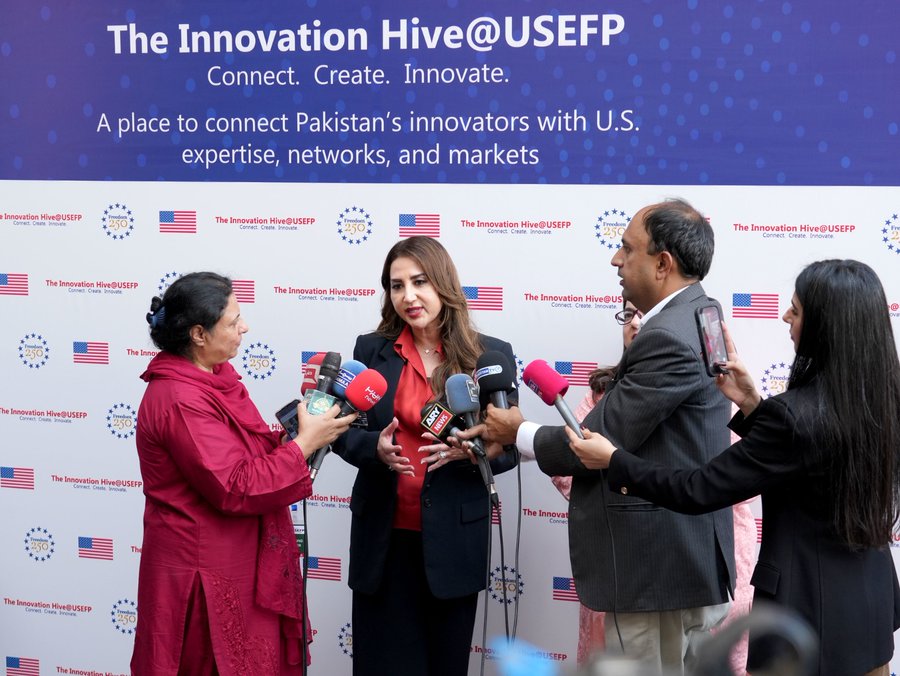
Equally important is the initiative’s focus on building connections. Through monthly “Links and Leads” sessions, entrepreneurs will have opportunities to engage with mentors, peers, and industry professionals. Regular demo days will allow startups to present their ideas and products to wider audiences, while online certificate programs will strengthen practical business skills.
Natalie Baker described the initiative as opening a new door for Pakistani entrepreneurs. It is an apt description. For decades, USEFP has helped students pursue educational opportunities in the United States. Today, it is extending that mission into the entrepreneurial arena, helping innovators build companies, create jobs, and contribute to economic growth.
If the Innovation Hive succeeds in helping young founders access new markets, attract investment, develop stronger businesses, and create employment opportunities, its impact will be felt far beyond Islamabad. It will contribute to a more dynamic economy and a stronger partnership between Pakistan and the United States.
In a world increasingly defined by technology, ideas, and innovation, opening doors for entrepreneurs may prove to be one of the most valuable investments any country can make. The United States has opened such a door for Pakistan’s innovators. What comes next will depend on how boldly they choose to walk through it.
