
TP REPORT
MARDAN: The three-day academic activity of the Quantum Optics Intensive School under the Physics without Frontiers (PWF) initiative was successfully conducted from March 30 to April 1, 2026, by Department of Physics, Women University Mardan. The program brought together students, researchers, and international experts to promote advanced learning in optics and photonics among women in the region.
The event was inaugurated by the Chief Guest, Prof. Dr. Razia Sultana, who appreciated the organizers for arranging such a valuable academic activity. In her remarks, she emphasized the importance of providing women with access to modern scientific education and highlighted the role of such initiatives in strengthening both confidence and technical skills.
Day 1 – Foundations of Quantum Optics (March 30)
The opening day featured foundational lectures delivered by Prof. Dr. Imrana Ashraf, focusing on key concepts of quantum mechanics, including wave mechanics, Dirac notation, and two-level quantum systems. The day also included a special talk by Prof. Joseph Niemela from the International Centre for Theoretical Physics, who shared insights on “Ruminations on Science and Being a Scientist.” The session concluded with lectures on quantum pictures, covering Schrödinger, Heisenberg, and interaction frameworks.
Day 2 – Quantum Statistical Description (March 31)
The second day focused on the statistical and semi-classical aspects of quantum optics. Topics included density matrix formalism, decoherence, and atom-field interaction through the semi-classical approach, including the Rabi model and optical Bloch equations. Participants also engaged in their first hands-on optics session, guided by facilitators from the Department of Physics, Quaid-i-Azam University, allowing them to explore experimental concepts in a practical setting.
Day 3 – Fully Quantum Interaction (April 1)
The third day advanced into fully quantum mechanical treatments of light-matter interaction. Prof. Dr. Imrana Ashraf covered quantum states of radiation fields, including Fock and coherent states. A highlight of the day was a special lecture by Prof. John Dudley from UNESCO who presented “Light, Lasers and the Nobel Prize,” inspiring students with real-world applications and historical developments in photonics. The day concluded with hands-on activities conducted by facilitators, enhancing participants’ experimental understanding.
Closing Ceremony
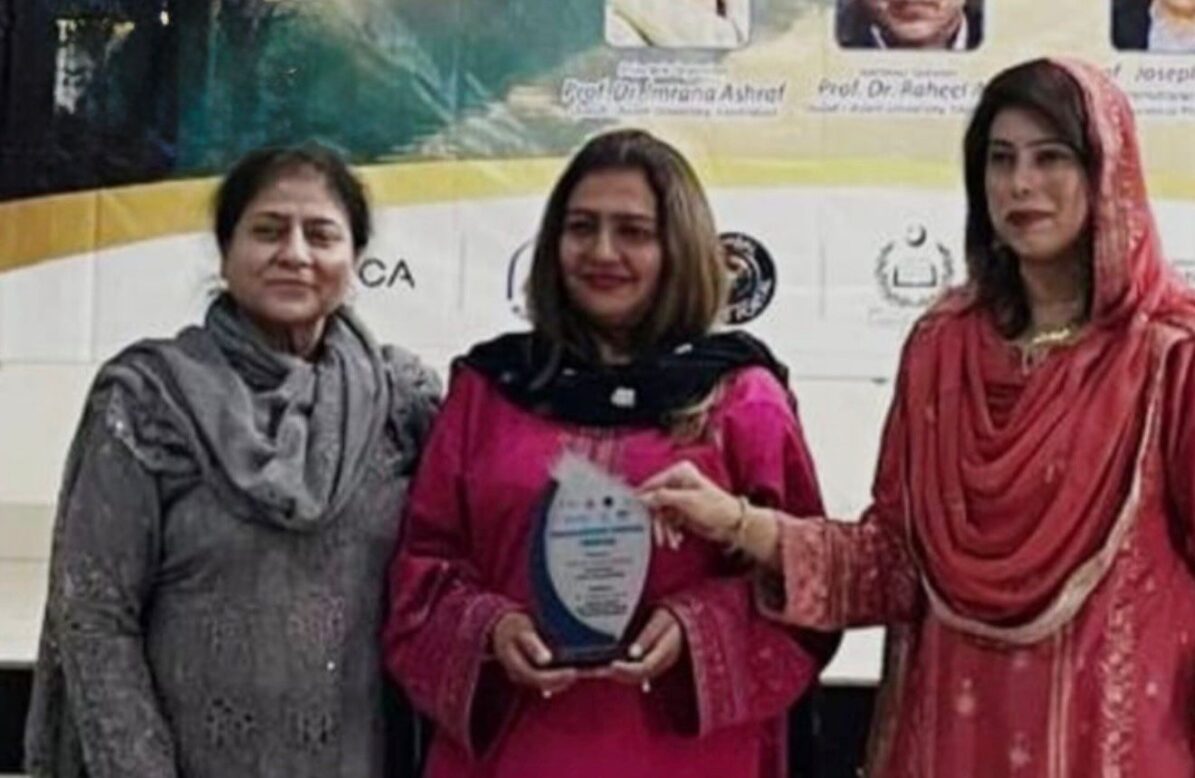
The program concluded with a closing ceremony in which shields were presented to distinguished speakers and organizers in recognition of their contributions. Certificates were also distributed among participants for their successful completion of the intensive training.
In her concluding remarks, the Patron-in-Chief, Prof. Dr. Razia Sultana, commended the organizers, speakers, and participants for making the event a remarkable success. She highlighted that such initiatives are instrumental in empowering women through quality scientific education and fostering a culture of research and innovation in the region. She expressed her confidence that the knowledge and skills gained during the program would inspire participants to contribute actively to the field of optics and photonics. She further reaffirmed the university’s commitment to supporting academic activities that promote excellence, collaboration, and inclusivity in science education.
The ceremony marked the successful culmination of the three-day academic activity, celebrating both learning achievements and collaborative efforts. The program successfully combined theoretical lectures with interactive and hands-on learning, aligning with the Active Learning in Optics (ALO) approach. Participants expressed strong enthusiasm for the opportunity to learn from both national and international experts.
