

By Junaid Qaiser
At a moment when the Middle East stands on the edge of a wider conflagration, Pakistan’s message to Saudi Arabia has been unequivocal: in times of danger, there’s no room for uncertainty or delay—only support. Ahmad Farooq, Pakistan’s ambassador to the Kingdom, emphasized that Islamabad will “always” back Riyadh if its sovereignty is threatened. This isn’t just diplomatic talk; it’s a strategic principle that’s deeply rooted in history, shaped by necessity, and tested through various regional crises.
During his recent visit to Saudi Arabia, Prime Minister Shehbaz Sharif, along with Field Marshal Asim Munir, aimed to show solidarity and manage the crisis at the highest level. The backdrop of this visit is the escalating tensions after US-Israeli strikes on Iran and Tehran’s retaliatory measures across the Gulf, which have led to one of the most precarious security situations in recent history. In such a charged atmosphere, silence might be seen as weakness, and ambiguity could be interpreted as detachment. Pakistan opted for neither approach.
Instead, Islamabad signaled clarity: Saudi Arabia’s security is intrinsically linked to Pakistan’s own strategic calculus.
The Strategic Mutual Defense Agreement signed last year has now moved from a theoretical framework into a living instrument of deterrence. While defense cooperation between the two countries is not new, the formalization of this understanding marks a significant evolution. It sends a message not only to adversaries but also to allies—that this partnership is structured, predictable, and anchored in mutual commitment.
Nevertheless, what makes this moment particularly delicate is the dual-track approach Pakistan is attempting to maintain. On one hand, it is reaffirming its readiness to stand by Saudi Arabia in the face of external aggression. On the other, it continues to advocate restraint, dialogue, and adherence to international law in dealing with Iran. This is not contradiction—it is strategic balancing.
Pakistan understands that a full-scale regional war would be catastrophic, not only for the Gulf but for the broader Muslim world. The economic fallout alone—rising energy prices, disrupted trade routes, and instability in labor markets—would have immediate consequences for Pakistan’s already fragile economy. Millions of Pakistanis working in the Gulf are directly exposed to this volatility. Their security is inseparable from regional stability.
Saudi Arabia, for its part, has demonstrated a calibrated posture. Under Crown Prince Mohammed bin Salman, the Kingdom has combined a firm defense of its sovereignty with a cautious approach toward escalation. This balance between deterrence and diplomacy reflects a broader effort to position Saudi Arabia as both a regional anchor and a responsible global actor.
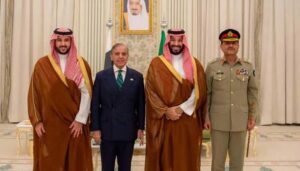
The recent consultations between Saudi and Pakistani leadership underscore a shared objective: prevent the current crisis from spiraling into an uncontrollable conflict. Military preparedness, in this context, is not about provocation—it is about prevention.
There’s a deeper aspect to the Saudi-Pakistani relationship that often gets overlooked in standard geopolitical discussions. Their ties go beyond mere transactions or security concerns. They’re built on decades of personal connections—millions of Pakistanis have lived and worked in Saudi Arabia, helping to shape its development while also supporting their families back home. This social element adds a layer of strength to their partnership, making it more resilient against the ups and downs of political shifts.
That said, the current crisis is putting even the strongest bonds to the test. Iranian missile and drone activities, threats to energy infrastructure, and the looming risk of maritime disruptions have created a level of uncertainty that requires ongoing collaboration. The Gulf region isn’t just a local issue; it’s a vital economic lifeline for the entire world. Any prolonged instability here sends shockwaves far beyond the Middle East.
Amid this tension, there are faint but notable signs of diplomatic movement. Reports of indirect communication between Washington and Tehran, however tentative, suggest that the door to de-escalation has not been completely shut. Whether these exchanges evolve into meaningful negotiations remains uncertain, but they highlight an essential truth: even in the most hostile environments, dialogue remains the only viable exit strategy.
Pakistan’s role, therefore, is not limited to that of a security partner. It is also positioning itself as a voice for restraint—urging all sides to respect sovereignty, adhere to international norms, and prioritize diplomacy over confrontation. This dual posture enhances its credibility, allowing it to engage across divides while maintaining its core commitments.
Ultimately, the importance of the Saudi-Pakistani partnership lies not just in its ability for collective defense, but in its potential to help maintain regional stability. During a crisis, alliances are tested not by statements, but by actions. The recent developments indicate that both Islamabad and Riyadh are ready to handle this uncertainty together—steadfast in defense, cautious in escalation, and aware of the wider consequences.
As the Middle East confronts one of its most dangerous chapters in recent history, the message from Islamabad is clear: solidarity with Saudi Arabia is not situational—it is structural. The challenge now is to ensure that this solidarity contributes not to further polarization, but to a collective effort to restore balance, prevent escalation, and preserve what remains of regional stability.
