
By Junaid Qaiser
In times of regional unrest, words can spread faster than diplomatic efforts. A single remark made in a studio, a hasty tweet, or a vlog uploaded for attention can resonate far beyond the borders of Pakistan. This reality highlights why the government’s recent plea for restraint in discussing the country’s foreign policy is worth serious consideration.
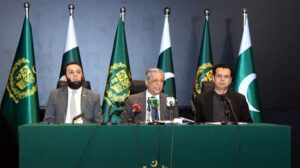
Federal Information Minister Attaullah Tarar, along with Law Minister Azam Nazeer Tarar and Minister of State for Interior Talal Chaudhry, recently called on citizens, journalists, officials and online commentators to be cautious when talking about Pakistan’s external relations—especially now, as the Middle East is experiencing one of its most turbulent confrontations in recent years.
The ministers’ message was significant: foreign policy cannot be treated like domestic politics. Inside the country, debate is loud, messy, and often deeply partisan. That is the essence of democracy. But when it comes to foreign affairs, especially during a conflict involving countries with which Pakistan maintains delicate relationships, speculation can have unintended consequences.
Pakistan, because of its geography and diplomatic relationships, finds itself in a particularly delicate position. It maintains longstanding ties with Iran, while also sharing deep strategic, economic, and religious relations with Saudi Arabia, the United Arab Emirates, and other Gulf states. Balancing these relationships has always required careful diplomacy. In moments of war, that balancing act becomes even more critical.
This is exactly why public discourse needs to be responsible. In our interconnected world, comments made on social media or television reach far beyond local audiences. What journalists, analysts, vloggers, and even regular folks say can be shared globally in just minutes. Often, foreign observers interpret these remarks as indicative of Pakistan’s official viewpoint.
That perception can create unnecessary diplomatic complications. A speculative analysis on a YouTube channel or an emotional tweet posted for engagement may be seen abroad as representing the position of the Pakistani state. This is the reality of the modern information ecosystem—where personal opinions can quickly be mistaken for national policy.
Responsible journalism, therefore, becomes essential during moments of international crisis. The media has every right, and indeed the duty, to analyze global events. But analysis must be grounded in facts and awareness of the broader consequences. Sensational interpretations of geopolitics—framing conflicts in simplistic “sides” or presenting speculation as certainty—may attract views, but they rarely serve the national interest.
The responsibility doesn’t rest solely on journalists and commentators. Ministers also need to show some restraint and discipline, especially on social media. In a democracy, it’s natural for ministers and public representatives to share their opinions. However, when these opinions are voiced on social media or in public discussions during a tense international crisis, they can be interpreted worldwide as indicators of government policy.
This is where the principle of collective responsibility becomes crucial. In parliamentary systems, ministers are expected to maintain coherence with the state’s official position. If government figures appear to contradict or deviate from that stance in public statements, it can create confusion not only domestically but also on the international stage.
Diplomacy relies heavily on clarity and consistency. When different voices within a country send mixed signals, it complicates the work of diplomats who are trying to maintain balanced relations with multiple partners. In a region already shaken by conflict, ambiguity can easily be misinterpreted.
Pakistan’s foreign policy has traditionally sought balance, dialogue, and stability. The country has consistently emphasized diplomatic solutions to conflicts in the Muslim world and beyond. At a time when tensions are rising across the Middle East, maintaining that balanced posture is more important than ever.
The digital age, however, has introduced a new challenge: the competition for attention. Online platforms reward dramatic narratives and polarizing opinions. This often encourages commentators to frame complex geopolitical issues in ways that generate engagement rather than understanding. Unfortunately, such narratives can distort realities and create unnecessary diplomatic noise.
What Pakistan needs in this moment is not silence, but maturity in public discourse. Debate and discussion should continue, but they must be informed, responsible, and conscious of the broader implications. The world is listening more closely than ever.
In times of peace, careless words may pass without consequence. In times of war, they can carry unintended weight. That is why journalists, analysts, public figures, and government officials alike must recognize the power of their voices.
Because when tensions rise and the world watches closely, words themselves become part of the geopolitical landscape. And in such moments, choosing them wisely becomes a national responsibility.
