

By Junaid Qaiser
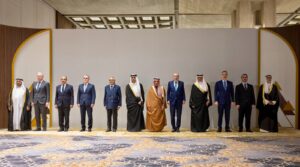
Foreign Ministers from Arab and Islamic countries are in Riyadh for an emergency meeting on regional security—an urgent gathering shaped by a deepening sense that the region is approaching a breaking point. The presence of Pakistan’s Deputy Prime Minister and Foreign Minister, Ishaq Dar, alongside his counterparts from across the Muslim world, underscores the gravity of the moment. What is unfolding is a broader reckoning with patterns of instability that many now believe can no longer be tolerated.
Saudi Arabia’s Foreign Minister, Prince Faisal bin Farhan, captured this shift with striking clarity. His assertion that the “little trust that remained” in Iran has been “completely shattered” reflects a decisive change in tone—one that moves beyond cautious diplomacy into open frustration. For years, regional states have attempted to manage their differences with Tehran through dialogue and restraint. But the accumulation of missile strikes, drone attacks, and proxy engagements has eroded that approach, replacing it with a growing consensus that the status quo is unsustainable.
The symbolism of this crisis could not be more stark. As high-level talks were underway in Riyadh, the sound of interceptors and explosions in the skies above sent a message louder than any communiqué. Diplomacy was being tested in real time, under fire. It was, as one observer noted, an unusual and telling moment—an indication that the gap between negotiation and confrontation is narrowing at an alarming pace.
The joint statement issued after the meeting reads as both a warning and a framework for what may come next. It condemns the attacks in unequivocal terms, highlights their targeting of civilian infrastructure and critical facilities, and reaffirms the right of states to defend themselves under international law. But more importantly, it ties the future of engagement with Iran to a clear set of expectations: respect for sovereignty, non-interference, and adherence to international norms. These are not new demands, but the tone suggests they are now being framed as conditions rather than aspirations.
What is emerging, then, is a shift from ambiguity to alignment. Countries that once pursued varying approaches to Iran are beginning to converge around a more unified position. This does not necessarily mean an immediate move toward confrontation, but it does signal that tolerance for continued escalation has limits—and those limits may already have been reached.
Within this evolving landscape, Pakistan’s role carries particular weight. Islamabad’s ties with Saudi Arabia are longstanding and multifaceted, encompassing economic and strategic cooperation, and political alignment. At the same time, Pakistan has maintained channels of communication with Iran, positioning itself as one of the few actors capable of bridging a widening divide. Ishaq Dar’s engagement in Riyadh reflects this dual responsibility: to stand with a key ally while also advocating for de-escalation.
The reported defence understanding between Pakistan and Saudi Arabia adds another dimension to this equation. While often discussed in theoretical terms, the principle of collective security embedded within it takes on new significance in the current climate. It introduces both reassurance and risk—reassurance for allies seeking security guarantees, and risk in terms of potential escalation should the conflict intensify. The very existence of such an arrangement is a reminder that regional crises rarely remain contained.
At the same time, Pakistan’s diplomatic outreach to Tehran suggests that Islamabad is keenly aware of the dangers of a wider conflict. The message conveyed to Iranian leadership—that existing security commitments cannot be ignored—appears to have been matched with efforts to ensure that tensions do not spiral further. This balancing act is not without its challenges, but it reflects a broader understanding that stability in the region serves Pakistan’s own national interests.
Beyond the immediate actors, the stakes extend far wider. The mention of threats to key maritime routes such as the Strait of Hormuz and Bab el-Mandeb in the joint statement highlights the global implications of the crisis. Any disruption in these corridors would reverberate through energy markets and international trade, drawing in powers that might otherwise prefer to remain at a distance.
There is also a shifting narrative within the Muslim world itself. Iran’s longstanding claim of defending broader Islamic causes is increasingly being questioned by countries that argue its actions have instead fueled division and instability. This internal critique carries a different weight—one that is rooted not in external rivalry, but in shared regional experience.
However, even at this critical juncture, the door to de-escalation has not been entirely closed. Saudi Arabia’s leadership has signaled that a political path remains possible, even as it reserves the right to respond through other means if necessary. This dual-track approach reflects the reality of the moment: a desire to avoid open conflict, tempered by a recognition that deterrence may be required.
Riyadh’s message, ultimately, is not just directed at Tehran—it is a statement to the entire region. It signals that the threshold for acceptable behavior has been crossed, and that the consequences of continued escalation will be collective.
