
By Junaid Qaiser
In times of rising conflict, it’s often the choice to hold back rather than react that truly influences what happens next. As tensions in the Middle East grow, Pakistan and Saudi Arabia seem to be finding common ground: prioritizing de-escalation, no matter how challenging it may be.
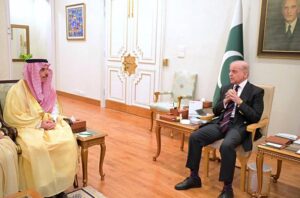
The recent talks between Prime Minister Shehbaz Sharif and Saudi Foreign Minister Prince Faisal bin Farhan in Islamabad indicate a purposeful alignment at a moment when the region desperately needs stability. By recognizing Saudi Arabia’s “remarkable restraint,” Pakistan isn’t just giving compliments; it’s reinforcing a principle that’s becoming increasingly rare these days—that true influence comes from patience and thoughtful responses.
During the meeting, Prime Minister Shehbaz Sharif outlined Pakistan’s wide-ranging diplomatic outreach in response to the ongoing crisis, emphasizing its role in promoting de-escalation and facilitating dialogue between the United States and Iran. In response, Saudi Foreign Minister Prince Faisal bin Farhan shared Riyadh’s latest take on the evolving regional situation, with both sides reaffirming their close cooperation.
The prime minister underscored Saudi Arabia’s key leadership role within the Muslim Ummah and highlighted the pressing need for unity among Islamic nations at this pivotal time. Looking back on his recent interactions with the Saudi Crown Prince, including their meeting in Jeddah earlier this month, he reiterated that Pakistan and Saudi Arabia are aligned in their commitment to advancing peace and stability through ongoing cooperation and diplomatic efforts.
For Riyadh, steering through a turbulent landscape without getting pulled into direct conflict is a strategic move. For Islamabad, supporting this approach helps it position itself as a trustworthy mediator rather than taking sides.
This alignment comes as Pakistan quietly expands its diplomatic footprint. Islamabad has moved beyond statements of concern to active engagement, maintaining channels with Washington while also facilitating communication with Tehran. The reported transmission of proposals and the willingness to host potential talks indicate that Pakistan is not merely observing developments—it is attempting to shape them. That both the United States and Iran have shown openness to Pakistan’s role, even if cautiously, suggests a level of trust that is not easily earned.
The quadrilateral talks in Islamabad, which include Pakistan, Saudi Arabia, Türkiye, and Egypt, add another dimension to this changing landscape. These nations have a lot at stake when it comes to regional stability—economically, politically, and strategically. Their gathering in Islamabad isn’t just for show; it highlights the understanding that working together is crucial to prevent escalation. The emphasis on dialogue, as reflected in these talks, points to a shared commitment to transition from disjointed reactions to a more unified diplomatic strategy.
For Pakistan, this moment represents a subtle but important shift. It is no longer confined to reacting to crises on its periphery; it is beginning to act as a facilitator within them. This has been made possible by sustained diplomatic outreach and, crucially, by internal coherence in decision-making. The coordination between civilian leadership and the military has lent credibility to Pakistan’s external posture, allowing it to engage multiple stakeholders without appearing inconsistent or opportunistic.
Saudi Arabia’s role in this equation remains central. As a key actor within the Muslim world and a country with deep ties across global power centers, its choices carry weight. By opting for restraint and engaging in coordinated diplomacy with partners like Pakistan, Riyadh is contributing to a framework that prioritizes stability over escalation. The emphasis on unity within the Muslim world, as highlighted in these engagements, reflects an awareness that fragmentation only amplifies vulnerability.
There are, of course, limits to what mediation can achieve in the short term. The underlying tensions are complex, and mistrust runs deep. Yet, the effort itself matters. In an environment where hard power dominates headlines, the quieter work of building consensus and opening channels often goes unnoticed—but it is no less critical.
The road to mediation is rarely straightforward. It requires patience, credibility, and a willingness to engage even when outcomes are uncertain. Pakistan and Saudi Arabia, through their recent coordination, appear to recognize this reality. Their approach does not promise immediate resolution, but it does offer something equally important: a pathway away from escalation and toward dialogue.
In a region accustomed to cycles of confrontation, that, in itself, is a meaningful step forward.
