

By Junaid Qaiser
There are moments when an honour given to an individual becomes larger than the individual himself. The recognition of Allama Muhammad Tahir Mehmood Ashrafi at London’s historic Lambeth Palace is one such moment. His receipt of the Hubert Walter Award for Reconciliation and Interfaith Cooperation 2026 is not simply an acknowledgment of a religious scholar’s personal efforts; it is also recognition of the difficult and often underappreciated work of building bridges between faiths in an increasingly divided world.
Presented by the Archbishop of Canterbury, Sarah Mullally, the award recognizes Ashrafi’s longstanding efforts for reconciliation, interfaith cooperation, intra-faith harmony, minority rights, peaceful coexistence and opposition to extremism, terrorism and sectarian violence.
For Pakistan, the significance of this recognition should not be overlooked.
The country is frequently discussed internationally through the language of terrorism, religious intolerance and sectarian tensions. These challenges are real and must be confronted honestly. But Pakistan’s story is not limited to them. There are also religious scholars, community leaders and civil society figures who have spent years trying to build a culture of dialogue and coexistence. Ashrafi’s international recognition brings that less visible side of Pakistan into the international conversation.
His career has been closely associated with the idea that religious leadership carries a responsibility beyond the pulpit. A scholar’s influence can either deepen divisions or help reduce them. At a time when extremists continue to exploit religious differences for political and violent purposes, the importance of responsible religious leadership has never been greater.
Ashrafi has repeatedly spoken against extremism, terrorism and sectarian violence while advocating dialogue among different schools of thought and faith communities. Through his role as Chairman of the Pakistan Ulema Council and Coordinator of the National Paigham-e-Aman Committee, he has promoted initiatives aimed at strengthening religious harmony and national unity.
The importance of such work lies in its practical character. Interfaith harmony cannot be achieved through speeches alone. It requires people of different beliefs to meet one another, listen to one another and develop enough trust to disagree without resorting to hostility. It requires religious leaders to challenge hatred when it emerges within their own communities. And it requires political and social institutions to protect the rights of minorities not as a favour, but as a matter of principle and citizenship.
Ashrafi’s message after receiving the award was significant in this regard. Rather than presenting the honour solely as a personal achievement, he dedicated it to religious scholars, leaders, intellectuals and ordinary people working for peace and reconciliation around the world. That emphasis on collective responsibility is important.
Peace cannot be the project of one individual.
Nor can it be left exclusively to governments.
The fight against extremism requires cooperation between states, religious institutions, civil society, educators and community leaders. Governments can establish laws and security mechanisms, but changing attitudes within communities requires voices that people trust. Religious scholars have a particularly important role because they can challenge extremist interpretations from within religious discourse itself.
This is where Ashrafi’s work acquires a wider significance.
His recognition in London also demonstrates that dialogue between Muslims and Christians need not be confined to formal diplomatic channels. Religious diplomacy can create relationships where conventional politics sometimes struggles. Faith leaders can open conversations, reduce suspicion and create an environment in which difficult issues can be discussed without immediately becoming political confrontations.
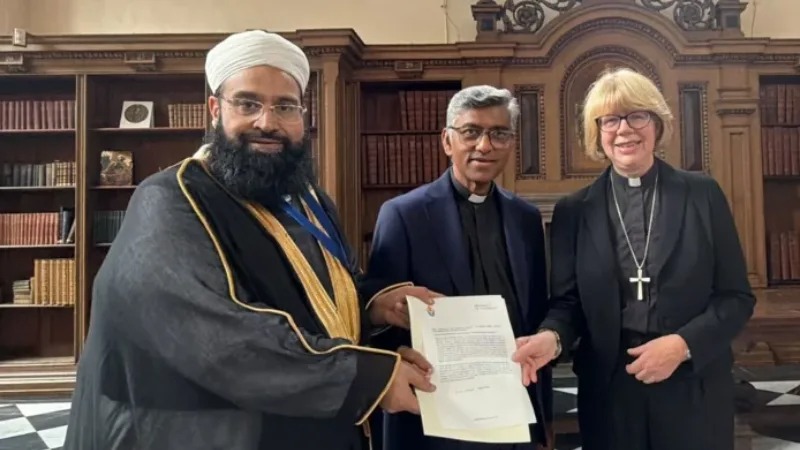
The setting of the award is itself symbolic. Lambeth Palace represents one of the world’s historic centres of Christian leadership, while Ashrafi represents an important voice within Pakistan’s Muslim religious landscape. Their coming together around reconciliation and interfaith cooperation sends a message that religious differences do not have to become barriers to human cooperation.
Pakistan’s religious diversity is a fact of its national life. Muslims belonging to different schools of thought live alongside Christians, Hindus, Sikhs and members of other communities. Protecting this diversity is not simply about improving Pakistan’s international image. It is fundamental to the country’s own stability.
When a minority community feels insecure, the entire society suffers. When sectarian differences become violent, national cohesion weakens. When religious disagreement turns into hatred, economic and social development also become more difficult.
That is why Ashrafi’s repeated emphasis on the protection of minorities deserves attention. His position that violence against any community, Muslim or non-Muslim, is unacceptable should become a broader national principle.
For Ashrafi, the award adds another chapter to a career already marked by international engagement on peace and religious harmony. For Pakistan, however, it offers something more valuable: an opportunity to demonstrate that the country can contribute to global peace not only through its strategic importance, but also through its religious and diplomatic voices.
The world does not need more walls between communities. It needs more people willing to cross them.
