
By:Latif Ur Rehman
The ongoing Monsoon Plantation Campaign across Pakistan, particularly in Khyber Pakhtunkhwa, has brought to light an encouraging reality: tree planting is no longer viewed merely as a government-led activity. It is gradually evolving into a broader expression of public awareness, social responsibility and collective commitment to environmental sustainability.
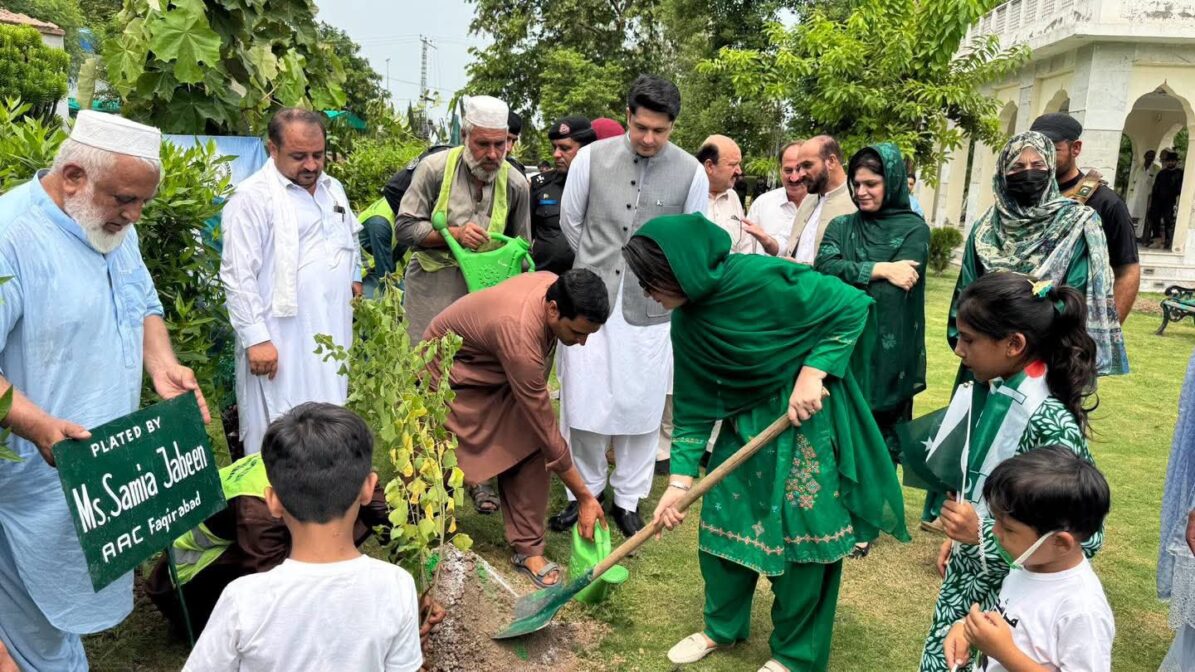
This year, children, young people, senior citizens, students, teachers, civil society organisations, non-governmental organisations, local communities and public institutions participated in plantation activities with remarkable enthusiasm, determination and a strong sense of responsibility. Their involvement reflects the emergence of a new and promising green consciousness within society.
Compared with previous decades, the scale of public interest, participation and commitment witnessed during this plantation season is particularly encouraging. It suggests that awareness of climate change, rising temperatures, air pollution and the need to protect natural resources is increasingly reaching ordinary citizens. Such awareness is the true foundation upon which lasting environmental change can be built.
Every year, the Khyber Pakhtunkhwa Forest Department raises millions of saplings of different species in its government nurseries. What is particularly commendable is that plantation planning is increasingly moving beyond numerical targets. Greater emphasis is now being placed on selecting species according to scientific research, local climatic conditions, soil composition, elevation, rainfall patterns, water availability and indigenous biodiversity.
This approach not only improves the survival prospects of planted saplings but also strengthens local ecosystems and enhances their long-term environmental value.
The true success of a plantation campaign cannot be measured merely by placing a sapling in the soil. Its real success lies in ensuring that, through proper care, irrigation, protection and continuous monitoring, that sapling survives, grows and eventually develops into a healthy, mature tree.
One of the most significant and memorable moments of this year’s monsoon plantation campaign came on Independence Day, when the celebration of national freedom was meaningfully linked with a commitment to a greener land and a safer future for generations to come.
At the government level, the Forest Department carried out plantation activities at 40 major sites across 15 districts of the province, planting more than 1.7 million saplings and setting an extraordinary example of collective environmental action. On the same day, members of the public, young volunteers, community organisations and various institutions planted hundreds of thousands of additional saplings, transforming the vision of a Greener Khyber Pakhtunkhwa from a slogan into a visible reality.
These were not merely saplings planted in the soil; they were green pledges, written by the hands of today for the generations of tomorrow.
Yet the greater responsibility begins now.
The young saplings planted today will require several years before they grow into mature trees. Their future depends upon continued care, irrigation, protection and systematic monitoring. The focus must therefore move beyond plantation alone and towards the protection, survival, growth and long-term stewardship of every plantation site.
Every major plantation programme should be supported by a structured system for recording survival rates, documenting locations, monitoring growth and ensuring long-term maintenance. Planting millions of saplings is undoubtedly an achievement; ensuring that those millions of saplings survive to become trees would be an even greater one.
This is also the stage at which Khyber Pakhtunkhwa can begin transforming its forests from purely natural and environmental assets into valuable green economic resources for the future.
The Forest Department should seriously explore opportunities to connect large-scale plantation and forest restoration initiatives with international environmental and carbon-finance markets. Forests have an important role in absorbing atmospheric carbon and reducing greenhouse-gas concentrations, and these environmental benefits can, where international standards are met, acquire measurable economic value.
In many parts of the world, forest expansion, ecosystem restoration and verified reductions in greenhouse-gas emissions are recognised through financial mechanisms. If the forests being planted, restored and protected in Khyber Pakhtunkhwa are subjected to credible measurement, proper documentation, independent verification and long-term protection in accordance with recognised international standards, the province could potentially generate significant financial resources from their environmental value.
If such revenues were reinvested in forest protection, aftercare of plantations, expansion of government nurseries, propagation of native species, forestry research, wildfire prevention and community participation, Khyber Pakhtunkhwa could gradually develop a more self-sustaining and financially resilient model of afforestation and forest restoration.
In this way, trees would no longer be valued only for shade, beauty and clean air. They could also contribute meaningfully to environmental protection, local employment, the rural economy and provincial revenues.
At the same time, making Pakistan greener also requires the protection of agricultural and cultivable land. Rapid, unplanned construction and the continuing conversion of fertile land into built-up areas could create serious long-term challenges for food security, water resources, the environment and the economy.
Turning productive soil into endless graveyards of brick, steel and concrete cannot be described as sustainable development.
What we need is a model of progress in which our cities continue to grow, our farmland remains protected, and our trees are allowed to breathe.
Farmers and landowners can also play a vital role by planting fruit-bearing, shade-giving and economically valuable tree species suited to their local climate and soil conditions. When properly integrated with agricultural production, such trees can become a sustainable source of supplementary income within a few years.
The organised promotion of agroforestry can simultaneously improve soil fertility, conserve water, strengthen resilience against climatic extremes, reduce soil erosion and reinforce rural livelihoods.
Making the country greener is not the responsibility of the Forest Department alone. It is a green covenant between the state, its institutions, society and every citizen.
Planting a sapling is only the first step in fulfilling that covenant. Our real responsibility is to nurture it into a tree and pass it on, alive and thriving, to the generations that follow.
A nation that plants and protects trees today is, in truth, safeguarding the air, water, soil, economy and very life of its generations yet to come.
The author, Latif Ur Rehman, serves as Spokesperson for the Department of Climate Change, Forestry, Environment & Wildlife, Government of Khyber Pakhtunkhwa. He may be contacted at latifmedia@gmail.com
