
By: Fizza Qaisar
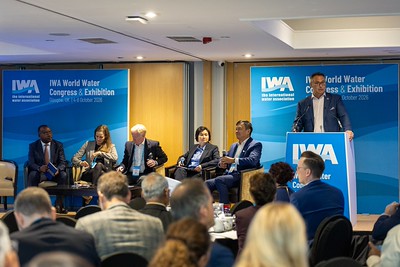
ISLAMABAD/GLASGOW: As thousands of water researchers, utility leaders, policymakers and environmental advocates entered the Scottish Event Campus on the River Clyde on Sunday morning, I watched the IWA World Water Congress and Exhibition 2026 on a video stream from my desk in Pakistan. I had an official invitation and press accreditation, but visa delays meant I covered the congress through its digital portal instead of the exhibition floor.
Missing the hall is a quiet disappointment for any journalist, yet reporting from a distance gave me a fresh view of how global water talks land in South Asia, where retreating glaciers, erratic monsoons and falling aquifers are daily problems. The congress theme, “Water action, the path to resilience and prosperity,” felt immediately personal.
Keynote speaker Katherine Richardson, a professor at the University of Copenhagen, opened by saying freshwater change is already one of the planetary boundaries we have crossed. Water, she explained, is not just one sector among many. It binds together energy, food security, public health and climate stability. In Pakistan, where floods and scarcity arrive side by side, that message hit hard. Our water governance is often reactive, rushing in after rivers breach their banks or wells run dry. The plenary called for a shift from emergency response to long-term resilience.
At the opening press conference, IWA representatives pointed to the gap in financing and technology. The Global North is moving toward carbon-neutral urban water cycles, while much of the Global South still struggles with basic sanitation and unmapped groundwater. The digital platform reflected the same gap. It let reporters like me track commitments live, but real progress needs capital, local political will and cross-border scientific cooperation.
Groundwater Security and Utility Transformation
Day Two moved from political vision to the gritty reality of delivering water. After the morning plenary led by Cees Buisman of Wetsus in the Netherlands, the question was how to turn climate strategy into working pipelines, clean taps and sustainable aquifers.
Utilities worldwide lose billions of cubic meters of treated water every year to leaks, ageing pipes and unbilled use, known as Non-Revenue Water. In fast-growing Pakistani cities, this loss often exceeds 40 percent, which is both a financial blow and a waste of a dwindling resource. Experts showed how smart metering, pressure management and acoustic leak detection can lift performance but stressed that technology cannot fix broken governance. Utilities need financial independence, transparent tariffs and strong institutions for upgrades to last.
In the afternoon, Sir Jon Cunliffe, former chair of the UK’s Independent Water Commission, criticised funding models sharply. Decades of underinvestment and fragmented governance, he argued, have left municipal networks exposed to extreme weather. The same is true in developing economies, where public funding is tight and private investors hold back over regulatory risk.
Groundwater stood out for me. It is the invisible lifeline of farming and drinking water across Asia and Africa, yet unregulated extraction and climate variability are draining it. Presenters highlighted satellite-based aquifer mapping, managed aquifer recharge and real-time monitoring networks. In Islamabad and Lahore, where water tables have fallen by several meters in a decade because of tube wells and concrete urbanisation, managed recharge is now a matter of survival. The sponge city techniques and recharge basins discussed offer a blueprint our planners should study. Day Two closed on a practical note: whether through public-private partnerships, community-led management, or digital overhauls, delivery is where water security is won or lost.
Nature-Based Solutions and Emerging Contaminants
Tuesday turned to ecotechnology. Keynotes led by Paula Kehoe set the stage for nature based solutions, circular water economies and problem of emerging pollutants.
For generations, water management leaned on gray infrastructure such as dams, channelled rivers and large treatment plants. These brought benefits but disrupted ecosystems and proved brittle under climate shocks. Presenters made the case for green and blue infrastructure: restored wetlands, protected mangroves and urban catchments that absorb floodwater. Mangrove restoration in the Indus Delta has already shown results in coastal defence and carbon capture, and scaling this across inland river basins could transform flood control and drainage.
Other sessions tackled a quieter threat: PFAS, microplastics and pharmaceutical residues in freshwater. PFAS, the so-called forever chemicals, do not break down naturally and are linked to serious health risks. Researchers from Europe and North America presented treatment options, including activated carbon filtration, high-pressure membranes and advanced oxidation. For developing countries, weak testing capacity makes this worse, as millions unknowingly drink water carrying industrial effluent, farm runoff and sewage. Affordable rapid test kits and local treatment units are urgently needed.
The evening ended with the IWA Project Innovation Awards Gala, honouring projects from rural decentralised wastewater systems to large reclamation plants serving industry. They proved that innovation thrives when scientific rigour meets community need.
Digital Water Revolution
On Wednesday, under the theme Infrastructure Delivery, the focus was digital technology, AI and resource recovery. Virtual press delegates followed the Operations Challenge, co-led by Skewb and Capgemini, where utility teams competed in pipe repair, process control, lab analysis and emergency response. It showed that software is only as good as the operators who run it.
Prabhu Chandrasekeran of Arcadis explained how AI, IoT sensors and Digital Twins, which are live virtual replicas of pipe networks or plants, help engineers simulate climate scenarios, predict bursts and cut energy use. Glasgow’s Smart Canal was a standout case. By linking weather forecasts to automated sluice gates on the Forth and Clyde Canal, authorities lower water levels before storms, creating storage for runoff and freeing land for regeneration.
Such ideas could help the Indus Basin Replacement Works, one of the world’s largest irrigation systems, which suffers from inefficiency, unequal distribution and siltation. Low-cost sensors and automated flow controls could ensure tail-end farmers receive their fair share. Presenters also treated sewage not as waste but as a source of clean water, bioenergy, phosphorus and nitrogen, a gain for both environment and economy at a time of costly fertiliser and energy insecurity.
A Unified Mandate for Action
The congress ended on Thursday with a clear message: the era of incremental water management is over. Closing keynotes said water security cannot be achieved by engineers alone. It needs integration with urban planning, agricultural policy, public health and climate finance. The week also reminded us that visa delays and travel limits keep journalists, researchers and advocates from the Global South out of these rooms, even though IWA’s digital access proved that knowledge could cross borders when channels stayed open.
The final reports set out four takeaways. First, Integrated Water Resources Management treats surface water and groundwater as one system from source to sea. Second, faster digital adoption of AI, remote sensing and smart metering. Third, equitable financing and capacity building, since technology fails without trained local workforces and steady funding. Fourth, community and youth engagement, so local stewards and young professionals lead water governance.
Now the real work begins far from the exhibition floor. Journalists must hold governments, utilities and donors accountable for the promises made in Scotland. From the melting glaciers of the Himalayas to flood-prone cities everywhere, water is how climate change is felt. The roadmap is clear. What is missing is the political courage and financial commitment to turn it into local reality.
