
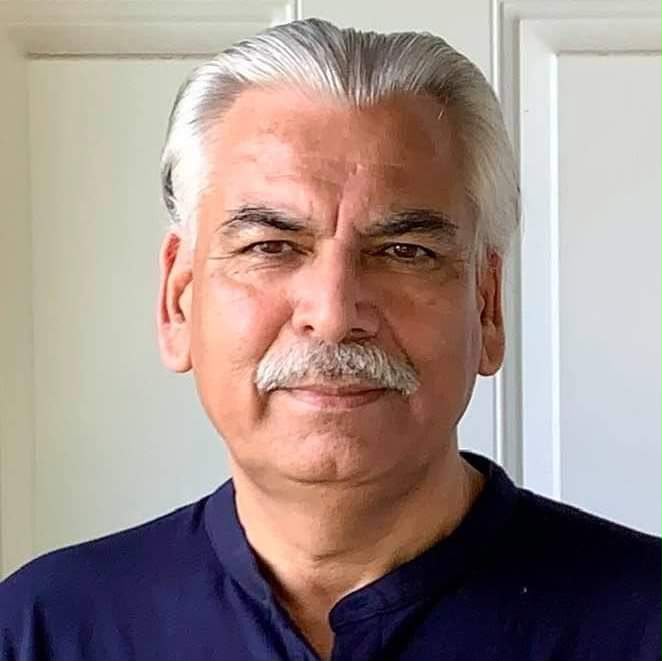
Barrister Usman Ali, Ph.D.
Politics has a habit of confronting people with the very culture they once helped create. Harsh rhetoric, ridicule and personal attacks used against political opponents rarely remain confined to the other side. Sooner or later, the same habits can turn inward.
The recent controversy involving Shaukat Yousafzai is a striking example.
Yousafzai, the provincial information secretary of Pakistan Tehreek-e-Insaf in Khyber Pakhtunkhwa, wrote to the party leadership suggesting that its planned long march be postponed in view of the security situation. His argument was straightforward: at a time of terrorism and other threats, political dialogue, restraint and strategic thinking might be preferable to confrontation.
In a democratic political party, such a suggestion should hardly be controversial. Political organisations are supposed to debate competing ideas before reaching collective decisions. Proposals may be accepted or rejected, but disagreement itself should not become a test of loyalty.
Yet that is precisely where the controversy shifted.
Khyber Pakhtunkhwa Chief Minister Sohail Afridi said that if the letter reached him, he would tear it up and throw it into the wastebasket. A fierce reaction followed on social media. Much of the criticism appeared to focus less on the merits of Yousafzai’s proposal and more on his commitment to the party. Eventually, during a television appearance, he became visibly emotional and broke down in tears.
His distress seemed to reflect something deeper than the rejection of a political suggestion. After years of association with the party, he found himself having to reaffirm his loyalty simply because he had expressed a different opinion.
That raises an important question: if a senior provincial office-holder must defend his political credentials after offering internal advice, how freely can an ordinary party worker be expected to speak?
PTI’s success in transforming social media into a major political force in Pakistan is undeniable. It used digital platforms to shape its narrative, mobilise supporters and communicate directly with the public on a scale rarely seen before in Pakistani politics.
But the same power can become damaging when it operates without political education, tolerance or ethical restraint.
Over the years, opposition politicians, journalists and critics have frequently faced derogatory labels, personal attacks and aggressive rhetoric. Other political parties are certainly not free of such behaviour, but PTI’s large and highly organised online network gives this issue particular importance.
Leadership plays a central role in shaping such a culture. When aggressive language is rewarded, celebrated or treated as evidence of political commitment, it stops being merely an individual failing and gradually becomes part of the wider political environment.
Imran Khan himself has often used sharp and insulting language for political opponents at public rallies, while colleagues who launched particularly fierce attacks on rivals were sometimes publicly praised. One former Punjab information minister, for instance, was famously applauded with words to the effect of “my cheetah has arrived” after attacking opposition leaders.
The irony is that the same former minister later left PTI and began using language against Imran Khan that even some of Khan’s strongest opponents might have avoided. The episode illustrates a wider problem: when political loyalty is rooted primarily in personalities and emotions rather than principles, attitudes can swing rapidly from one extreme to another.
A political culture that routinely describes opponents as thieves, traitors, enemies or conspirators conditions supporters to attack rather than argue. Once that habit becomes normal, it does not necessarily stop with political rivals or journalists. Eventually, it can also be directed against people inside the party who think differently.
The role of some overseas-based YouTubers and social media activists also deserves attention. Content centred on Imran Khan and PTI generates large audiences and, for some, significant income. This creates incentives of its own. Confrontation, anger and accusations often attract more attention than moderation, compromise or negotiation.
As a result, whenever a politician proposes talks, reconciliation or a change in strategy, the reaction from some quarters can become so intense that the person involved is forced to defend himself against accusations rather than discuss the actual merits of the proposal.
Such an environment ultimately harms the leadership as well.
People capable of offering serious advice begin to remain silent. Those advocating negotiation or constructive alternatives hesitate for fear of being branded weak, compromised or disloyal. Gradually, the leadership hears more from those who endorse every decision and less from those willing to challenge it.
The result is weaker internal consultation and increasingly one-sided decision-making.
That is why the Yousafzai episode matters. The debate quickly moved away from whether his proposal was strategically sound and towards whether he remained sufficiently loyal to the party. He was compelled to clarify that he stood with PTI and Imran Khan and would accept the party’s final decision.
Why should such declarations be necessary after the expression of a political opinion?
This question goes to the heart of the difference between a democratic party and personality-driven politics.
In personality-centred politics, unconditional loyalty to the leader gradually becomes the highest measure of political virtue. In an institutional political party, disagreement is expected. Members debate, challenge one another, lose arguments and still continue working together.
A democratic political party cannot be judged merely by the size of its rallies or the number of its social media followers. A better test is whether its workers and leaders can disagree with the party chief without being forced to produce a certificate of loyalty afterwards.
Seen in this light, Shaukat Yousafzai’s tears represent more than the personal hurt of one politician. They raise a broader question about a political culture in which trolling, humiliation and character attacks may once have been viewed as effective tools against opponents but are now also being directed at dissenting voices within the party.
This is not entirely new. Other prominent PTI figures, both men and women, have in the past faced internal trolling and personal attacks. Some were publicly distressed; others became so disillusioned that they eventually left the party.
Critics may call this political karma. More importantly, it should be seen as a warning about institutional decline.
When disagreement becomes dangerous, serious voices retreat. When loyalty becomes more important than judgment, debate weakens. And when every difference of opinion is treated as betrayal, a political party loses part of its ability to correct its own mistakes.
There is still room for PTI to strengthen itself as an institution: by moving beyond personality-centred politics, investing in the political education of its workers, encouraging genuine internal consultation, and distancing itself from abusive online behaviour that some of its own serious-minded leaders have also criticised.
Political parties do not become strong merely through slogans, rallies or social media influence.
Their real strength is revealed when a worker can disagree with the leader , and still be accepted as one of their own.
