
PROVINCE REPORT
Paris / France : An exhibition of the written heritage, arts, and culture of Tajikistan, held in honor of the two great Persian-Tajik thinkers — Abu Ali ibn Sina (Avicenna) and Omar Khayyam — opened at UNESCO Headquarters. Mr. Sirojiddin Muhriddin, Minister of Foreign Affairs of the Republic of Tajikistan, addressed the opening ceremony.
In his address, the Minister noted that holding such an exhibition at UNESCO Headquarters in Paris reflects the constructive role and unique place of science and culture in the development of international relations, as well as in the creation of an atmosphere of friendship and respect among nations.
“Our scientific and cultural heritage is not only a record of our historical journey but also one of the principal means of dialogue among nations in today’s world,” he stated.
The exhibition brings together rare examples of written heritage, lithographed works, and artefacts of exceptional historical and cultural significance. Among them are manuscript copies and lithographed books of the scientific, philosophical, and medical works of Abu Ali ibn Sina, along with collections of the rubaiyat (quatrains) of Omar Khayyam. These rare items cover various stages in the development of the culture of manuscripts and book printing, with the historical examples dating from the fifteenth to the nineteenth centuries.
The exhibition also features quatrains by Omar Khayyam, artistically rendered in calligraphy by renowned masters of the art, in keeping with the finest traditions of bookmaking and decorative script. These works embody the enduring bond between science and letters, the art of calligraphy, and the book culture of the Persian-Tajik people.
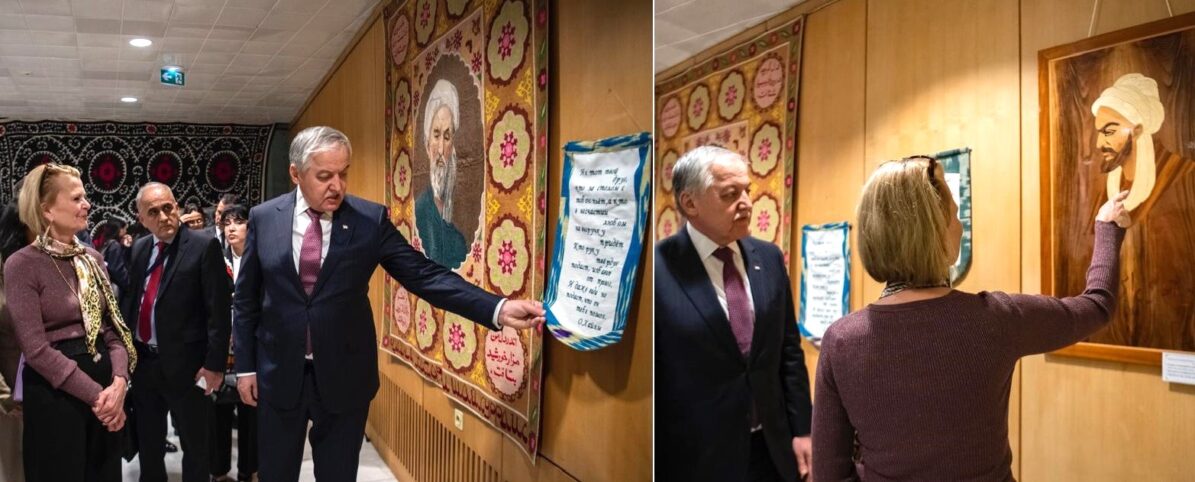
Alongside the written heritage, visitors will find examples of Tajik folk crafts, including khotamkori (fine wooden inlay) and suzani embroidery, bearing the image of Shaykh ur-Ra’is Abu Ali ibn Sina, created by Tajik artisans. Also on display is a collection of commemorative and jubilee medals and badges with the image of Abu Ali ibn Sina issued in different periods in honor of this great thinker.
The Minister emphasized that the study of written heritage is essential for the preservation of cultural identity, the transmission of historical knowledge, and the growth of intellectual and artistic skills. Ancient manuscripts and calligraphic works are not merely vessels of written knowledge, but integral expressions of a nation’s history, art, and civilization. They deepen understanding of cultural, literary, and historical roots and preserve the link between the new generation and those who came before.
He described the exhibition as a mirror reflecting the life of an ancient nation and a chronicle of the historical journey of Persian-Tajik science and culture, whose enduring contributions have enriched humanity for millennia. The timeless legacy of Abu Ali ibn Sina and Hakim Omar Khayyam, he noted, is a source of pride not only for the Persian-Tajik people but also a spiritual treasure for all humankind.
The Minister expressed his sincere gratitude to the UNESCO Secretariat, the Rudaki Association, and all those whose valuable contributions made the exhibition a success. He voiced confidence that fruitful cooperation with UNESCO in the preservation and promotion of the cultural and historical treasures of the Tajik people would continue, for the benefit of international cooperation and the dialogue of civilizations.
