
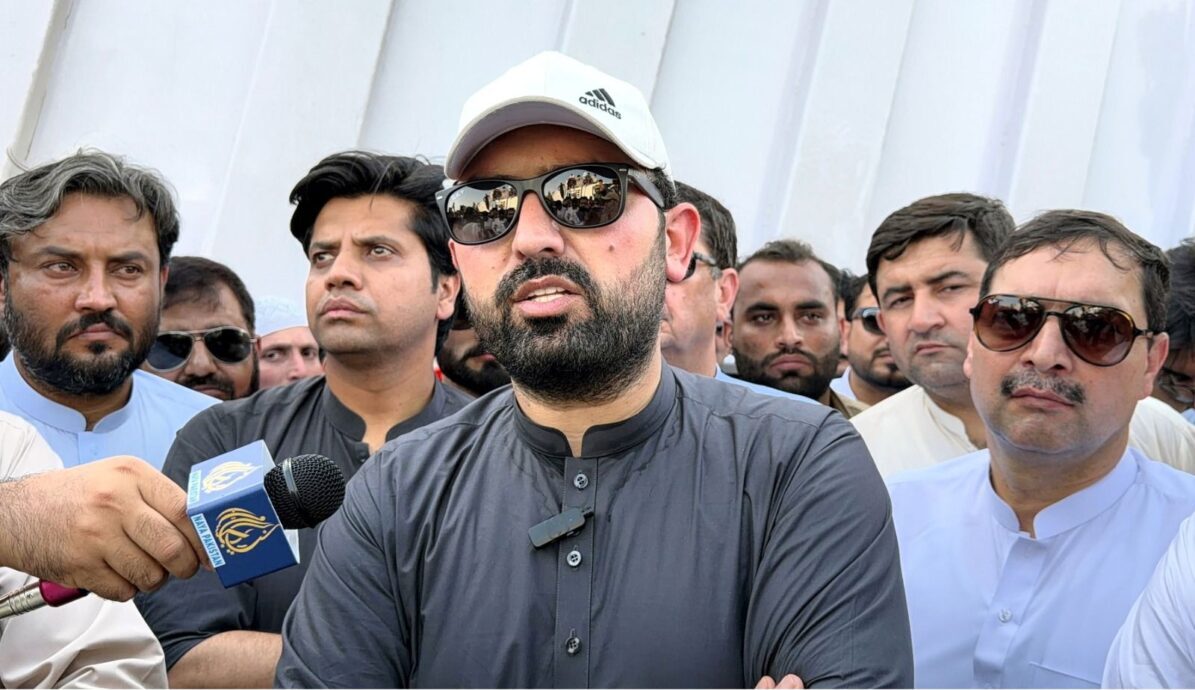
Says he travelled to Islamabad to express solidarity with IK sisters
Province Report
PESHAWAR: Chief Minister Khyber Pakhtunkhwa Muhammad Sohail Afridi, while speaking to the media at the Peshawar Mor interchange on Srinagar Highway, said that he had travelled to Islamabad peacefully to express solidarity with the sisters of Imran Khan, while party workers had consistently demonstrated restraint, discipline and responsibility despite repeated obstacles and restrictions. He said it was deeply troubling that the elected Chief Executive of a province, accompanied by his cabinet, had been prevented from proceeding, describing the move as inconsistent with democratic norms and reflective of a discriminatory approach towards a federating unit. He questioned what message the federal government intended to send by treating a provincial government in such a manner. The Chief Minister noted that the day had been fixed by courts for family meetings with Imran Khan, yet, as on previous occasions, his family members, legal team and personal physicians continued to face restrictions on access. He emphasized that his sole demand was that Imran Khan be allowed appropriate medical examination and treatment under the supervision of his doctors and in the presence of his family. He stated that if there was nothing to conceal regarding Imran Khan’s health and wellbeing, all unnecessary restrictions on access should be lifted immediately. The continued denial of meetings and the imposition of avoidable barriers were fueling public concern and raising legitimate questions that could only be addressed through transparency and openness. Muhammad Sohail Afridi said that reports concerning Imran Khan’s health, particularly those relating to his eyesight, had heightened public anxiety. He maintained that unrestricted access for family members and medical professionals was necessary to dispel concerns and ensure public confidence. He added that obtaining direct reassurance regarding Imran Khan’s health and treatment in the presence of his sisters remained essential. The Chief Minister asked whether the people of Khyber Pakhtunkhwa were expected to accept the continued erosion of their constitutional and legal rights without question. Criticising the increasingly authoritarian approach to governance, the Chief Minister said that Khyber Pakhtunkhwa had repeatedly faced actions detrimental to its interests, including restrictions affecting wheat supplies, natural gas availability and electricity provision, while the movement of its elected leadership was now also being obstructed. He asserted that such treatment was incompatible with the principles of federalism and equal treatment guaranteed under the Constitution. Referring to constitutional provisions, he noted that Article 158 accords priority rights over natural gas resources to the province in which they are produced, yet Khyber Pakhtunkhwa continued to face gas shortages and supply restrictions. He further argued that attempts to impede the movement of wheat were inconsistent with Article 151 of the Constitution, which safeguards the free movement of trade and essential commodities between provinces. Muhammad Sohail Afridi stated that Pakistan Tehreek-e-Insaf and its leadership had made significant political sacrifices over the past eighteen months in the broader national interest. He stressed that his position was not based on any unlawful or unconstitutional demand but on the protection of fundamental rights, constitutional supremacy and the rule of law. He remarked that Imran Khan had never stood in the way of medical treatment for political opponents and questioned why similar consideration was now being denied to him. Commenting on the cipher issue, the Chief Minister said that developments reported in both the international and domestic media reinforced concerns regarding external influence over national affairs. He reiterated his belief that Pakistan must remain sovereign in its decision making and free from dependence on external direction. He said that dignity, self respect and national sovereignty were non negotiable principles and that Pakistan must remain faithful to the vision of Quaid-e-Azam Muhammad Ali Jinnah and Allama Muhammad Iqbal. He further observed that while the Constitution guarantees freedom of expression, political participation and peaceful assembly, opposition political activities were increasingly being subjected to restrictions in practice. Responding to a question, he argued that the 27th Constitutional Amendment had curtailed the effective functioning and authority of the judiciary. Concluding his remarks, the Chief Minister said that if access to Adiala Jail continued to be denied, an appropriate course of action would be determined in light of the prevailing circumstances. He reaffirmed his commitment to democratic values, constitutional governance and the rights of the people, adding that Pakistan belongs to its citizens and should never be left at the mercy of external interests or those acting at their behest.
