
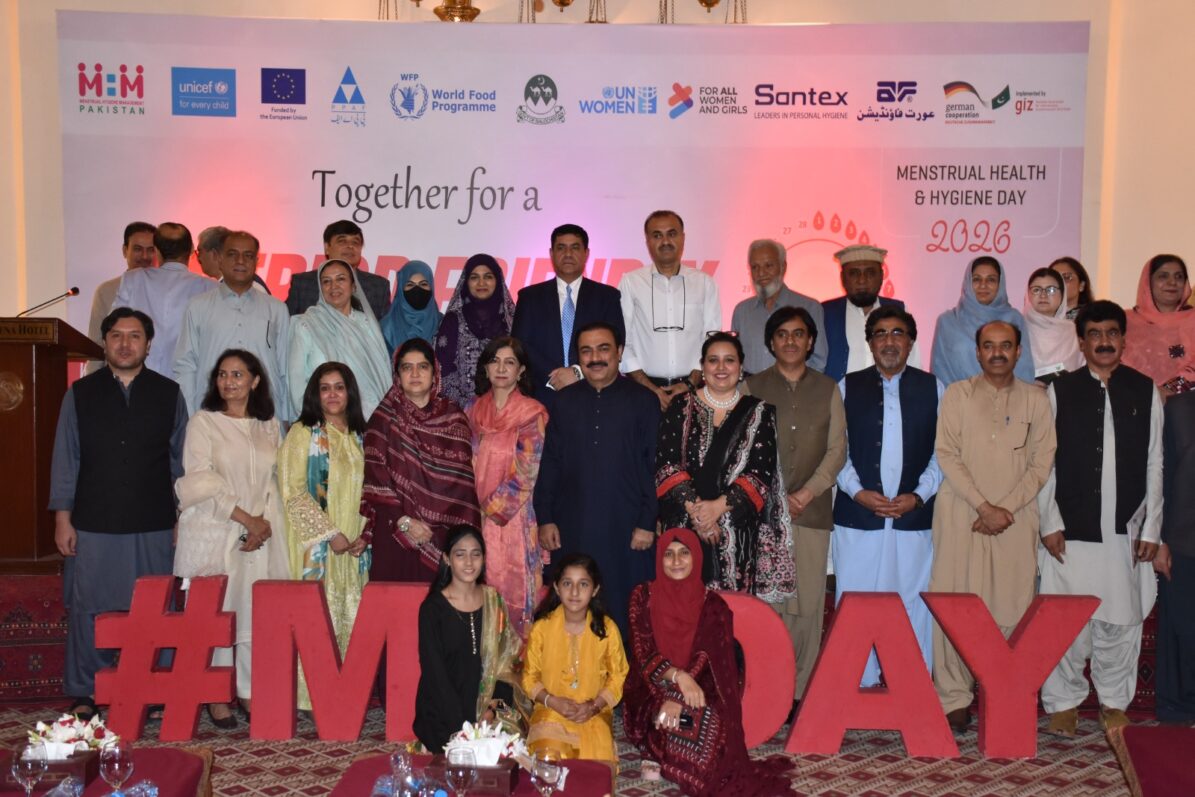
QUETTA (May 21, 2026): The political and social leadership of the province, while sharing a strong commitment to the wellbeing of women and girls, pledged to work toward eradicating period poverty across Pakistan. This historic resolve was solidified at the Global Menstrual Hygiene (MH) Day 2026 marked here on Tuesday, held by Menstrual Health and Hygiene Working Group (MHMWG) Secretariat, Balochistan, in collaboration with UNICEF, WFP, UNWomen PPAF and EU supported Education Support Programme (ESP) besides active participation of other member organizations, government officials, CSOs and media.
Delivering the keynote address, Honorable Minister for Education Ms. Raheela Hameed Durrani elevated menstrual health as a paramount public policy priority, signaling the need for robust nationwide momentum. She emphasized that integrating menstrual hygiene management into educational frameworks is an essential prerequisite to preventing school dropouts and securing an uninterrupted future for adolescent girls.
Mir Rehmat Saleh Baloch, Member of the Balochistan Assembly, said, “It is time for all political divides to be set aside to unite for women and girls’ fundamental rights.” This vision was strongly reinforced by Mr. Abdullah Khan, Chairperson of the Balochistan Revenue Authority, who outlined concrete steps to making Balochistan a comprehensively period-friendly province.
Building on the provincial assembly’s recent, historic resolution to end the period tax, Dr. Tahira Kamal, Chair of the MHMWG Secretariat, outlined a “Leadership Vision” focused on a future of equity. She presented on the global context of MHH, emphasizing that the province’s legislative success is a crucial stepping stone.
Addressing the complexities of crisis management, Dr. Faaria Ahsan of the World Food Programme (WFP) detailed the critical link between menstrual health in emergencies and nutritional security. She highlighted that coupling MH interventions with WFP’s flagship school meal programmes creates a vital safety net, ensuring that nutritional needs besides MHH needs are addressed to keep vulnerable girls in the classroom.
Representing UNICEF Pakistan, Sehrish Nagi issued a call to action, marking the occasion by launching a puberty awareness book to spearhead MHH advocacy across the country. She highlighted various UNICEF initiatives aiming at wellbeing of women and girls.
Mr Abdul Rehman, while representing Pakistan Poverty Alleviation Fund (PPAF), asserted on effective strategies for community-based resilience building for women and girls. He highlighted that PPAF’s grassroots poverty alleviation and livelihood initiatives play a critical role in empowering women economically, building their financial capacity to afford essential hygiene commodities.
Ms. Ayesha Wadood of UN Women, in her powerful message, positioned menstrual health interventions as a vital catalyst for empowering women and achieving gender equality. She noted that her organization is actively striving to create gender equality in employment, advocating for period-friendly workplace policies that allow women to participate safely and comfortably in the economy.
Earlier, Ms. Shahana Tabassum set the context for the day by reflecting on MHM advocacy as a journey of impactful interventions. This was followed by a strategic briefing on navigating the economics of equity and MHH tax reforms by MHH Policy and Advocacy Expert Shafqat Aziz.
A dynamic expert panel discussion featuring a health sector specialist, education sector specialist, taxation expert, youth champion, Chief Economist (P&D), and an MHH media champion was also held during the event. The panelists collectively covered various dimensions of MHH in the Balochistan perspective. Ms Zulaikha Karim Buledi, Co-Chairperson of the MHMWG Secretariat concluded the event with a formal vote of thanks and an outline of the path forward to pursue shared vision.
Ends_
