

By Junaid Qaiser
Some books are simply read, while others are truly felt — deep in the chest, in the throat, and in the quiet moments between heartbeats. Hum Ehd-e-Wafa Mein Zinda Hain (“We Live On in Our Covenant of Loyalty”), a heartfelt tribute by the National Award-winning poet and thinker Dr. Khalid Abbas Al-Asadi, clearly falls into the latter category. Its launch at Mozart Haus Lahore on May 25th was a vibrant testament woven from breath, sorrow, gratitude, and a fierce love for a nation that demands so much from its people.
The title, Hum Ehd-e-Wafa Mein Zinda Hain — We Live in the Covenant of Loyalty — carries a profound message that resonates with Pakistanis everywhere. It speaks of a connection that spans generations, linking those who protect the nation with those who benefit from their sacrifices. It serves as a powerful reminder that loyalty isn’t just an abstract idea; it’s a living promise upheld through bravery, service, and a deep love for one’s homeland.
Held at the elegant Mozart Haus in Lahore, the ceremony was a gathering that brought together literature, patriotism and collective remembrance. The book itself is a heartfelt tribute to Pakistan’s armed forces, its martyrs and the countless brave men and women who have safeguarded the country’s sovereignty through sacrifice and service.
Mozart Haus — a space that bridges two civilisations, Austrian and Pakistani, through culture and art — lent the evening an unlikely but fitting cosmopolitanism. Director Amir Rafique reminded the audience that literature and music do not observe borders, and the event bore him out entirely: an Austrian cultural venue sheltering the deepest Pakistani emotions.
What made the evening unforgettable was not the prestige of the guests — though the guest list was formidable — but the presence of the families. The heirs of martyrs sat and listened to poetry written in honour of their losses. Col. Syed Jafar Abbas spoke of his son Yasir Abbas with a soldier’s restraint and a father’s pride, two registers almost impossible to hold simultaneously. Mrs. Saba, whose entire family serves in the Pak Army, carried in her posture the accumulated weight of a household that has sent its men forward, again and again, without asking for guarantees.
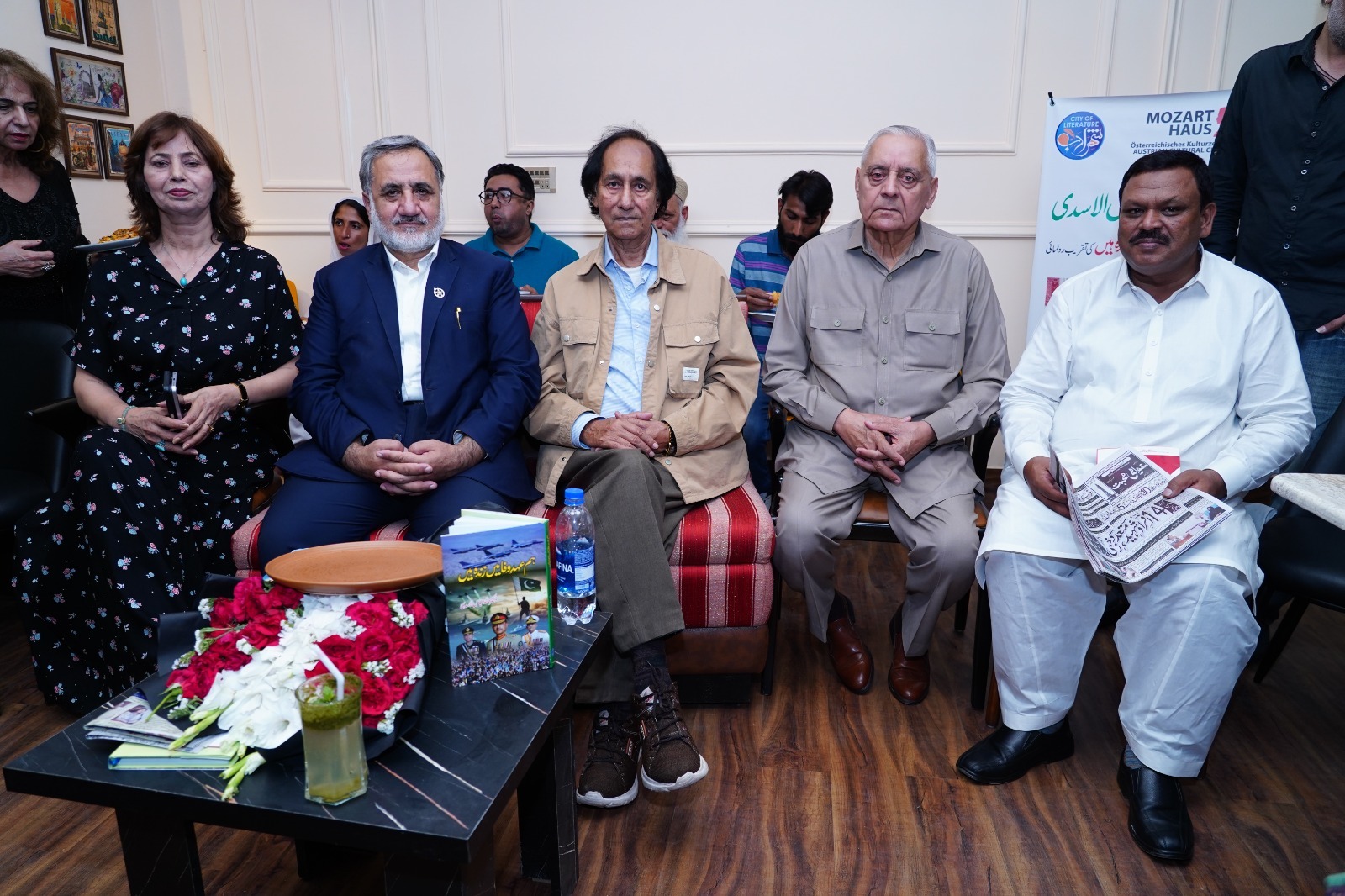
The timing of the book’s launch adds another layer of significance. As Pakistanis continue to reflect on the spirit of Marka-e-Haq and the national resolve demonstrated during Bunyan-un-Marsoos, the publication feels especially relevant. The emotions that emerged during those defining moments — pride, unity, sacrifice and resilience — are reflected throughout the book’s pages. In many ways, the work serves as a literary continuation of those sentiments, preserving them for future generations.
This is the great achievement of Dr. Al-Asadi’s work: it refuses to let martyrdom be abstract. The poems do not traffic in distant heroism. They reach into specific grief and hold it up to the light. Renowned anchor Ms. Rabia Rehman called the book an intellectual movement for the new generation, and she is right — because the young need to understand not just that men died for them, but what that dying cost.
Professor Dr. Abdul Rauf Rafiqi, presiding with the authority of the Iqbal Academy, drew a comparison to Allama Iqbal’s motivational poetry — and it does not feel like flattery. Iqbal, too, wrote for a people who needed reminding of what they were capable of. Al-Asadi writes for a people who need reminding of what has already been given on their behalf. The lineage is legitimate.
The timing of the launch is also pointed. The Pakistani nation is completing a year since the success of “ Marka -e-Haq”. “Bunyan Marsous” — a phrase evoking a wall of steel, a formation that does not break. The publication of this book within that atmosphere of national reckoning feels less like coincidence and more like continuation. Nazir Qaiser, whose own Presidential Award-winning literary life has been devoted to Pakistan’s cultural richness, put it with characteristic grace: a lamp does not announce itself as a lamp; its light does the declaring. This book is that kind of lamp.
Ali Zeeshan Amjad, carrying forward the tradition of his father Amjad Islam Amjad, called it a literary asset. The word is precisely chosen. Assets appreciate. They compound. This book will do the same — not in rupees but in the currency of national memory, which is the only kind that buys anything worth having.
One leaves such an evening changed in small but indelible ways. The national anthems of Pakistan and Austria played in and no one found it strange, because beauty and sacrifice speak the same language everywhere. Folk singer Dr. Nisar Bhatti’s song hung in the air long after the room emptied. Major Shahzad Nayyar’s moderation gave the event its rhythm — that rare gift of knowing when to speak and when to let silence do the work.
Dr. Al-Asadi, joining via video link from abroad, spoke with the emotion of a man who has poured something irreplaceable onto a page and trusts the world with it. Hum Ehd-e-Wafa Mein Zinda Hain is more than a book. It is an expression of national gratitude. It is a salute to those who stood firm when the country needed them most. Above all, it is a reminder that loyalty to one’s homeland is not measured by words alone but by the willingness to honor, remember and uphold the sacrifices that make a nation’s future possible.
