
Shahzad Rasheed
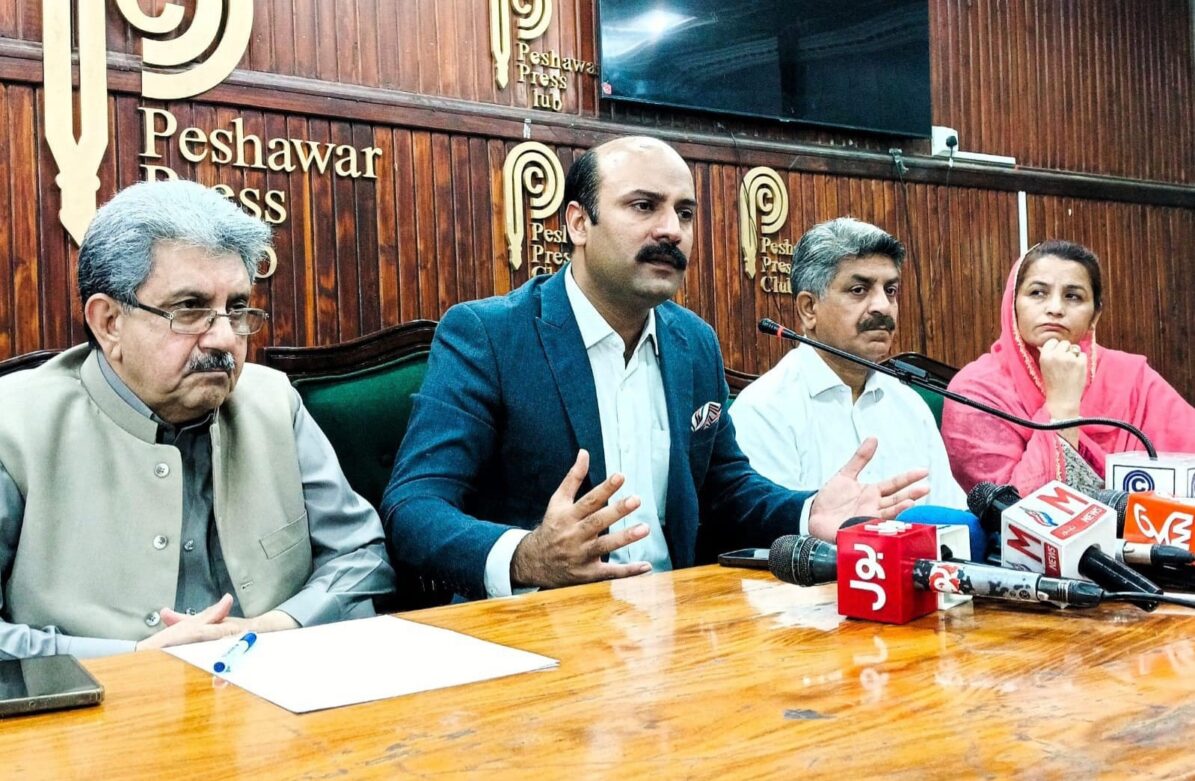
Peshawar: Pakistan Business Forum (PBF) Chief Organiser Ahmed Jawad, KP Chairman Ashfaq Paracha, Peshawar Region President Arif Yousaf, and other office-bearers of the Forum, while addressing a press conference at the Peshawar Press Club yesterday, commended Prime Minister Shehbaz Sharif and Field Marshal Syed Asim Munir for their statesmanship and diplomatic efforts in promoting peace, stability, and regional harmony.
The PBF leadership appreciated Pakistan’s constructive and balanced diplomatic role during the recent tensions involving the United States and Iran, stating that Pakistan demonstrated responsible and effective diplomacy aimed at de-escalation and dialogue.
While expressing concerns over the federal budget and the economic challenges facing businesses, industry, and agriculture. Chief Organiser Ahmad Jawad stated that the budget had failed to provide meaningful relief to the industrial and agricultural sectors. He emphasized that Pakistan requires an annual economic growth rate of at least 6 percent to address its mounting economic challenges, yet the budget lacks effective measures to achieve this target.
The PBF leadership highlighted that Pakistan’s economy requires the creation of at least three million new jobs annually, but the current fiscal framework offers no clear roadmap to stimulate employment generation.
Referring to the Economic Survey, Jawad noted that more than 72 million Pakistanis are living on less than Rs. 8,000 per month and questioned what tangible relief the budget offers to ordinary citizens beyond additional taxation.
PBF representatives expressed concern that tax revenues continue to increase every year while the country’s average economic growth remains around 3 percent. They argued that sustainable economic expansion cannot be achieved without reducing the cost of doing business and promoting industrial productivity.
The Forum criticised the high cost of energy, questioning how exports could be increased under the prevailing electricity and gas tariffs.
It also pointed out that businesses in Khyber Pakhtunkhwa face operating costs approximately 34 percent higher than competitors in other regions, undermining their competitiveness.
On fiscal matters, PBF noted that approximately Rs. 8 trillion—equivalent to 43 percent of the total federal budget will be spent on debt servicing in the coming fiscal year, while insufficient attention has been paid to reducing this burden.
However, the Forum welcomed the government’s decision to amend the Super Tax, noting that it was originally introduced as a temporary one-year measure.
The business body called for the abolition of the Petroleum Levy and its replacement with an 18 percent General Sales Tax (GST) on petroleum products to provide relief to consumers. It further demanded the removal of GST on dairy products and stressed the need for a national program to increase local edible oil production, noting that edible oil remains one of Pakistan’s largest import categories after petroleum products.
Regarding agriculture, PBF maintained that agricultural input costs could have been reduced through lower duties and taxes on fertilizers. The Forum warned that the lack of incentives for the agriculture sector could negatively impact GDP growth targets and food security.
Addressing tax policy, Ahmed Jawad urged the government to withdraw recent amendments relating to delayed filing of tax returns under the Active Taxpayers List (ATL). He argued that such measures discourage potential taxpayers and weaken confidence in the tax system.
Khyber Pakhtunkhwa Chairman Ashfaq Paracha said that the province’s business community has become a casualty of the prevailing political environment. He called for a change in the Provincial Advisor on Finance, emphasizing the need for a local representative who possesses a thorough understanding of the province’s economic realities, business landscape, and development priorities.
Paracha also criticized the provincial authorities for their lack of engagement with key stakeholders, stating that the business community is not being adequately consulted on important economic and fiscal matters. He stressed that meaningful dialogue with the private sector is essential for formulating policies that can promote investment, industrial growth, and economic stability in the province.
Ashfaq Paracha called for greater clarity regarding the provincial government’s industrial policy and questioned its strategy for promoting industry and commerce in the province. He urged the provincial government to present its budget without delay, stating that a province cannot be managed on a temporary basis.
The PBF leadership also expressed concern over funds belonging to Pakistani businesses that remain stuck in Afghanistan and called upon the Government of Pakistan to take up the issue with the Afghan authorities.
Peshawar Region President, Arif Yousaf stressed that providing economic direction to the province is the responsibility of the provincial government. He lamented the deteriorating condition of Peshawar, stating that even the provincial capital lacks adequate attention and development.
PBF called for a comprehensive pro-growth economic strategy, meaningful engagement with stakeholders, lower energy costs, support for agriculture and industry, tax reforms, and measures aimed at restoring business confidence and accelerating economic growth.
