
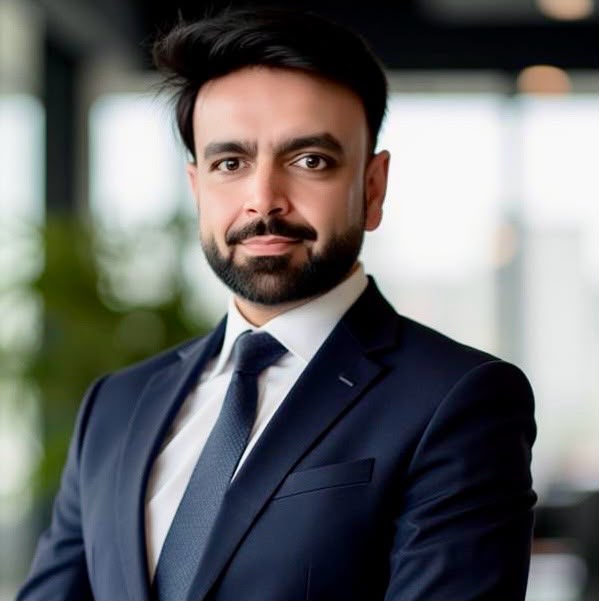
A profile of Umair Ahmad, one of the most quietly consequential cybersecurity professionals from Pakistan, working in the Gulf today.
When Umair looks back at sixteen years of work across Pakistan and the Middle East, he does not describe a planned career. He describes a series of choices. “I never set out to become a global expert,” he says. “I just kept choosing the harder assignment.”
That instinct, repeated consistently across different countries and diverse sector, has produced something rare: a professional whose experience spans the exact sectors that governments and regulators worldwide are now most desperate to secure.
Ahmad, 38, grew up in Mansehra, Khyber Pakhtunkhwa. He graduated with distinction in Information Technology from the University of Engineering and Technology in Peshawar, then earned a Master’s degree in Information Security from the National University of Sciences and Technology in Islamabad, both independently verified against international academic standards. His professional certifications place him among a genuinely small global cohort. He holds the CISM, a senior leadership qualification in information security held by fewer than 50,000 professionals worldwide; the CRISC, which recognizes demonstrated mastery of managing technology risk inside large organizations; the CDPSE, certifying expertise in protecting sensitive data at the engineering level; and the AAISM, a specialist credential in governing artificial intelligence within security environments held by only a fraction of the global security community. He also holds ISO 27001 Lead Implementer and Lead Auditor qualifications and the CHFI, the Computer Hacking Forensics Investigator certification. In February 2021, he spoke at the World Cyber Security Summit, one of the most prominent international gatherings of security professionals and policymakers in the world.
He began his career at the Bank of Khyber before taking on his first serious national challenge at a local huge telecommunication organization, owned by the government whose networks formed a critical part of Pakistan’s critical national communications backbone. There, he led a complete overhaul of how the organization identified, assessed and responded to security threats, conducting formal risk assessments using internationally recognized methodologies, building continuity frameworks that kept services running through live cyber incidents, and designing a governance model that was later adopted during its merger with the main telecommunication company in the country.
The harder assignment came next. In Oman, he was placed in charge of protecting a critical energy company operating active national drilling infrastructure, including the kind of computerized industrial control systems that physically govern energy production. He built the organization’s entire information security function from nothing, developed its first formal business continuity system, and identified and closed a specific network vulnerability that both the U.S. Department of Energy and the Cybersecurity and Infrastructure Security Agency have formally identified as one of the primary attack vectors used by state-sponsored actors against national energy infrastructure. The security architecture he designed remained the organization’s active compliance standard seven years after he left.
Most cybersecurity professionals spend their careers protecting office systems and data centers. Ahmad worked where a security failure has physical consequences. That distinction matters more today than it ever has.
In Bahrain as well as Saudi Arabia, over eight years at one of the world’s top professional services networks, he served as outsourced head of information security for heavily regulated banks, investment firms and government agencies. He helped institutions achieve compliance simultaneously with the security requirements of regulators across the Gulf, the United States and Europe. He contributed strategic input that shaped cybersecurity rules now mandatory for every licensed bank within an entire national financial system. He oversaw hundreds of security compliance audits for one of the world’s most security-sensitive energy producers, leading a specialist team across multiple countries.
But it was a pattern he kept observing across every organization he worked in that would eventually define the next chapter. “Every organization I worked in had the same blind spot,” he reflects. “They knew they had risks. They just had no idea how serious those risks actually were.”
Nowhere is that blind spot more dangerous today than in the adoption of artificial intelligence. Across the world, banks, hospitals, government departments and defense establishments are using AI tools to work faster and make sharper decisions. Most do not realize that almost every one of those tools requires sending sensitive information to outside servers, beyond the organization’s walls, beyond its borders, and beyond its control. For institutions with strict legal obligations to protect that information, the consequences range from severe regulatory penalties to direct compromise of classified operations.
Ahmad has spent years watching the same crisis unfold across the world’s most regulated institutions. Banks, hospitals, government departments and defence establishments are using artificial intelligence tools to work faster and make sharper decisions. Most do not realise that every one of those tools sends sensitive information to outside servers, beyond the organisation’s control, often beyond its borders entirely. For institutions legally obligated to protect that information, whether under American banking laws, European data protection regulations, or national security classifications, this is not a minor oversight. It is a direct and growing legal exposure that regulators across the United States, the European Union and the Gulf are now actively enforcing.
Hunbal AI resolves this at its foundation. It deploys inside the organisation’s own environment, on its own servers, under its own security policies. Nothing leaves. Every interaction is automatically logged, attributed and auditable. For a bank it means the full power of AI without client data ever reaching an external system. For a hospital it means AI-assisted care without patient records crossing any boundary. For a government agency it means AI-enabled operations with every output legally traceable and defensible.
The question every regulated institution in the world is now being forced to answer is exactly the one Hunbal AI was built to solve.
What makes this solution credible is not the technology alone. It is the fact that the person who built it spent sixteen years sitting across from regulators, closing the exact vulnerabilities this platform is designed to prevent, in the most demanding environments in the world.
He just kept choosing the harder assignment. It turns out the world needed someone who would.
Umair Ahmad holds a Master’s in Information Security from NUST Islamabad and active certifications including CISM, CRISC, CDPSE, AAISM, and ISO 27001 Lead Implementer and Auditor. He serves as Director of Information Security at Moore JFC Technologies, an independent member firm of Moore International, and is the founder of Digital Era, registered in New York, Bahrain and Pakistan.
