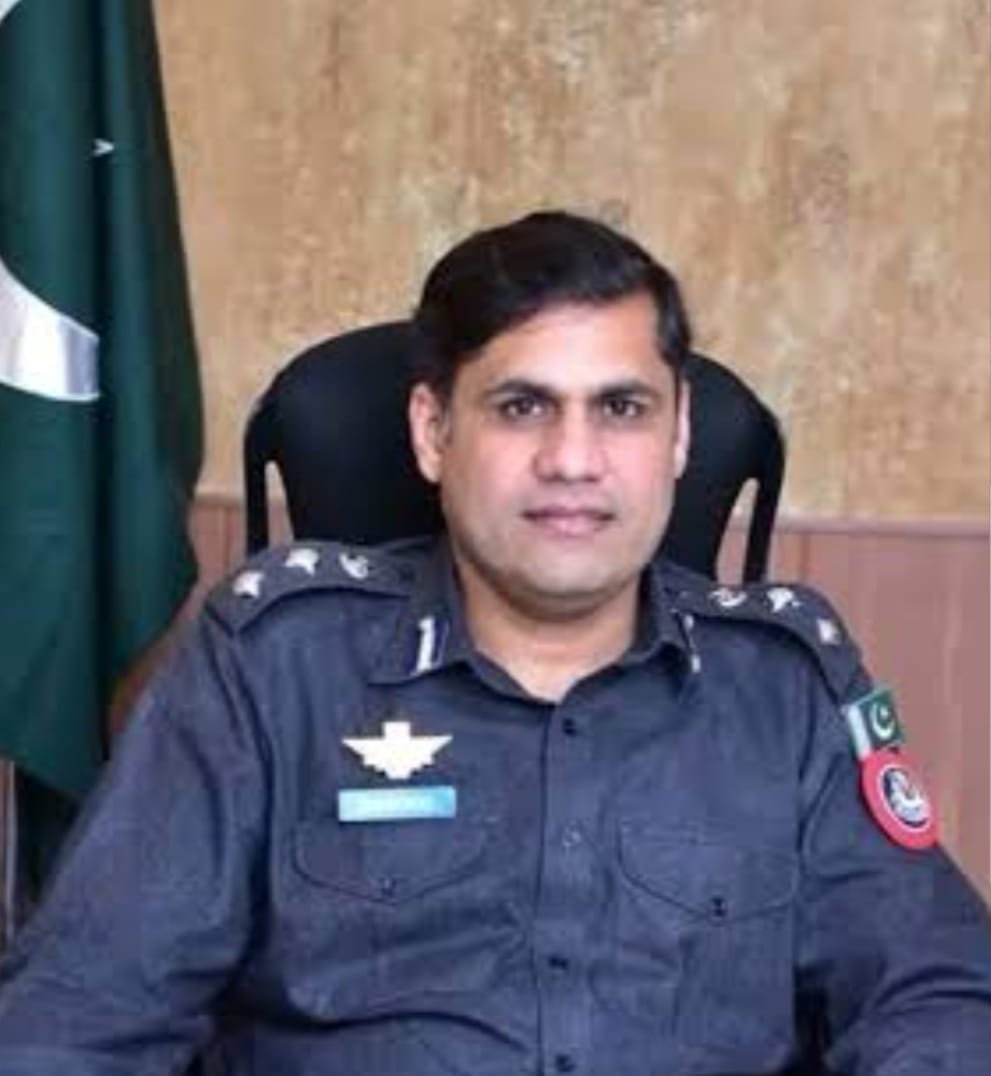
By Shamsul Haq
Some people create the wrong impression the moment you meet them. At first glance, they seem simple, soft-spoken, and perhaps even a little absent-minded. But spend a few moments with them and you realize there is far more beneath the surface. Masood Ahmad is one of those people.
He begins a sentence, speaks only half of it, and then falls silent. The pause is long enough for you to wonder whether he has forgotten what he wanted to say. He hasn’t. He is thinking. And when he resumes, you realize the silence was never an interruption—it was part of the conversation itself.
He is equally selective in building relationships. His circle of friends issaid to be not large, but those who earn a place in it tend to remain there for years. His appearance is more that of a university professor than a police officer. Yet for hardened criminals, that gentle face represents determination and resolve. His uncompromising actions have earned him both praise and criticism, but one thing remains certain: he is guided more by duty than by public reaction.
Friends say fried and half-fried eggs are his weakness. Perhaps that is understandable. In a profession as demanding as policing, a hearty breakfast may well be a necessity rather than a luxury.
Belonging to the Bangash tribe of Kohat Division, he has chosen not to append “Bangash” to his name. Why, no one seems to know. It is a question I still hope to ask him—provided he does not pause into one of his characteristic silences before answering.
Masood Ahmad earned a master’s degree in journalism from the University of Peshawar. He had intended to become a journalist, but fate placed the Central Superior Services (CSS) examination before him. Journalism lost what might have been an accomplished reporter, while the police gained an officer who frequently becomes the subject of headlines rather than the one writing them.
His early years in service were spent in Sindh, including Larkana, a city where power, politics, and tradition intersect in unique ways. He returned not only with valuable administrative experience but also with a lasting appreciation for Sindhi hospitality. He still speaks fondly of Sindhi dates and seems to derive greater pleasure from sharing them with friends than from eating them himself. Those familiar with Sindh also say he continues to enjoy warm relationships with many of the province’s senior figures.
As Superintendent of Police (Operations) in Peshawar, he made life increasingly difficult for criminal networks. Later, in Charsadda, the district’s delicate social fabric and complex challenges never altered his professional approach. It was there that he conceived the Safe City Project, an initiative reflecting his forward-looking vision. By the time he arrived in Mardan, it appeared that development projects had arrived with him.
Whether it is the Safe City Project, modern Police Facilitation Centres, or initiatives for the welfare of police personnel, Masood Ahmad belongs to the rare category of officers who do not merely dream of reforms rather they implement them. A visit to the Police Facilitation Centre at Mardan’s Saddar Police Station leaves one with the impression that government institutions, when led with commitment, can match the standards of the finest public service facilities. Likewise, significant improvements in welfare facilities at Police Lines and the approval of multi-million-rupee projects for clean residential barracks and modern washrooms for police personnel across various police stations stand among his notable achievements.
Perhaps his greatest strength, however, lies not in planning projects but in finding the resources to complete them. In Pakistan’s bureaucracy, promising proposals often disappear into files marked “budget unavailable.” Masood Ahmad has repeatedly demonstrated an ability to mobilize resources through professional relationships, institutional trust, and administrative skill, ensuring that ideas move beyond paperwork and become reality.
Firmly believing in public engagement, his office is rarely quiet. Visitors seeking solutions to their problems are a constant presence. He listens to each one patiently and makes every effort to resolve their concerns.
Those who know Masood Ahmad describe him as a police officer but I see him differently. To me, he is a quiet builder. He speaks little, listens more, and, above all, strives to turn ideas into reality. That is perhaps why, long after he leaves a posting, people remember his work more vividly than his words. In every city he serves, a few buildings, a few reforms, and a few lasting memories bear his imprint. Ultimately, that is the true measure of a public servant: files may be closed, but the work continues to live in the hearts and minds of the people.