
By . Dr Muhammad Fazal ur Rehman.
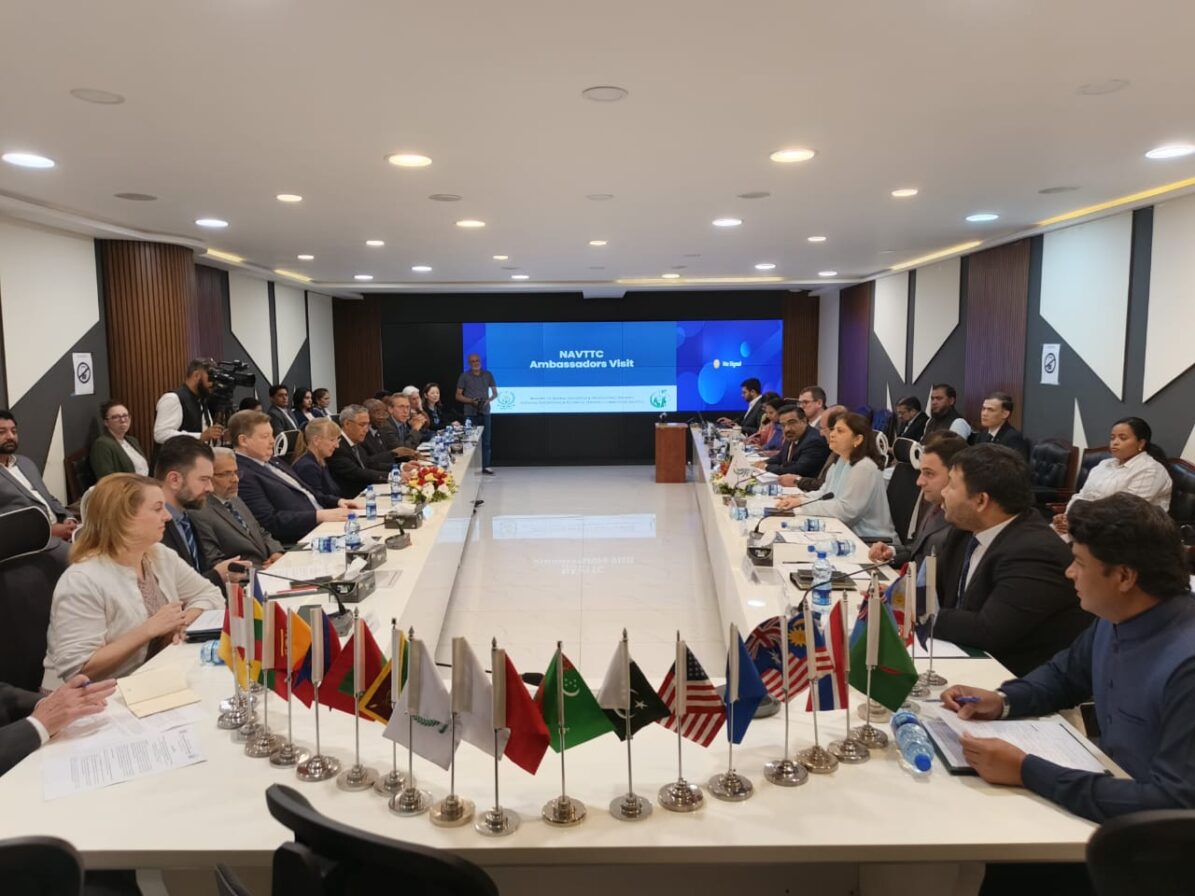
In a significant move to strengthen its engagement with the global community on skills development, the National Vocational and Technical Training Commission (NAVTTC), under the Government of Pakistan, convened a landmark Ambassadorial Roundtable on Technical and Vocational Education and Training (TVET).
The session was graced by Rana Mashhood Ahmad Khan, Chairman PMYP, while Ms. Gulmina Bilal Ahmad, Chairperson NAVTTC represented the Commission.
Distinguished delegates and representatives from from 14 countries, including the United States, United Kingdom, Germany, China, Uzbekistan, Nepal, Sri Lanka, Malaysia, Bangladesh, Morocco, Bhutan, Myanmar, France, and Singapore, along with the European Union, participated, reflecting strong global interest in Pakistan’s skills development initiatives.
This was the first time that Pakistan brought together members of the diplomatic corps for a focused dialogue on education—specifically on skills development and workforce readiness.
The roundtable emerged as a dynamic and forward-looking platform, bringing together ambassadors, development partners, and national stakeholders to deliberate on the future of skills development in Pakistan. Participants engaged in solution-oriented discussions, recognizing the critical role of TVET in driving economic growth, improving employability, and preparing Pakistan’s youth for an increasingly competitive global labor market.
What set this engagement apart was its clear shift from dialogue to action. The roundtable delivered tangible outcomes and secured strong international interest in collaborating with Pakistan across key domains, including curriculum development, certification standards, language proficiency, green economy training, and inclusive skilling. As a result, the event laid a solid foundation for structured, outcome-driven partnerships aimed at transforming Pakistan’s skills ecosystem in line with global demands.
A key highlight of the roundtable was the initiation of bilateral cooperation between Pakistan and Tajikistan, with NAVTTC tasked to draft a formal Memorandum of Understanding (MoU). The proposed collaboration will focus on skills training, exchange of trainees and trainers, and institutional partnerships—marking the beginning of formal government-to-government cooperation in the TVET sector.
Another major outcome was the agreement to undertake a comprehensive national TVET gap analysis. Supported by the US Embassy, endorsed by the German Ambassador, and backed by the Regional English Language Office (RELO), this initiative will assess curriculum relevance, certification systems, and faculty capacity. The findings are expected to guide a data-driven reform roadmap and shape future international partnerships.
Recognizing the importance of language skills in global employability, NAVTTC will also integrate structured English language programs into its system, with RELO offering direct engagement and technical support. This initiative is expected to significantly enhance overseas employment opportunities for Pakistani youth.
The roundtable also explored an innovative bilateral skills exchange model with Mauritius. Under this framework, Pakistan will share expertise in renewable energy (particularly solar), textile and apparel manufacturing, smart agriculture, and drone technology. In return, Mauritius will provide training in hospitality and hotel management. The collaboration will focus on “Train the Trainer” programs, short-term technical courses, industry attachments, and curriculum development—creating a mutually beneficial skills transfer model.
In alignment with global trends, the International Organization for Migration committed to supporting Pakistan in integrating green skills, entrepreneurial training, and migration-linked pathways into TVET programs. This will help align Pakistan’s workforce development with international labor market needs and the emerging climate economy.
Inclusivity remained a central theme, with UNICEF supporting targeted programs for out-of-school children and NEET (Not in Education, Employment, or Training) youth, particularly females. These initiatives will focus on foundational literacy and numeracy, as well as facilitating the transition from learning to earning.
Policy coherence and institutional alignment were also emphasized. The European Union delegation highlighted the need for improved inter-ministerial coordination, while Finland stressed the importance of aligning training programs with industry and business demands—signaling a shift toward a market-driven skills development model.
NAVTTC leadership reaffirmed its strong institutional commitment to reform. The integration of TVET into youth employment strategies and the broader national development agenda was emphasized, alongside priorities such as international partnerships, quality assurance, and inclusive skilling. Ongoing reforms—including competency-based training, international certifications, and stronger industry linkages—were also highlighted as key pillars of transformation.
Following the roundtable, a comprehensive action framework has been set in motion. Immediate steps include launching the Tajikistan MoU process, commissioning the national gap analysis, establishing a partner coordination mechanism under NAVTTC, and integrating English language training at the system level. Additional priorities include piloting bilateral programs, embedding green and migration-linked skills into curricula, expanding inclusion-focused initiatives, and strengthening policy coordination across government institutions.
The strategic impact of the roundtable is already evident. It has created concrete pathways for bilateral and multilateral cooperation, aligned international partners with Pakistan’s priorities, and accelerated the shift toward evidence-based and demand-driven TVET reform. Importantly, it has also integrated key global themes—such as green economy, migration, inclusion, and digital skills—into Pakistan’s skills development agenda.
This Ambassadorial Roundtable represents a turning point in Pakistan’s engagement with the international community on skills development. By moving beyond dialogue to clear, actionable outcomes, NAVTTC has established a strong foundation for scalable partnerships, system-wide reform, and measurable impact in employment and workforce development. The focus now shifts firmly to implementation, coordination, and delivery—ensuring that these commitments translate into real opportunities for Pakistan’s youth and economy.
