
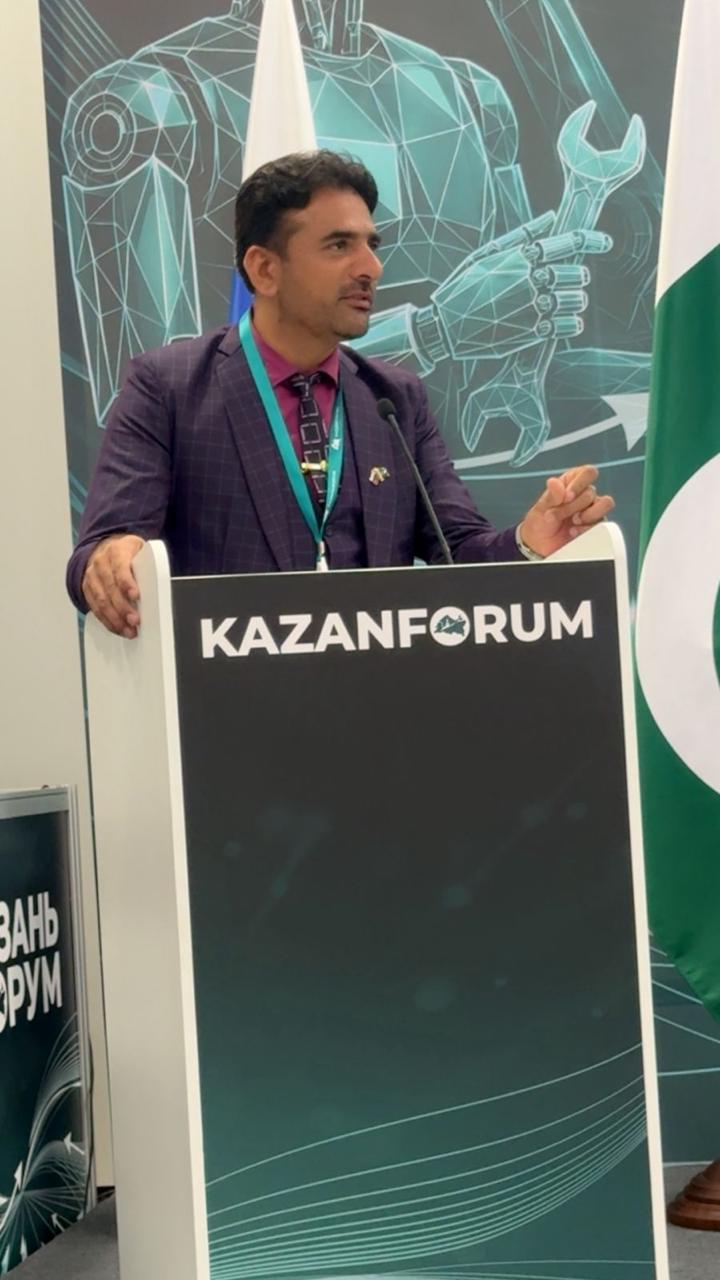
By Dr. Faisal Javaid
President Asif Ali Zardari’s state visit to the Kyrgyz Republic from 6–9 July 2026 is historic, marking the first visit by a President of Pakistan to the Kyrgyz Republic in 21 years. Beyond its symbolic significance, the visit reflects Pakistan’s renewed commitment to strengthening engagement with Central Asia through enhanced cooperation in trade, connectivity, energy, security, healthcare, education, and people-to-people exchanges. At a time when Eurasia is undergoing significant geopolitical and geo-economic transformation, the visit underscores Islamabad’s determination to deepen strategic partnerships with the Central Asian republics and advance its “Connect Central Asia” policy.
Held at the invitation of President Sadyr Japarov, the visit built upon the momentum generated during the Kyrgyz President’s visit to Islamabad in December 2025. The two leaders agreed on a comprehensive roadmap to elevate bilateral relations and reaffirmed their shared vision of promoting regional peace, economic integration, and sustainable development.
A major outcome of the visit was the reaffirmation of the bilateral objective to increase trade to US$200 million by 2027–2028. Although trade volumes remain modest, both governments agreed to facilitate greater private-sector participation, improve market access, and encourage investment to unlock the untapped economic potential between the two countries.
Agriculture presents another promising avenue for cooperation. As agriculture-based economies, Pakistan and Kyrgyzstan possess complementary strengths in livestock, dairy production, food processing, seed technology, and agricultural research. Enhanced collaboration in these sectors could strengthen food security while creating new commercial opportunities for farmers and agribusinesses in both countries.
The healthcare sector also witnessed a significant breakthrough with the signing of a Memorandum of Understanding between Pakistan’s Drug Regulatory Authority (DRAP) and the Kyrgyz Ministry of Health. The agreement is expected to facilitate pharmaceutical exports, regulatory cooperation, and broader collaboration in healthcare services.
President Zardari was accompanied by a high-level delegation comprising Minister for Parliamentary Affairs Tariq Fazal Chaudhry, Minister of State for Health Dr. Mukhtar Bharath, and Senator Saleem Mandviwalla, highlighting Pakistan’s intention to institutionalize cooperation across multiple sectors.
Regional connectivity remained the central theme of the discussions. Both presidents emphasized that peace and security are indispensable prerequisites for transforming Central and South Asia into an interconnected economic region. They reviewed progress on the Quadrilateral Traffic in Transit Agreement (QTTA), which provides an alternative transport corridor linking Pakistan with Central Asia, while reaffirming support for the timely implementation of the CASA-1000 electricity transmission project. These initiatives complement Pakistan’s broader regional vision under the Shanghai Cooperation Organisation (SCO), the Economic Cooperation Organization (ECO), and the China–Pakistan Economic Corridor (CPEC).
Security cooperation featured prominently in the bilateral talks. Both countries agreed to deepen collaboration against terrorism, violent extremism, and transnational organized crime through closer institutional coordination and intelligence sharing. On Afghanistan, Pakistan and Kyrgyzstan adopted a common position, emphasizing that lasting peace and stability are essential for regional connectivity. They urged the Afghan authorities to take concrete and verifiable action against terrorist groups operating from Afghan territory, recognizing that economic integration cannot flourish without a secure regional environment.
The visit also strengthened parliamentary and cultural diplomacy. President Zardari met Speaker of the Kyrgyz Parliament Marlen Mamataliyev to enhance legislative cooperation and parliamentary exchanges. He also paid tribute at the Ata Beit Memorial Complex and visited the resting place of renowned Kyrgyz writer Chingiz Aitmatov, highlighting the importance of cultural diplomacy in strengthening long-term bilateral relations.
Pakistan’s endorsement of Kyrgyzstan’s hosting of the Second Global Mountain Summit (Bishkek+25) in 2027, together with Kyrgyzstan’s invitation to Pakistan to participate in the VI World Nomad Games, further broadened the scope of bilateral engagement beyond politics and economics.
The visit demonstrates that Pakistan increasingly views Central Asia as a strategic priority. Situated at the crossroads of South and Central Asia, Pakistan can serve as a gateway for Central Asian states to the Arabian Sea through Karachi, Port Qasim, and Gwadar, while Central Asia offers Pakistan access to new markets, energy resources, and strategic partnerships. The success of this vision, however, will depend on sustained political commitment and effective implementation of the understandings reached in Bishkek.
Policy Options
To sustain the momentum generated by President Zardari’s visit, both countries should establish an annual ministerial-level Strategic Dialogue, supported by dedicated working groups on trade, security, connectivity, health, education, and culture to ensure the effective implementation of bilateral agreements. They should also introduce preferential trade arrangements, simplify customs procedures, establish reliable banking channels, and develop logistics hubs to achieve the bilateral trade target of US$200 million. More importantly, Pakistan and Kyrgyzstan should adopt a “Connectivity Plus” strategy that combines physical connectivity through the QTTA, CASA-1000, and CPEC with economic integration, digital connectivity, institutional cooperation, and people-to-people exchanges. At the same time, both countries should strengthen educational and human capital linkages by expanding scholarships, university partnerships, joint research programmes, faculty exchanges, vocational training, and youth exchanges. Collectively, these initiatives would transform Pakistan–Kyrgyzstan relations from transactional diplomacy into a comprehensive strategic partnership while reinforcing Pakistan’s role as a bridge between South Asia and Central Asia.
President Zardari’s visit should therefore be regarded as more than a successful diplomatic engagement. It represents a strategic investment in Pakistan’s long-term Central Asia policy and demonstrates Islamabad’s commitment to building stronger partnerships across Eurasia. If both governments translate their commitments into concrete action, the visit could become a turning point in Pakistan–Kyrgyzstan relations and contribute meaningfully to regional connectivity, shared prosperity, and long-term stability across Central and South Asia.
Dr Faisal Javaid, Head of the Department of International Relations at Federal Urdu University Islamabad and Sr, Vice President CAPES
