
By Junaid Qaiser
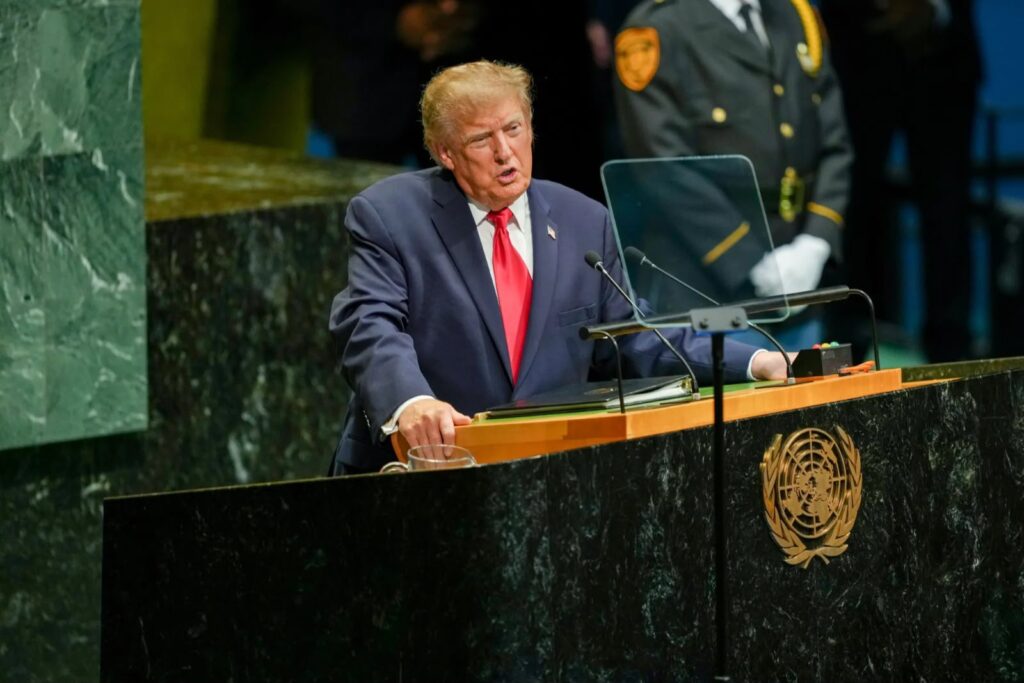
When world leaders gathered in New York for the 81st United Nations General Assembly, most attention was expected to focus on the wars, crises, and geopolitical rivalries dominating the international agenda. President Donald Trump ensured that happened. His address was marked by forceful warnings to Iran, criticism of international institutions, and a robust defense of his “America First” foreign policy. Yet amid the headlines about the Middle East and nuclear diplomacy, one unexpected theme emerged: Trump’s public praise for Pakistan and Prime Minister Shehbaz Sharif.
For Pakistan, the significance of those remarks extends beyond diplomatic courtesy. At a time when countries are competing for strategic relevance in an increasingly fragmented world, recognition from the President of the United States at the UN’s premier forum carries weight. It signals that Pakistan is being viewed not merely through the lens of past security challenges but as a country with a role to play in regional stability and international diplomacy.
Trump’s comments were unusually warm. Calling Pakistan “a great country” and describing Prime Minister Shehbaz Sharif as “a terrific man,” he referenced conversations with the Pakistani leader and highlighted Pakistan while discussing efforts to prevent conflicts from escalating into wider wars. Such statements are particularly noteworthy given the often-complex history of U.S.-Pakistan relations.
Over the decades, relations between Washington and Islamabad have moved through periods of close cooperation and periods of tension. However, recent developments suggest a renewed convergence of interests. Counterterrorism cooperation, regional stability, economic engagement, and diplomatic coordination have all re-emerged as areas of mutual interest. Trump’s remarks indicate that Pakistan’s contributions are being acknowledged at the highest level.
The President’s reference to the 2025 India-Pakistan crisis was especially significant. While New Delhi continues to reject suggestions of third-party mediation and maintains that de-escalation occurred through direct military communication, Trump has consistently argued that his administration played a constructive role in preventing a broader confrontation. Regardless of differing narratives, the broader reality remains that avoiding conflict between two nuclear-armed neighbors serves the interests of regional and global security.
Pakistan’s leadership has increasingly emphasized dialogue and restraint in dealing with regional crises. That approach has become particularly important at a time when the international system is experiencing heightened instability. From the war in Ukraine to tensions in the Middle East and strategic competition among major powers, the world is confronting a shortage of effective mediators and trusted interlocutors. Countries capable of maintaining relationships across competing camps are finding their diplomatic value enhanced.
This is where Pakistan’s recent foreign policy efforts deserve attention. Islamabad has sought to maintain productive relations with the United States, China, Saudi Arabia, Türkiye, the Gulf states, and other regional actors. Rather than viewing diplomacy as a zero-sum exercise, Pakistan has increasingly presented itself as a bridge-builder capable of facilitating communication between different stakeholders.
Trump’s speech also underscored the continuing importance of the Middle East in global politics. His message to Iran was uncompromising. He reiterated that Tehran would never be allowed to acquire a nuclear weapon and called for sustained international pressure to bring Iran back to a negotiated settlement. At the same time, reports of discussions between American and Iranian officials on the sidelines of the General Assembly highlighted a familiar reality of international affairs: even the toughest public rhetoric often exists alongside private diplomacy.
For supporters of Trump’s foreign policy, this combination of pressure and negotiation reflects a deliberate strategy. The objective is not endless confrontation but securing agreements from a position of strength. Whether one agrees with that approach or not, it has become a defining feature of Trump’s international engagement and continues to shape American policy in critical regions.
Pakistan has an interest in seeing tensions between Washington and Tehran managed responsibly. As a country situated at the crossroads of South Asia, Central Asia, and the Middle East, Pakistan understands that instability in the Gulf affects energy markets, trade routes, and broader regional security. Any diplomatic breakthrough that reduces the risk of conflict would benefit not only the immediate parties involved but the wider region as well.
The positive references to PM Shehbaz Sharif are also a reflection of Pakistan’s growing diplomatic visibility. Over the past year, Islamabad has sought to project itself as a responsible stakeholder committed to economic development, regional connectivity, and constructive engagement. Whether through participation in international forums, support for dialogue initiatives, or efforts to facilitate communication among rival actors, Pakistan has worked to strengthen its diplomatic profile.
International recognition alone does not solve economic challenges or transform foreign policy realities. However, it can create opportunities. Positive engagement with Washington can support trade, investment, technology partnerships, educational exchanges, and cooperation in emerging sectors such as artificial intelligence and digital innovation. These are areas where both countries have much to gain from deeper collaboration.
President Trump’s UN address was a speech that sought to define America’s role in a turbulent world and to project confidence in the effectiveness of strong leadership. Yet for Pakistan, one message stood out clearly. The country is increasingly being recognized as a relevant actor in discussions about regional peace and international stability.
In a world where diplomatic influence is often measured by who is invited to the table and whose voice is heard during moments of crisis, that recognition matters.
