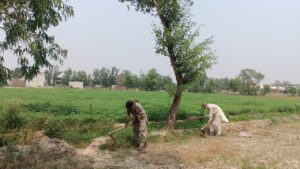
There is a strange and dangerous gap in how we talk about progress in Pakistan today. If you look at our national budget or our news headlines, everything is about “Digital Pakistan” and training urban youth for the gig economy. We have massive programs for coding, freelancing, and vocational skills in the big cities, and that is great. But while we focus all our energy on the metropolitan hubs, the actual backbone of our country, the farmer, is being left to fight a 21st-century battle with tools and knowledge from the 1970s. We are essentially ignoring the majority of our population.
More than 63% of Pakistanis live in rural areas, and nearly 40% of our entire workforce depends on agriculture and livestock. In many villages, that number is closer to 70% or 80%. When the farmer struggles, the whole country feels it at the dinner table. Yet, we have no national-level program to upgrade the skills of these farmers. We just assume they will figure it out because “that’s what their fathers did.” But the world their fathers farmed in is gone.
Today, a farmer in Punjab or Sindh is trapped. On one side, the costs of everything, fertilizer, seeds, electricity for tube wells, and diesel for tractors, have hit the roof. On the other side, nature has become unpredictable. Canal water is shrinking, and rains that used to be a blessing now come as sudden, destructive storms or don’t come at all. Because our focus is always on the “smart cities,” we have neglected the basic field-to-market roads. This is why our rural youth are running toward the cities; it’s not because they want to leave, but because staying on the farm has become a losing game.
One of the biggest tragedies is the total lack of “market intelligence.” A farmer spends six months of sweat and borrowed money on a crop, but he has no idea what it will be worth when it’s finally ready. Look at what happened last year with wheat. We had a “bumper crop” of over 31 million tons, which should have been a celebration. Instead, it was a disaster for the growers because there weren’t enough buyers at a fair price, and rates crashed. Right now, we see potato farmers selling their produce for ‘throwing rates’ as low as Rs. 20 per kg because they have no way to store it or process it, and no data to tell them what to plant instead. Without the skills to understand market cycles, our farmers remain at the mercy of the market rather than acting as informed businessmen.
To fix this, we don’t just need more subsidies; we need a knowledge revolution. We actually have a huge network of institutions that could help if they were properly mobilized. At the federal level, we have the Pakistan Agricultural Research Council (PARC) and the National Agricultural Research Centre (NARC) in Islamabad. In the provinces, we have heavyweights like the Punjab Agriculture Department and the Ayub Agricultural Research Institute (AARI) in Faisalabad.
We also have world-class universities like the University of Agriculture Faisalabad (UAF), Arid Agriculture University in Rawalpindi, and Sindh Agriculture University, Tandojam. These places shouldn’t just be for students getting degrees; they should be training grounds for every farmer in the surrounding districts. We need to bridge the gap between a PhD student’s research and a smallholder’s field.
There is also a lot of support waiting to be used from international partners like the Food and Agriculture Organization (FAO), IFAD, and the CGIAR network. Locally, we have seen how the Aga Khan Rural Support Programme (AKRSP) and the National Rural Support Programme (NRSP) can organize farmers to do great things. But we need a national-level push that ties all of this together.
If our government can spend billions to teach a teenager in Lahore how to design a website, it can surely spend the same energy teaching a farmer in Multan or Swat how to use satellite weather data, how to save water with new irrigation tech, and how to read market trends so they don’t grow a crop that will be worthless in six months.
Pakistan cannot move forward if we leave the rural heartland behind. It’s time we stopped obsessing only over the metropolitans and started investing in the people who actually feed us. Investing in a farmer’s skills is the only way to make our agriculture productive again and stop the desperate migration to our already overcrowded cities. The soil is ready, but the mind of the farmer needs the tools of today.
———
Muhammad Anwar is CEO of Freedom Gate Prosperity, a development practitioner with 30+ years of experience in governance, public policy, international affairs, and climate advocacy. He can be reached at ceo@fgp.org.pk