

By Awais Haider Shaikh
The Strait of Hormuz is arguably the most important piece of maritime real estate on the planet.
This narrow sliver of water, separating the Persian Gulf from the Gulf of Oman, serves as the primary artery for the global energy market. At its narrowest point, the shipping lanes are only two miles wide, yet through them flows roughly 21 million barrels of oil per day—approximately 20% of the world’s total consumption. For the Islamic Republic of Iran, which possesses the longest coastline along this maritime chokepoint, the strait is more than just a geographic feature; it is a potential engine for national wealth and a lever of global influence. Yet, when examining the history of the last several decades, it becomes clear that this immense potential has remained largely untapped. Instead of serving as a golden gateway for Iranian integration into the global market, the strait has functioned as a source of friction, isolation, and missed economic opportunities.
The theoretical benefits of the Strait of Hormuz for Iran are rooted in its status as a global logistics hub. In a world defined by maritime trade, nations that control key transit points usually translate that control into massive service economies. Iran had the potential to develop a sophisticated network of deep-water ports, refueling stations, and ship-repair yards along its southern coast. Every tanker passing through the strait represents a customer requiring maintenance, fuel, and supplies. By building a world-class maritime infrastructure, Iran could have captured billions of dollars in annual revenue, diversifying its economy away from raw crude exports and toward high-value service industries that would provide jobs for its massive youth population.
Beyond the logistical revenue, the strait offered Iran a unique path toward diplomatic invulnerability. Had Tehran chosen to position itself as the indispensable guarantor of energy security, it could have woven its economy so deeply into the fabric of global trade that sanctions would have become unthinkable. Major energy consumers like China, India, Japan, and South Korea are fundamentally dependent on the stability of the Hormuz transit. If Iran had fostered a policy of total maritime openness and integration, it would have created a shield of economic interdependence. In such a scenario, any attempt by the West to isolate Iran would have been met with fierce resistance from the world’s largest economies, who would view Iranian stability as synonymous with their own energy security.
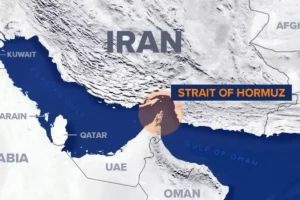
However, the historical reality has taken a much darker turn. For the past forty years, the Iranian leadership has viewed the Strait of Hormuz primarily through a military lens rather than an economic one. The strategy has focused on using the ability to close the strait as a deterrent against foreign intervention. While this has provided the Iranian military with a powerful tool of asymmetric warfare, it has effectively poisoned the well of economic development. The constant threat of disruption has led to the heavy militarization of the Persian Gulf, with a permanent and massive presence of foreign naval fleets. This high-tension environment is the antithesis of a thriving trade hub. International shipping companies and foreign investors are inherently risk-averse; they do not build billion-dollar logistics centers in a region where a single skirmish could lead to a total naval blockade.
This strategy of brinkmanship has also triggered a long-term strategic retreat by Iran’s neighbors and global customers. Seeing the strait as a liability rather than a reliable passage, neighboring countries have spent decades and hundreds of billions of dollars developing infrastructure to bypass Hormuz entirely. Pipelines now cut across the Arabian Peninsula to the Red Sea and the Gulf of Oman, specifically designed to ensure that the global oil supply can survive an Iranian shutdown. By forcing the world to find alternatives, Iran has inadvertently diminished the very leverage it sought to preserve. Each new bypass pipeline represents a dilution of the strait’s importance and a permanent loss of potential transit revenue for the Iranian state.
Furthermore, the domestic cost of this missed opportunity is visible in the technical decay of Iran’s own maritime industry. Because of the sanctions triggered by the geopolitical standoff, Iran has been unable to access the modern technology required to build and maintain competitive port facilities. While nearby hubs like Dubai’s Jebel Ali have grown into some of the most advanced and profitable ports in the world, Iran’s southern coast remains underdeveloped and reliant on aging equipment. The talent of the Iranian workforce and the natural depth of its harbors are wasted as global shipping lines prefer the stability and efficiency of ports on the southern side of the gulf.
In the final analysis, the Strait of Hormuz has been a masterclass in the opportunity cost of hard power. Iran sits upon the most valuable gate in the world, yet it has chosen to act as the gatekeeper rather than the merchant. By prioritizing the ability to threaten the flow of energy over the ability to facilitate it, the nation has traded long-term prosperity for short-term tactical deterrence. The tragedy of this geographic blessing is that it remains a tool of survival rather than an engine of growth. Until the strategy shifts from using the strait as a weapon to using it as a bridge, the wealth that flows through those narrow waters will continue to pass Iran by, enriching its neighbors and the global market while leaving its own shores in a state of unrealized potential. Iran’s command of the strait should have been its greatest economic victory, but for now, it remains a silent witness to what could have been a transformational era for the nation.
